Key points
- Plan a job before it is scheduled: scope, steps, parts, tools, estimate, access and safety.
- In a crew of 2 to 10, one person plans, schedules and supervises, with a fixed planning slot.
- Plan only the jobs that need it: long jobs, parts to order, a stop, a contractor or a lockout.
- A job waiting on a part is not ready; scheduling it anyway is the most common way a schedule fails.
- Plan on Tuesday and Thursday afternoons, schedule next week on Friday, and adjust each morning.
Maintenance planning vs scheduling: the difference
Planning works out what a job needs and how it is done. Scheduling decides when it is done and by whom. People use “planning” for both, and that is where most weeks go wrong. A planned job does not stop halfway for a missing part, and a week scheduled from planned jobs, against the hours each person really has, is one the crew can finish.
| Planning | Scheduling | |
|---|---|---|
| When | Days or weeks before the job | The week before, then each morning |
| What it produces | A job that is ready: scope, steps, parts, tools, estimate, safety | A week of jobs on people’s days |
| What goes wrong without it | The technician finds out at the machine that a part is missing | Ready jobs sit while people are overbooked or idle |
When a job is ready to schedule
The parts are in hand or on the shelf, the steps are written, and the time it needs is agreed with whoever runs the machine or the room.
Who does it: planner, scheduler and supervisor
At a large plant, planning, scheduling and supervising are often three people: a planner on the weeks ahead, a scheduler who puts ready jobs into next week, and a supervisor who hands out the work each morning and decides what moves when something breaks. The maintenance planner job description has an ad to paste, a planner’s week and the questions to ask.
A crew of 2 to 10 has one person doing all three, plus their own share of the repairs. That works if two rules hold:
- Planning gets a fixed slot. Two hours on Tuesday and Thursday afternoon, with the door shut and the radio passed to someone else.
- Only the jobs that need a plan get one. Planning a 15-minute fix costs more than it saves.
Plan a job if any of these is true:
- It is more than about 2 hours of work.
- It needs a part that is not on the shelf.
- It needs a machine or a line stopped, or a room closed.
- It takes two trades, two people or a contractor.
- It will be done again, as a repeating job.
- It needs a lockout, a permit or a lift.
Skip the plan for a quick fix one person can finish with what is in the truck or the shop, using parts that are always stocked, such as filters and fuses, when it interrupts nobody and will never come back. In an emergency, make it safe and fix it now, then plan the permanent repair.
Repeating preventive jobs are planned once and reused. Correct the steps, parts and estimate after the first few runs, and every later copy arrives planned.
What goes into a job plan
A job plan is the work order, filled in properly before the job is scheduled. Not every job needs every line.
- Scope: what will be done, and what done looks like. The technician knows when to stop.
- Steps: the order of work, as a checklist. The job is done the same way each time.
- Parts: each part, how many, and where it is. No trip to the storeroom mid-job.
- Tools: anything beyond the toolbox: a puller, a lift, a torque wrench, a crane. Nobody hunts for the lift on the day.
- People and estimate: how many people, which trade, and the hours each one will spend. The schedule can be built from it.
- Access: when the machine can stop or the room can close, agreed with whoever runs it. The job is not cancelled at the door.
- Safety: the lockout procedure, any permit (confined space, hot work), protective equipment. The hazard is handled before anyone is in a hurry.
- References: manual pages, drawings, notes from the last time. It saves the first hour of the job.
The lockout belongs in the plan
In the US, OSHA’s lockout/tagout rule (29 CFR 1910.147) covers servicing and maintenance where an unexpected start-up or a release of stored energy could hurt someone. It requires written energy control procedures for that work.
The plan names the procedure for this machine, so nobody writes one in their head at the panel. In Canada, check your province’s occupational health and safety rules. Writing a lockout procedure covers what one holds.
The best estimate is the time the job took last time. For a first job, ask the person who will do it. Correct it once the job is done: a schedule built on estimates nobody checks is wrong in the same direction every week.
Job kitting: the parts in a bag before the day
A kit is every part for one job, pulled before the job is scheduled and set aside in a tote or a bag. Every walk to the storeroom mid-job comes off wrench time, the share of a shift spent on the job itself.
- Pull the parts when the job is planned, not on the morning of the job. A part that turns out to be missing has days to arrive, not minutes.
- Label the kit with the work order number, the asset and the day.
- Keep kits apart from stock, so nobody takes a bearing out of next Wednesday’s kit for today’s breakdown without saying so.
- Check the kit the day before. If something has gone, the job is not ready and it comes off the schedule.
A job waiting on a part is not ready
It stays in the backlog, marked as waiting, until the part is in hand. Scheduling it anyway is the most common way a schedule fails.
Kits are worth the trouble on jobs with three or more parts, and on every job in a planned shutdown. Spare parts inventory management covers what to keep on the shelf so fewer jobs have to wait.
Planning and scheduling steps: a weekly cycle for a small crew
A small crew can plan twice a week, schedule on Friday and adjust each morning:
- Tuesday and Thursday afternoons: plan. Take the largest jobs in the backlog that are not ready. Walk to the machine, write the plan, order what is missing, pull the kits.
- Friday: schedule next week from what is ready. Preventive jobs first, then ready jobs by priority, against real hours and with room for breakdowns. How to build a weekly maintenance schedule walks through it step by step, with a board to print.
- Each morning: 10 minutes. Check what broke overnight, decide what moves, and say so.
- Friday: look back. How much of what was scheduled got done is schedule compliance, and the reasons behind the misses tell you what to fix in the plans.
If the person who plans is pulled into every breakdown, the planning stops first, and three weeks later the schedule has nothing ready to put in it.
How far ahead: yearly, weekly and daily plans
Keep three plans: the year, the week and the day. The yearly one lists jobs that need a shutdown, a contractor or a part with a long lead time, often planned against the year’s shutdown dates. The weekly and daily ones are the cycle above. A small crew that does only those two still needs a list of the long jobs, or the shutdown arrives before their parts do.
Maintenance planning example: a chain change and the week around it
A made-up plant: Maria Chen supervises three technicians, Ben Carter, James O’Neil and Luis Ortega. Every number below is invented for the example.
The job. A weekly check on infeed conveyor CV-2 finds the drive chain stretched past the maker’s wear limit. Maria plans the replacement on Tuesday afternoon.
ExampleThe job plan for CV-2's drive chain
| Item | Entry |
|---|---|
| Scope | Replace the drive chain and both sprockets on CV-2, Line 1. Done when it runs 30 minutes empty with no chain noise, guard back on, then one hour loaded once the line restarts. |
| Steps | 1. Lock out CV-2 under its written procedure and, with everyone clear, try the start button, then return it to Off. 2. Remove the guard. 3. Remove the old chain and both sprockets. 4. Fit the new sprockets and check alignment with a straightedge. 5. Fit and tension the new chain, lubricate it. 6. Refit the guard, remove locks, test run, hand back to the line lead. |
| Parts | 1 roller chain, 10 ft; 1 drive sprocket; 1 driven sprocket; 2 connecting links. The drive sprocket is not in stock: ordered Tuesday, due Thursday. |
| Tools | Chain breaker, gear puller, straightedge, torque wrench |
| People and estimate | Two people, 3 hours each, from the last chain change on this conveyor, which took 3 hours 5 minutes |
| Access | Line 1 stops at 2 p.m. Wednesday for cleaning, a 4-hour window agreed with the production supervisor |
| Safety | Lockout procedure for CV-2; guard removal |
| References | The chain section of the conveyor manual; notes from the last chain change |
The job is not ready on Tuesday, because the sprocket is on order. It arrives Thursday, Maria pulls the kit, and on Friday the job goes on next week’s schedule for Wednesday afternoon, with Ben and Luis.
The week around it, in hours112 hours available, 30 held for breakdowns, and 70 of 82 scheduled hours done
The week. On Friday, Maria counts 112 hours available: three technicians at 40 hours, less James’s vacation day. She holds back 30 for breakdowns, her recent average. Preventive jobs due take 28, which leaves 54 for ready jobs by priority, 6 of them for the chain.
The look back. By the next Friday, 70 of the 82 scheduled hours are done, so 85%. Breakdowns took 36 hours, more than the 30 held back, and two jobs with 12 hours between them move to the following week. A guard repair took 4 hours against an estimate of 2, so that estimate is corrected.
Common maintenance planning mistakes
- Planning on the day. A plan written at the machine on the morning of the job is not a plan.
- Filling every hour. A week with no room for breakdowns is a week where preventive work is dropped first.
- A schedule changed in silence. When a breakdown moves a job, say which one and when it goes back on.
When not to bother
One or two people looking after a building, where most work is a stream of small requests, need a short list for the day and a plan only for the few large jobs.
Planning and scheduling in Maintensor
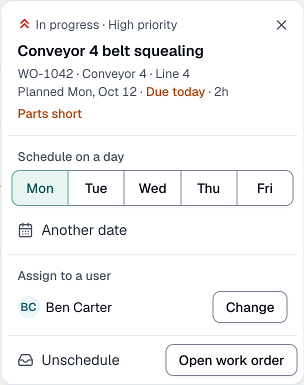
In Maintensor the job plan is the work order: the description and asset, a procedure that becomes the checklist (lockout steps can be written into it), attachments, an estimate, and planned parts, whose line says “N short” when the storeroom holds less than the job needs.
On Pro and Max, the schedule is the Planner, the maintenance scheduling software in Maintensor: a week of people, grouped by team, with the days across.
- The hours: drag a job onto a person’s day: that day becomes its start date, and its due date stays. Hours add up from the estimates against a fixed 8 hour day, so an overbooked Tuesday reads “9.5h of 8h”. A job over several days spreads its estimate evenly, weekend days included. A job given to two people counts its full estimate on each of their days.
- Waiting work: open work whose dates all ended before this week waits in a Late column; work with no date or no assignee waits in the Unscheduled panel.
What it does not do
The 8 hours are the same for everyone, so a day off or a half day of training does not shrink anyone’s day on the board; you leave that day light yourself.
Parts are not set aside for a job (stock comes off when the work order is completed), and each job’s parts are checked against stock on their own, not added up across the week. The planner does not schedule anything by itself: it shows the load, and a person decides.