Key points
- The planner works on the weeks ahead, not today's breakdowns, and directs no one.
- Keep what the job does not include in the ad: it stops the role turning into a second supervisor.
- At 3 hours won back per technician, one full-time planner breaks even at about 13 technicians.
- Under about 8 technicians, the supervisor or lead plans part-time instead.
- Judge the first month by the work, and the third by the counts.
A maintenance planner job description to paste into your ad
The planner prepares work so each job is ready when it is scheduled, and works on the weeks ahead, not today’s breakdowns.
Copy the block below, from “Maintenance Planner” to “Hours and pay”, and fill in the square brackets. Delete duties your site does not have, but keep what the job does not include: it stops the role turning into a second supervisor.
Maintenance Planner
[Site name], [city]. Full time, on site.
About the job
You will prepare our maintenance work before it reaches the floor, so that when a technician starts a job, the parts, tools, steps and access are ready. You work on the weeks ahead, not on today’s breakdowns. Our crew of [number] technicians looks after [the site: a food plant on two shifts].
What you will do
- Look at each job before planning it: the equipment, its history, the measurements and nameplate, and the people who run it.
- Write job plans: the scope and what done looks like, the steps, parts and quantities, special tools, trades and people, the hours, and the lockout procedure and permits.
- Order the parts a plan needs, chase deliveries, and pull and label a kit for each job before it is scheduled.
- Keep the backlog honest: mark each job ready, waiting for parts or waiting for a stop, and close jobs nobody needs.
- Agree stops with [production], book contractors and rentals, and plan shutdowns months ahead.
- Build next week’s schedule from ready jobs with the maintenance supervisor, preventive work first. [Delete if a scheduler does this.]
- Read the closed work orders on planned jobs, correct estimates and plans from what the technician found, and keep preventive procedures up to date.
- Report each week how much of the schedule was done, and why the rest was not.
What this job does not include
- Running breakdowns. You help with parts and information; the supervisor directs the response.
- Assigning or supervising technicians day to day.
- Work on the tools, except to look at a job. [On a small crew, write down how many hours a week, if any.]
- Running the storeroom. [Delete if there is no one else to run it.]
What you bring
- Enough hands-on maintenance experience to see how a job will go before it starts.
- You read drawings, manuals and parts lists, and can find a part by its number.
- You write short, clear steps a technician can follow on a phone or on paper.
- You know lockout/tagout and permit work well enough to name what each job needs.
- You use a maintenance system (CMMS) and a spreadsheet.
- You can tell a production manager a job is not ready, and give the earliest day it will be.
Experience
- [Number] years as a maintenance technician, mechanic or electrician, ideally in [industry].
- Planning, scheduling or leading jobs, or running a shutdown, is a plus.
- A trade certificate or license, or a planning or reliability course, is a plus.
Reports to
The [maintenance manager]. Works daily with the maintenance supervisor, the storeroom, purchasing and [production].
Hours and pay
[Days and hours.] [Pay range.] [Benefits.]
On pay
O*NET, the US Department of Labor’s occupation database, lists Maintenance Planner as a reported job title under First-Line Supervisors of Mechanics, Installers, and Repairers (49-1011). It gives a 2025 national median wage of $79,860 a year, from Bureau of Labor Statistics data.
That occupation also counts supervisors and foremen, so treat the figure as a marker. Check whether your state or province requires a pay range in the ad.
Planner, scheduler or supervisor: who owns what
At a large plant these are three jobs. At a site hiring its first planner, give the planner the scheduling too, and keep the day with the supervisor.
| Planner | Scheduler | Supervisor | |
|---|---|---|---|
| The question | What does this job need, and how is it done? | Which ready jobs go on which day, with whom? | What happens today, and what moves when something breaks? |
| Looks at | Next week and after; shutdowns months out | Next week | Today and this week |
| Produces | Ready jobs: plan, parts, estimate, safety | A week of ready jobs on people’s days | Work done safely, and the calls when it goes wrong |
| Judged by | Jobs that run without stopping for parts or information | How much of the week was done as scheduled | Safety, quality and the crew |
The planner directs no one. When a technician finds at the machine that the plan was wrong, the supervisor decides what happens now, and the planner fixes the plan for next time. Maintenance planning and scheduling covers what goes into a job plan, and the weekly cycle.
A planner’s week, Monday to Friday
A made-up food plant: Dan Kowalski supervises 14 technicians on two shifts, and Mike Sullivan plans the work and builds the schedule with Dan. Every name and hour is invented.
- Monday. The 7:00 meeting: Mike hears what broke over the weekend, and Dan decides what moves. Then last week’s closed work orders, the floor until noon, and plans after lunch.
- Tuesday. Three hours at the machines, measuring and asking the line leads when each can stop, then writing plans.
- Wednesday. Plans until mid-afternoon, then the shutdown six weeks out: its parts and contractor quotes.
- Thursday. Kits for next week and chasing deliveries, then 90 minutes with Dan and the production scheduler on the ready list and the stops.
- Friday. Kits checked, the week built with Dan following how to build a weekly maintenance schedule, and the look back: what was scheduled, what got done, why the rest did not.
Where the 40 hours goMike's week, by kind of work.
| The work | Hours in the week |
|---|---|
| Writing job plans and procedures | 10 |
| Looking at jobs on the floor | 9 |
| Parts: ordering, chasing, kits | 7 |
| Reading closed work orders, correcting estimates | 4 |
| Shutdown and long jobs | 3 |
| The schedule, with Dan and production | 3 |
| The Friday look back | 1.5 |
| Morning meetings | 1.25 |
| Questions from the floor | 1.25 |
| Total | 40 |
Nothing in the week is a breakdown repair. A day at a failed compressor instead is a day of plans not written, which shows up weeks later as jobs that arrive unready.
Does your crew need a planner?
A full-time planner costs a person’s 40 hours a week. The job pays when the crew gets back more than that from delays a plan would catch: a walk back to the storeroom, a wait for a part, an hour at the machine working out the job, a machine not released.
For two weeks, ask each technician to note on every job what held it up and for how long. That is a cheaper way to see where the hours go than a full wrench time study.
ExampleSizing it, with made-up numbers
| 6 technicians | 14 technicians | |
|---|---|---|
| Hours each loses a week to delays a plan would catch | 4 | 4 |
| Hours a planner wins back, each | 3 | 3 |
| Hours the crew gets back | 18 | 42 |
| Against one planner’s 40 | Less than half | More than a full week |
At 3 hours each, the break-even is about 13 technicians (40 ÷ 3). Six get back less than half a week: two fixed afternoons of the supervisor’s time, not a hire.
A rough rule from that arithmetic, not a published ratio (your own count of lost hours is the better test):
| Technicians | Who plans |
|---|---|
| Under about 8 | The supervisor or lead, part-time |
| 8 to 15 | A senior technician half the week, or a planner who also does the scheduling |
| Above 15 | A full-time planner usually pays |
Interview questions, and what a good answer sounds like
Start with work. Pick three closed work orders from your last year: a vague repair (“P-4 leaking”), a preventive job, and one that went wrong. Give the candidate 30 minutes and each asset’s history to plan them. Then ask:
- “Walk me through your plan for the pump leak.” Good: goes to look first, asks when the line can stop, lists parts by number, names the lockout, gives hours per person. Warning sign: “I’d send a mechanic”, and nothing after.
- “Tell me about a job you planned that stalled at the machine.” Good: names the job, what was missing, and what they changed. Warning sign: it was the technician’s fault, or it has never happened.
- “Where do your estimates come from?” Good: the time logged last time, the person who will do the job, and a correction afterwards. Warning sign: “experience”, with no way to check it.
- “Production wants a job done tomorrow that is not ready. What do you do?” Good: says what is missing, offers the earliest ready day, and leaves safety calls to the supervisor. Warning sign: yes to everything, or no with nothing offered.
- “Which jobs would you not plan?” Good: quick fixes with stocked parts, one person, no stop, and a rough line for where planning starts. Warning sign: plans everything, or has no line.
- “A technician tells you your plan was wrong. Then what?” Good: goes to look, fixes the plan and thanks them. Warning sign: defends the plan.
- “What do you need from me in the first month?” Good: time on the floor, the work order history, and protection from breakdowns. Warning sign: a new system before they have seen the site.
Judging the first 90 days
A planner’s results arrive late: jobs planned in week three are done in week six. Judge the first month by the work, and the third by the counts.
Count four things against their own starting point, not a target. Ready work is the part of the maintenance backlog that could start tomorrow.
| Count | How | Going the right way |
|---|---|---|
| Jobs stopped for parts or information | The technician writes the reason on the work order | Falling |
| Estimates on repeat jobs | Time logged against the estimate | Closer each time |
| Ready work | Ready hours, against next week’s hours for planned work | At least a week’s worth, and steady |
| Schedule compliance | Scheduled hours done ÷ scheduled hours | Steady or rising |
Also watch whether the technicians use the plans and send corrections back. If nothing has moved by day 90, look at the planner’s week first: two days a week at breakdowns is not the job you hired for.
Planning work in Maintensor
In Maintensor the job plan is the work order: a procedure for the steps, planned parts from a storeroom, and an Estimate of work time, separate from the Starts and Due dates (days, with no time of day). A part line reads “N short” when its storeroom holds too few, so an unready job shows before it is scheduled. When a repeating work order is completed, the next one carries the procedure, planned parts and estimate, so a job planned once arrives planned.
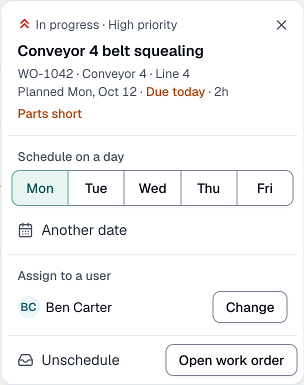
On Pro and Max, the Planner lays out a week of people and teams by day, each against a fixed 8-hour day. Drag and drop works from 1024 px wide; smaller screens get a list. Open work whose dates all ended before this week waits in a Late column, and open work with no date or no one assigned in the Unscheduled panel.
A Full user can create, assign and move work orders but cannot see requests or Reporting. A planner who turns requests into work orders, or reads Reporting, needs to be an Admin.
Reporting’s On time counts the work orders due in a date range: done by the end of the due day, or still open and not yet due. It measures due dates kept, not whether the week went as scheduled.
What it does not do
There are no shifts or custom hours per person, no time of day, and no forecast of future work.
Plans are on the pricing page.