Key points
- Count the hours each person really has after days off, training and meetings, not their paid hours.
- Hold back room for breakdowns, from the unplanned hours of your last four to eight weeks.
- Place preventive work first, then fill the rest with ready jobs from the backlog by priority.
- Fix any overloaded day before Monday, and agree machine stops with whoever runs them.
- Review on Friday: what got done, why the misses were missed, and which estimates were wrong.
What a weekly schedule is
A weekly maintenance schedule is next week’s work, laid out by person and day. “Kevin, Tuesday: forklifts 3 and 4, monthly service, 3 hours” is one line of it.
To build it, count the hours left after days off and training, place preventive work first, fill the rest from the backlog by priority, hold back room for breakdowns, and fix any overloaded day before Monday.
It sits between two other lists:
Jobs are planned first (scope, parts, steps, estimate) and scheduled once they are ready. Maintenance planning and scheduling covers the planning half.
A weekly schedule template to print
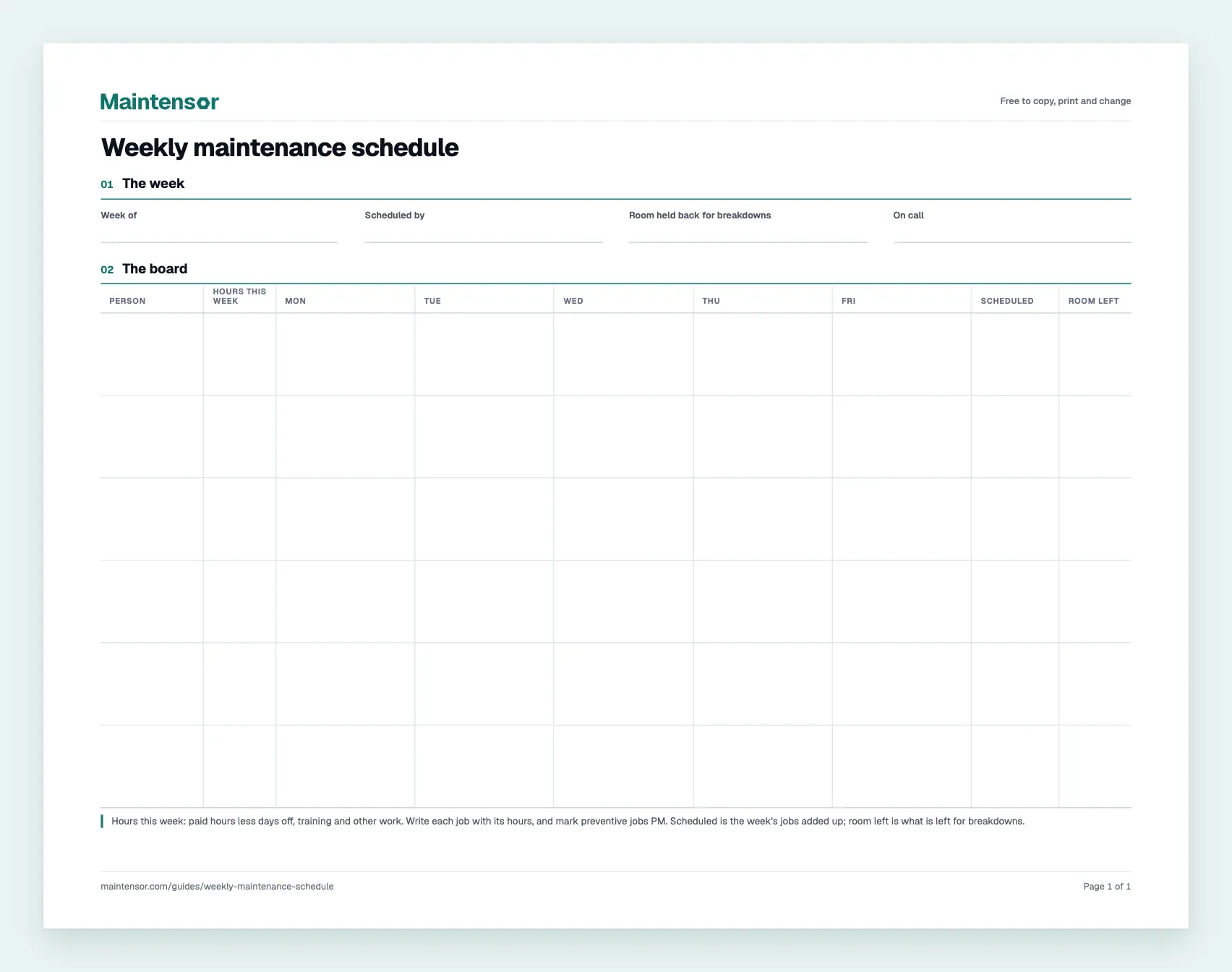
A free week board on one landscape page: a line for each person, a box for each day, then the hours scheduled and the room left. The Excel file works out the room left.
Build next week in seven steps
Have to hand: who is in, the preventive jobs due and overdue, the ready backlog, what operations has planned, and recent breakdown hours. The maintenance schedule maker lays out the year by month; the week below is yours to build.
1. Count the hours each person really has
Start from paid hours, then take out everything that is not maintenance work: days off, holidays, training, a standing meeting, a supervisor’s planning and parts orders. Write the number for each person, and for each day if a day is short.
2. Decide how much room to leave for breakdowns
Add up the hours spent on unplanned work in each of the last four to eight weeks, and take the average. How much of that to hold back is your choice: a plant with old equipment holds back more than a new building does. There are two common ways to hold it:
If breakdowns run over the room most weeks, hold back more. Scheduling 100% of the hours and hoping is how preventive work gets dropped.
3. Place preventive work first
Put next week’s preventive jobs on first, on days when the equipment can be stopped, then any overdue ones. Preventive work is the first to be dropped when the week fills up, and dropping it is how next month’s breakdowns start. Some jobs have dates that do not move.
A date that does not move
In the US, OSHA requires portable fire extinguishers to be visually inspected monthly, and a job like that goes on before anything else.
4. Fill from the backlog by priority
Take ready jobs from the maintenance backlog, highest priority first, then by due date. Group jobs in the same area on the same day to save walking. A job waiting on a part or a contractor stays off the schedule, however loud the person asking for it.
5. Check who is over
Add up each person’s day. Any day over their real hours is a job that will slip, so move something now. Watch two kinds of day: the short days from step 1 (a person in training all afternoon has 4 hours, not 8), and two-person jobs, which take hours from both people’s days.
6. Agree on the stops
Jobs that stop a line, close a room or block a dock need a time that whoever runs it has agreed to. Confirm them before the schedule goes out.
7. Publish it, then keep to it
Give the crew the week before the weekend. Each morning, take 10 minutes for what broke overnight. When a breakdown pushes a job, say which one and where it goes, rather than letting it drop off quietly. Real emergencies come first, and emergency maintenance covers telling a true emergency from an urgent job.
A week board for a crew of four
A made-up distribution warehouse. Greg Thompson leads a crew of four: himself, Kevin Brooks, Maria Santos and Tyler Jensen. Every name, job and hour below is invented for the example. Greg plans and schedules as well as working on the floor: a crew of four is well short of needing a full-time planner.
The hours. Greg spends about 2 hours a day on planning, parts and the morning huddle. Kevin is on vacation Friday. Maria is in a training course Wednesday afternoon.
The hours, person by person138 available, 28 held for breakdowns, 110 to schedule
| Person | Paid | Out | Available | Room for breakdowns | Scheduled |
|---|---|---|---|---|---|
| Greg Thompson | 40 | 10 (planning and parts) | 30 | 5 | 25 |
| Kevin Brooks | 40 | 8 (vacation Friday) | 32 | 5 | 27 |
| Maria Santos | 40 | 4 (training Wednesday) | 36 | 6 | 30 |
| Tyler Jensen | 40 | 0 | 40 | 12 | 28 |
| Crew | 160 | 22 | 138 | 28 | 110 |
The room. Over the last six weeks, breakdowns took 22, 31, 26, 35, 24 and 30 hours. Tyler is on call this week, so the largest share of the 28 hours, 12, sits on his days.
22 + 31 + 26 + 35 + 24 + 30
168 ÷ 6
The work. Preventive jobs due this week come to 34 hours. That leaves 76 hours for ready jobs from the backlog.
The board, day by dayEvery job on every person's day.
PM marks a preventive job; “with” marks a two-person job, which counts on both people’s days.
| Person | Mon | Tue | Wed | Thu | Fri |
|---|---|---|---|---|---|
| Greg (6 a day) | RTU-2 economizer actuator 3; conveyor merge photo-eye bracket 2; 5 | Emergency lights test (PM) 1.5; break room water heater 3.5; 5 | Fire extinguishers, monthly look (PM) 1; charger 4 cable 1.5; two office door closers 2.5; 5 | Dock seal, door 2 3; restroom partition 2; 5 | Paint dock bollards 5; 5 |
| Kevin (8, off Fri) | Forklifts 1 and 2 (PM) 3; door 6 springs, with Tyler 3; 6 | Forklifts 3 and 4 (PM) 3; dock seal, door 3 3; mezzanine gate latch 1; 7 | Battery room (PM) 2; aisle 3 and 4 high-bay lights, with Tyler 5; 7 | Forklifts 5 and 6 (PM) 3; conveyor drive, quarterly, with Tyler (PM) 3; parts cage shelf 1; 7 | Vacation |
| Maria (8, 4 on Wed) | Levelers 1 to 4, quarterly (PM) 6; 6 | Rooftop units 1 and 3, quarterly (PM) 4; dock bumpers, door 5 2; 6 | Dock doors, weekly check (PM) 1.5; dock wall lights 1.5; 3 | Air compressor (PM) 1.5; return belt re-lace 4; shipping office heater 2; 7.5 | Stretch wrapper guard 3; trailer restraint, door 7 4.5; 7.5 |
| Tyler (8, on call) | Conveyor walk (PM) 1; door 6 springs, with Kevin 3; charger room fan belt 2; 6 | Sorter divert shoes, lane 3 5; 5 | Aisle 3 and 4 high-bay lights, with Kevin 5; dock hose bib 1; 6 | Conveyor drive, quarterly, with Kevin (PM) 3; yard light timer 1; door 4 photo eye 2; 6 | Eyewash stations (PM) 0.5; trash compactor leak 4.5; 5 |
Each row adds up to the Scheduled column: Greg 25, Kevin 27, Maria 30, Tyler 28. The forklift operators do their own pre-shift checks, so those are not on the board.
The check in step 5 caught one day
In Greg’s first draft, Maria’s Wednesday held the weekly door check, the wall lights and the 2-hour office heater: 5 hours on a day when she has 4. The heater moved to Thursday. On an 8-hour day it would have looked fine.
The Friday review
Fifteen minutes at the end of the week, as you build the next one:
- What was scheduled and what got done. Scheduled hours finished, divided by the hours scheduled, is schedule compliance. Work that broke in does not count either way.
- Why each miss was missed. A breakdown, a part, the machine not released, an estimate too small, someone out. The reasons tell you what to fix.
- How breakdowns compared with the room you held. Add this week to your average for next week’s step 2.
- Estimates that were wrong. Correct them on the job, so the next copy is right.
- Where the backlog is heading. Growing week after week means more work is arriving than the crew finishes.
ExampleThe warehouse week, looked back on
| Line | Result |
|---|---|
| Scheduled hours finished | 95.5 of 110, so 87% |
| Preventive jobs finished | All 34 hours |
| Breakdowns | 33 hours against 28 held back. The largest: door 2 knocked off its track by a trailer on Tuesday, 8 hours. |
| Not done | Dock bollards (5 hours) and the restroom partition (2): Greg spent Tuesday at door 2 and ran a day behind. Trash compactor (4.5: wrong seal kit). Stretch wrapper guard (3: the wrapper was not released). |
| Estimates off | Dock seal, door 3: 4.5 hours against 3 |
| Next week | The six-week breakdown average is now about 30 hours, so Greg holds back 30 |
The four missed jobs go back on next week’s board first, unless something higher has come in.
When the week falls apart
When a big failure takes the rest of the week, keep the schedule. Decide what moves, starting with the lowest priority and the jobs not tied to a stop that operations has given you. Keep the preventive jobs with fixed dates. Tell the people whose jobs moved, and put them back on the next week’s board.
When not to bother
One person looking after a small building, with most of the work coming in as requests, needs a short list for the day and a weekly look at what is due, not a board.
Scheduling the week in Maintensor
The planner in Maintensor, on Pro and Max, is the week board. People are grouped by team down the side, and the days run across, for this week or any other.
- The hours. Drag a job onto a person’s day. Their hours are added up from the jobs’ estimates and measured against an 8 hour day, so an overbooked day reads “9.5h of 8h”.
- Unscheduled. Open work orders with no date or no one assigned wait in the Unscheduled panel.
- Late. Open work whose dates ended before this week sits in a Late column beside its person.
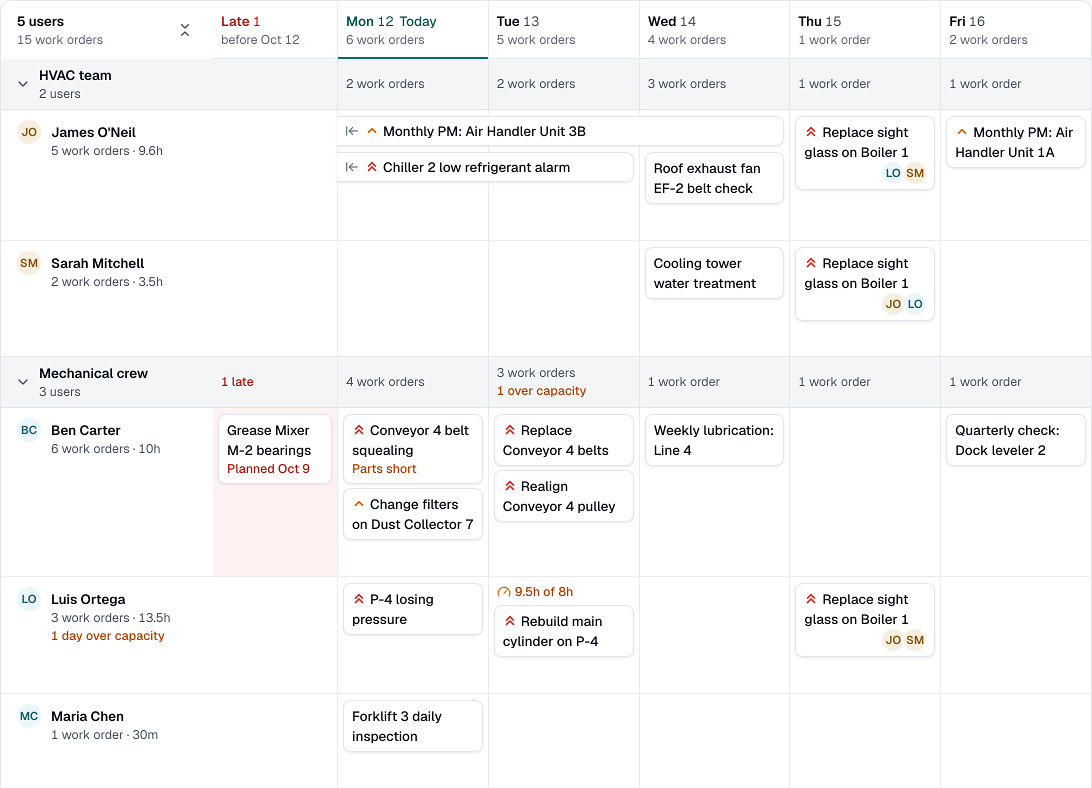
Drag and drop works on screens 1024 px wide or more. On a phone, the planner is a list of people, and jobs are moved from their card.
What it does not do
The board does not know about time off. Every weekday is 8 hours for everyone, so Kevin’s Friday off and Maria’s afternoon of training do not shrink their days. Maria’s 5-hour Wednesday would not have been flagged: leave those days light yourself, as in step 5.
The planner does not schedule anything on its own. It keeps no copy of Friday’s plan to compare with what was done, so keep that list for the review.