Key points
- Maintenance teams write an equipment FMEA for a machine already installed, to decide its preventive maintenance.
- Each cause is rated 1 to 10 for severity, occurrence and detection; the RPN multiplies the three.
- Act on every severity of 9 or 10 first, whatever its RPN, then work down the RPN list.
- In the pump example, a missing coupling guard ranks last by RPN and first by severity.
- The result is not the worksheet: it is preventive tasks and inspection steps aimed at the failures that matter.
What FMEA is, and the kind maintenance teams use
An FMEA goes through a machine one way of failing at a time. It asks what that failure would do (the effect), why it would happen (the cause), and whether we would see it coming (the detection). The ratings decide where the effort goes.
For a maintenance team the result is not the worksheet. It is a short list of preventive tasks and inspection steps aimed at the failures that matter. FMEAs come in three common kinds:
- Design FMEA: written by engineers designing a product.
- Process FMEA: written by manufacturing engineers for the steps that make the product.
- Equipment FMEA: written by maintenance teams for a machine already installed, to decide what its preventive maintenance should be.
This guide is about the third. Reliability centered maintenance uses the same analysis inside a larger decision process. FMEA works up from each part; a fault tree works down from one unwanted event.
How to do an FMEA, step by step
- Pick the machine and the people: one critical asset, the technician who repairs it, an operator and someone who can approve the actions.
- List its functions and the ways it can fail, from its work order history, the maker’s manual and the people in the room.
- Rate the effect of each failure mode for severity, from 1 to 10.
- Rate each cause for occurrence: how often it would produce that failure.
- Rate the current checks for detection: how unlikely they are to catch it in time.
- Rank the lines and assign actions: severity 9 and 10 first, then by RPN, each action with an owner, a due date and a work order.
FMEA worksheet columns
The worksheet is free to download: one landscape page with eleven lines, each line one cause, rated before and after its action.
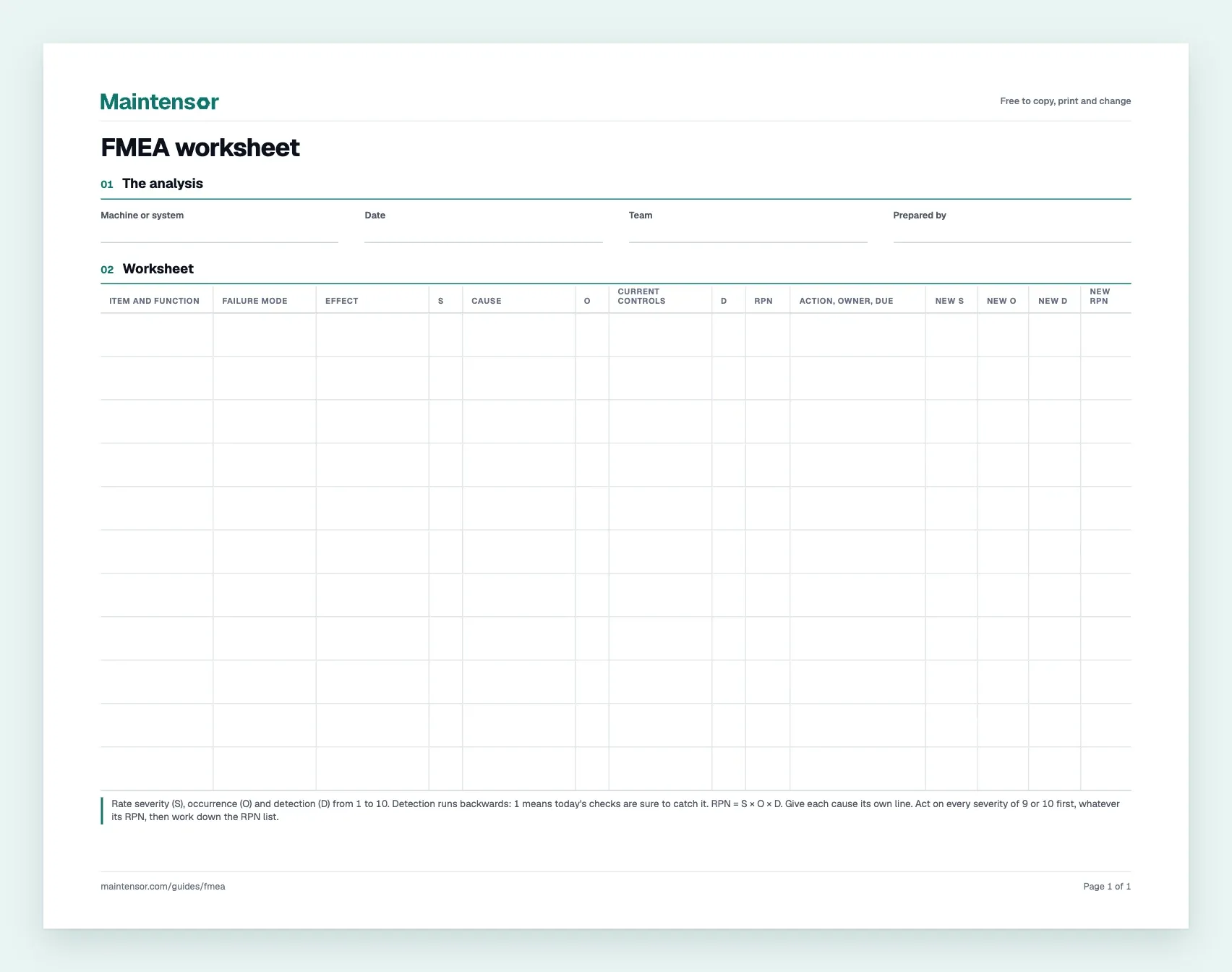
What goes in each column:
| Column | What goes in |
|---|---|
| Item and function | The machine or part, and what it must do |
| Failure mode | How it fails to do that |
| Effect | What happens when it does |
| Severity (S) | How bad the effect is, 1 to 10 |
| Cause | Why the failure mode would happen |
| Occurrence (O) | How often that cause would produce the failure, 1 to 10 |
| Current controls | What you do today that would catch or prevent it |
| Detection (D) | How unlikely the current controls are to catch it before it fails, 1 to 10 |
| RPN | S × O × D |
| Action, owner, due | What will change, who does it, by when |
| New S, O, D and RPN | The ratings once the action is in place |
One failure mode can have several causes; give each cause its own line, because each needs its own action.
Rating severity, occurrence and detection
For a maintenance FMEA, a scale like this one, a suggestion to adapt and not a standard, is enough:
| Rating | Severity: what the failure does | Occurrence: how often it happens | Detection: will current checks catch it in time? |
|---|---|---|---|
| 1 | No noticeable effect | Not expected in the machine’s life | Certain: an alarm or a check that always catches it |
| 2 to 3 | A nuisance; no lost output | Once every few years | Very likely: a routine check would see it coming |
| 4 to 6 | Lost output or a costly repair; no safety effect | Once every year or two, up to a few times a year | Maybe: someone might notice; no check looks for it |
| 7 to 8 | A line, a building system or a critical asset stops; major repair | Every month or two | Unlikely: noticed only when it is about to fail |
| 9 to 10 | Could hurt someone, or break an environmental or legal rule | Weekly or more | No chance: no way to know until it fails |
Detection runs backwards
On the detection scale, 1 is good and 10 is bad. Rate occurrence from your own reactive work orders where you can. Do not argue a rating for more than a minute: the order of the lines matters more than any one number.
RPN, and what the automotive handbook uses instead
The risk priority number multiplies the three ratings, and runs from 1 to 1,000:
RPN = S × O × D
- S
- severity of the effect, 1 to 10
- O
- occurrence of the cause, 1 to 10
- D
- detection by the current checks, 1 to 10 (10 is worst)
Sorting by RPN puts the biggest risks at the top most of the time, but not always. Take two lines from the pump example below:
S 10 × O 2 × D 2
S 5 × O 5 × D 3
Multiplying ranks puts the drip above a hazard that could take a hand.
The automotive industry has moved away from the RPN. Its 2019 AIAG and VDA FMEA Handbook, for design and process FMEA, replaced it with an Action Priority (VDA QMC summary of the changes): a table that gives each line High, Medium or Low priority from its three ratings.
The severity rule
A maintenance crew does not need the handbook’s table. One rule covers most of the gap: act on every severity of 9 or 10 first, whatever its RPN, then work down the RPN list.
FMEA example: a centrifugal pump, line by line
On this made-up pump, the clogged strainer tops the RPN list at 210 and the missing guard comes last at 40, yet the guard gets acted on first. Every rating is invented. P-4 is an end-suction centrifugal pump with a 10 hp (7.5 kW) motor, a mechanical seal, grease-lubricated bearings, a flexible coupling and a suction strainer. It moves cooling water from the tower basin to the process heat exchangers.
The worksheet: seven failure modes, ratedFrom the clogged strainer at RPN 210 down to the missing coupling guard at RPN 40
| Failure mode | Effect | S | Cause | O | Current control | D | RPN |
|---|---|---|---|---|---|---|---|
| Suction starved, cavitation | Low flow to the exchangers; impeller pitted over time | 6 | Suction strainer clogged | 5 | None | 7 | 210 |
| Bearing fails | Pump seizes; no cooling water; process stops | 8 | Grease missed, wrong amount or wrong type | 4 | Noticed when it gets loud | 6 | 192 |
| Motor winding fails | Pump stops; motor replaced | 8 | Overheating: fins and fan cover packed with dust | 2 | None | 8 | 128 |
| Coupling fails | Vibration damages the seal and bearings, then the pump stops | 7 | Misalignment after motor or pump work | 3 | None | 5 | 105 |
| Impeller wears | Flow falls slowly; process runs warm | 4 | Normal wear, faster with grit in the water | 3 | None | 8 | 96 |
| Mechanical seal leaks | Water on the base plate; can run dry | 5 | Seal faces damaged by running dry at start-up | 5 | Weekly walk-by | 3 | 75 |
| Coupling guard loose or missing | Someone could reach the turning coupling | 10 | Guard not refitted after work | 2 | Operator’s daily round | 2 | 40 |
Then the actions, with the guard first under the severity rule and the rest by RPN:
The actions, line by lineSeven actions, the guard first, each with its new ratings and RPN
| Failure mode | Action | New S, O, D | New RPN |
|---|---|---|---|
| Guard | A required last step on every procedure that takes the guard off: “Guard refitted and every fastener in” | 10, 2, 2 | 40 |
| Cavitation | Weekly strainer check and clean, with a suction pressure reading | 6, 2, 3 | 36 |
| Bearing | Grease to the maker’s interval, with the grease type and amount written in the step; monthly bearing temperature and listening check | 8, 2, 4 | 64 |
| Motor | Quarterly cleaning of the fins and fan cover | 8, 1, 8 | 64 |
| Coupling | Alignment check after any motor or pump work, and once a year | 7, 1, 3 | 21 |
| Impeller | Yearly performance check: pressures at a known flow against the maker’s pump curve | 4, 3, 4 | 48 |
| Seal | A “no drip at the seal” check on the weekly strainer job | 5, 5, 2 | 50 |
From 210 down to 64 or below
Every line ends at 64 or below, the hazard is handled first, and the whole result is four recurring jobs and two required steps.
Turning the actions into preventive tasks and inspection steps
Each action is a one-time change (one work order), a task that repeats, or a step added to a procedure that exists. Group the repeating checks by interval, so the strainer, seal and guard checks share one weekly job (the pump maintenance checklist has the usual intervals).
P-4 ends up with a weekly job (strainer, suction pressure reading, seal, guard in place), a monthly one (grease, bearing temperature reading, rumble or knock), a quarterly one (fins and fan cover, with a photo after cleaning) and a yearly one (alignment, and pressures at the stated flow). Alignment checked and guard refitted are required last steps on each repair’s own procedure.
Write each check so a Fail is plain, such as “Fail: visibly loaded” on the strainer, because a limit nobody wrote down gets judged differently by every technician. Choose intervals from the maker’s manual and the ratings, then adjust them from what the checks find. A preventive maintenance program is where these tasks sit alongside everything else.
A root cause analysis that finds a new failure mode adds a line. Work it out in the browser: root cause worksheet.
Mistakes that make an FMEA paperwork
- Too big a scope. A whole plant in one worksheet never finishes. Do one critical machine, then the next.
- Every imaginable failure. List what has happened on machines like this one, and what the manual warns about.
- Arguing over numbers. The ratings only sort the list.
- The worksheet as the result. If no work order or checklist changed, nothing changed.
- Never revisited. Machines get modified, moved and run harder, so reopen the worksheet when they do.
FMEA actions as repeating work orders in Maintensor
Maintensor has no FMEA tool: keep the worksheet in a spreadsheet. As preventive maintenance software, it runs what the worksheet decides.
- The repeat. Each repeating action is a work order with a calendar repeat. The next one is created when the current one is completed.
- The checks. A procedure of an Inspection check answered Pass, Flag or Fail, a Number step for a reading, an Instruction, a Photo.
- Required steps. A step can be marked Required. One left open at sign-off does not block completion, but it is written to the work order’s History. So the guard step is a record, not an interlock, which is why the example’s ratings for the guard do not change.
- A failed check. It asks for a note and a photo before the next step, then offers a follow-up work order. The job can still be closed without them.

For next year’s occurrence ratings, Reporting’s Most problematic assets (Pro and Max, for Admins) shows the five assets with the most unplanned downtime, counted by the clock with nights and weekends included, with their reactive work orders and MTBF.
What it does not do
A Number step has no unit or limits, so write both into the step’s label and pair it with an inspection check for the judgment. Its value stays on that work order’s checklist, so trends are read in your own sheet.
Schedules run on the calendar only, with nothing due from run hours, meters or conditions.