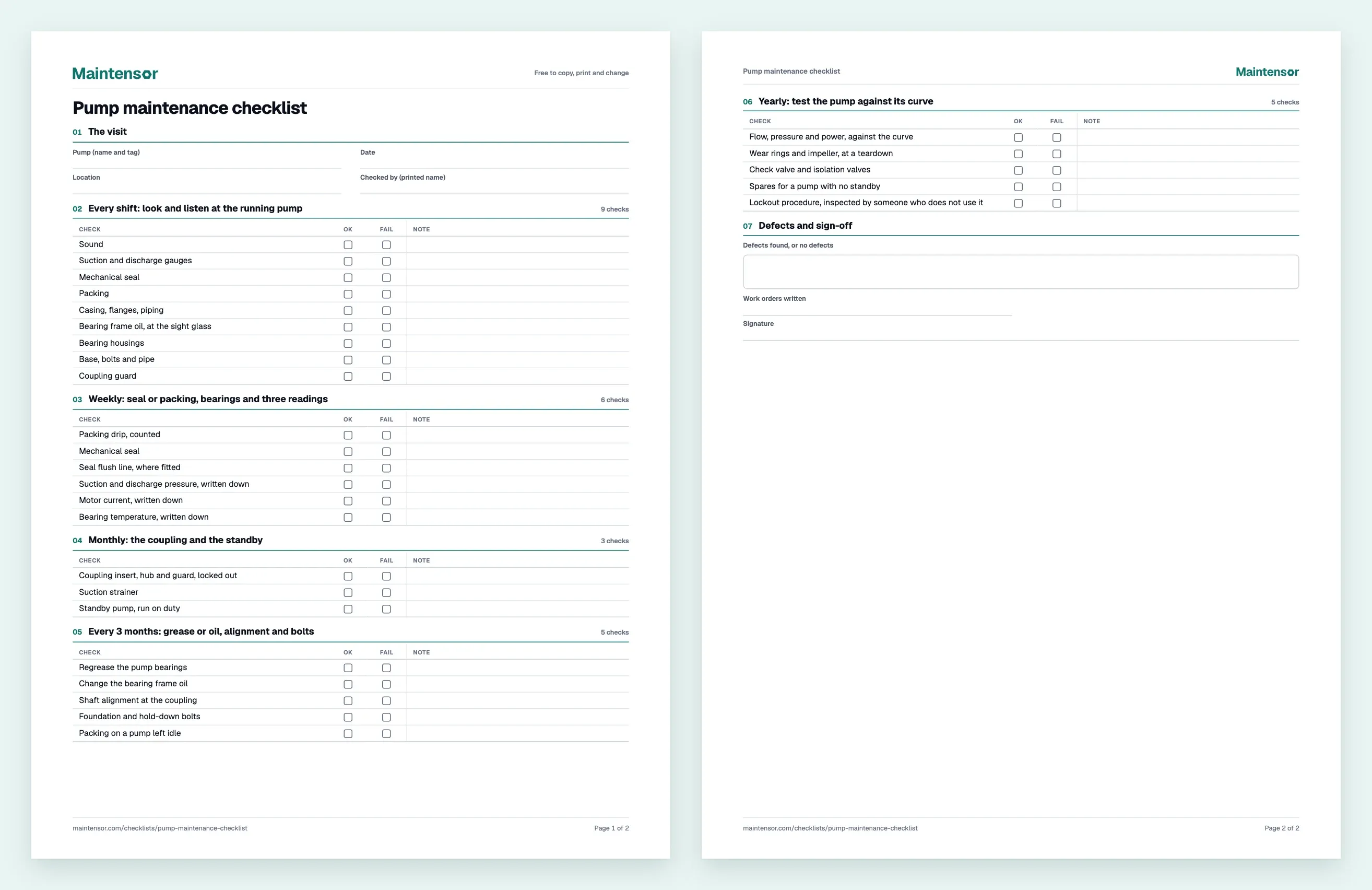
The checks, by visit
One sheet per pump and visit, for a horizontal centrifugal pump with its own bearing frame, a coupling and a separate motor: a plant’s cooling water or transfer pump, or a building’s chilled and hot water pump. A failed check gets a work order, and the pump’s manual wins where it differs.
Every shift: look and listen at the running pump9 checks
- Sound
- Suction and discharge gauges
- Mechanical seal
- Packing
- Casing, flanges, piping
- Bearing frame oil, at the sight glass
- Bearing housings
- Base, bolts and pipe
- Coupling guard
Weekly: seal or packing, bearings and three readings6 checks
- Packing drip, counted
- Mechanical seal
- Seal flush line, where fitted
- Suction and discharge pressure, written down
- Motor current, written down
- Bearing temperature, written down
Monthly: the coupling and the standby3 checks
- Coupling insert, hub and guard, locked out
- Suction strainer
- Standby pump, run on duty
Every 3 months: grease or oil, alignment and bolts5 checks
- Regrease the pump bearings
- Change the bearing frame oil
- Shaft alignment at the coupling
- Foundation and hold-down bolts
- Packing on a pump left idle
Yearly: test the pump against its curve5 checks
- Flow, pressure and power, against the curve
- Wear rings and impeller, at a teardown
- Check valve and isolation valves
- Spares for a pump with no standby
- Lockout procedure, inspected by someone who does not use it
What counts as a fail, check by checkThe full tables, and where each interval comes from.
The intervals come from the Goulds Pumps 3196 i-FRAME manual, for a common process pump, and from the Department of Energy’s pumping system sourcebook, written with the Hydraulic Institute. In the last column, Rule links the regulation, Maker is the pump maker’s manual, and Practice is common plant practice.
Every shift: look and listen at the running pump
| Check | Fail when | Basis |
|---|---|---|
| Sound | A new whine or knock, or a crackle like marbles in the casing (cavitation) | Practice |
| Suction and discharge gauges | Away from their usual reading for the same duty | Practice |
| Mechanical seal | Any drip or spray | Maker |
| Packing | Streaming, or dry and smoking | Maker |
| Casing, flanges, piping | A new wet spot | Maker |
| Bearing frame oil, at the sight glass | Below the mark, milky or dark | Maker |
| Bearing housings | Hotter or noisier than yesterday | Maker |
| Base, bolts and pipe | Shaking more than usual; a loose bolt | Practice |
| Coupling guard | Missing, loose or rubbing | Rule |
The guard row: OSHA 1910.212(a)(1) requires guarding against hazards such as rotating parts, and 1910.219(i)(2) says shaft couplings must present no hazard from bolts, nuts, setscrews or revolving surfaces.
Weekly: seal or packing, bearings and three readings
| Check | Fail when | Basis |
|---|---|---|
| Packing drip, counted | Outside the maker’s rate; steam at the gland | Maker |
| Mechanical seal | Leaking beyond the maker’s figure | Maker |
| Seal flush line, where fitted | Valve shut, line blocked, no flow | Practice |
| Suction and discharge pressure, written down | Difference down from its baseline | Practice |
| Motor current, written down | Up or down from its baseline | Practice |
| Bearing temperature, written down | Up from its baseline | Maker |
The DOE sourcebook puts packing and seal adjustments on a weekly round (page 33). A warm bearing is not a fault by itself: the Goulds manual’s standard oil is for bearings running 120 to 180 °F (49 to 82 °C), and a rise from the pump’s own baseline is the warning.
A vibration reading taken at the same points each time turns “shaking more than usual” into a number.
Monthly: the coupling and the standby
| Check | Fail when | Basis |
|---|---|---|
| Coupling insert, hub and guard, locked out | Worn or cracked insert, loose hub | Rule |
| Suction strainer | Pressure drop across it up from clean | Practice |
| Standby pump, run on duty | Will not start, or will not make pressure | Practice |
1910.219(p)(1) requires power-transmission equipment, couplings included, to be inspected at intervals not exceeding 60 days; monthly leaves a margin.
Every 3 months: grease or oil, alignment and bolts
| Check | Fail when | Basis |
|---|---|---|
| Regrease the pump bearings | Not done; old grease comes out gritty, dark or wet | Maker |
| Change the bearing frame oil | Not done; oil milky or dark | Maker |
| Shaft alignment at the coupling | Outside the maker’s limit | Maker |
| Foundation and hold-down bolts | Loose, or grout cracked | Maker |
| Packing on a pump left idle | Hard or dry | Maker |
How much grease goes in is in the bearing lubrication guide; the DOE sourcebook warns that too much makes bearings run hot. Align to the manual’s figure, not by eye: precision maintenance works an example of realigning a pump after a seal change.
Yearly: test the pump against its curve
| Check | Fail when | Basis |
|---|---|---|
| Flow, pressure and power, against the curve | Below the curve with the process unchanged | Maker |
| Wear rings and impeller, at a teardown | Clearance past the maker’s limit | Maker |
| Check valve and isolation valves | Backflow when stopped; a valve that will not shut tight | Practice |
| Spares for a pump with no standby | No seal kit, bearings or coupling insert on the shelf | Practice |
| Lockout procedure, inspected by someone who does not use it | Not done in the last year | Rule |
The Goulds manual’s yearly check is capacity, pressure and power: if they no longer meet an unchanged process, take the pump apart and inspect it. The DOE sourcebook calls a substantial decline in performance the key sign of worn wear rings (page 35).
The lockout row is 1910.147(c)(6): a periodic inspection of the energy control procedure at least once a year.
Pump example: what falling pressure and falling amps mean
ExamplePump P-4, six months after a rebuild
A made-up cooling water pump, P-4, was rebuilt in spring. Every Monday, with the valves set as they always are, the crew writes down three numbers; week 1 is the baseline.
| Week | Suction | Discharge | Difference | Motor current |
|---|---|---|---|---|
| 1 | 5 psi | 65 psi | 60 psi | 30 A |
| 8 | 5 psi | 63 psi | 58 psi | 30 A |
| 16 | 5 psi | 60 psi | 55 psi | 29 A |
| 24 | 5 psi | 57 psi | 52 psi | 27 A |
Head. The difference is what the pump adds. For water, DOE’s pumping tip sheet on control valves gives 1 psi as 2.308 feet of head, so 60 psi is about 138 feet and 52 psi about 120: the pump has lost 13 percent of its head.
Current. On a radial centrifugal pump the motor current rises with flow (DOE’s pumping system sourcebook, page 17), so less current at the same valve settings means less water is moving.
What it points to. Suction held at 5 psi and nobody moved a valve, so the strainer and the tank are not the cause. That leaves worn wear rings or impeller, or something lodged in it: the crew orders wear rings and a gasket set and books a teardown for the next shutdown.
What to look at first, from the readings at the same valve settings:
Packing drip and seal leaks: how much is normal
Packing has to leak. The drip cools and lubricates the rings where they press on the shaft, and the DOE sourcebook says to set the gland for the leak rate the pump maker allows, usually 2 to 60 drops a minute (page 33).
The sourcebook warns that overtightening burns up the packing. One pump maker, Cornell Pump, says to tighten the gland nuts a quarter turn at a time and aims for 40 to 60.
Adjust a running pump only where the manual and your lockout procedure allow it.
A mechanical seal should show no steady drip. The sourcebook says to replace it if leakage exceeds the maker’s figure, and that dirt degrades a seal quickly. A second seal in a year on the same pump is a cause to find, not a part to keep buying.
Grease and oil: 2,000 hours or three months
The Goulds manual says to regrease every 2,000 operating hours or every three months, and to change the oil after the first 200 hours, then every 2,000 hours or three months. Which comes first depends on the pump’s hours.
ExampleWhich comes first: the hours or the months
| The pump runs | Hours a week | Reaches 2,000 hours in |
|---|---|---|
| Around the clock | 168 | About 12 weeks (2,000 ÷ 168 = 11.9) |
| One 8-hour shift, five days a week | 40 | 50 weeks, so the three months come first |
Three months is about 13 weeks, so only the pump running around the clock reaches its 2,000 hours first.
Sump, circulator, close-coupled and positive displacement pumps
The tables fit a pump with its own bearing frame and a coupling. These four kinds change some of the checks.
What changes, pump by pumpClose-coupled pumps, wet-rotor circulators, sump pumps and ejectors, positive displacement pumps.
Close-coupled pumps carry the impeller on the motor shaft: no bearing frame and no coupling to align. The bearings are the motor’s, greased or not as its nameplate says. The seal checks stay.
Wet-rotor circulators on heating loops have no seal and no grease point. Taco’s instruction sheet for its 00 series says the bearings are water lubricated, the system must be filled before the circulator runs, and running it dry causes permanent damage. Check that it runs, the loop warms, and the flanges are dry.
Sump pumps and sewage ejectors: unplug or lock out the pump before a hand goes in the pit. Zoeller’s maintenance advice is to lift the float by hand to see the pump start and stop, and to clean a switch that sticks.
Also check the sump’s high-water alarm and intake screen, and that the check valve holds so the pipe does not drain back and restart the pump.
Positive displacement pumps (gear, lobe, piston, diaphragm) must never run against a closed valve. The DOE sourcebook says pressure then builds until a relief valve lifts, a pipe or fitting ruptures, or the motor stalls (page 5). Their relief valve belongs on the list, at the maker’s interval.
Before you start
When a check fails
A seal spraying, hot or chemical liquid leaking, a bearing smoking or screaming, or a pump running dry: stop it, lock it out, and start the standby if there is one. Anything else gets a work order with the reading and a photo.
Locking out a pump: what the rules say
OSHA 29 CFR 1910.147 covers servicing where an unexpected start-up or a release of stored energy could hurt someone. Its energy isolating devices include a line valve as well as a disconnect switch, and on a pump both matter.
The rule on a pump, step by stepValves, stored energy, proving it dead, and Canada.
Lock the motor disconnect, then close and lock the suction and discharge valves. Flow back through a leaking check valve can turn the impeller, so the discharge valve is locked too.
Paragraph (d)(5) requires stored energy to be relieved or restrained: bleed and drain the casing, and let hot liquid cool. Paragraph (d)(6) requires isolation to be verified: press start, and read the casing gauge at zero.
The lockout/tagout procedure guide covers writing the steps for one machine. Provinces in Canada have their own lockout rules.
This is information, not legal advice: check the rules that apply to your site and the pump maker’s manual.
Pump checks in Maintensor: readings, repeats and a seal that fails
Make the pump an asset with its nameplate, and put its motor under it with Parent asset, so the pump’s record lists the motor. Build a procedure for each visit, and set each work order to repeat: the round weekly, the coupling monthly, the grease or oil change monthly with Every 3, the curve test yearly.
- Make each line of the table an Inspection check and each reading a Number step. A Number step has no unit or limits, so write them in: “Discharge pressure, psi (baseline 65, flag under 59)”.
- Start the quarterly service with a required Checkbox: “Motor locked out, valves closed and locked, casing at zero.” Skipping it does not stop anyone finishing, but it is listed at sign-off and written to the history.
- A Fail asks for a note and a photo, then offers a follow-up work order and Mark asset down. Put the seal kit on the follow-up as a part.

What it does not do: repeats go by the calendar only, with no run-hour counter, so do the 2,000-hour arithmetic once (a pump running around the clock gets Weekly, Every 11: 11.9 weeks, rounded down so the grease is never late). A reading stays on its work order’s Checklist, not on the asset or in Reporting, and nothing draws a trend.
A table like P-4’s is kept by opening past work orders or in a spreadsheet. Only Admins and Full users answer checklists, so whoever does the round in the app needs a user seat. The manufacturing maintenance software page shows the rest of a plant’s setup.