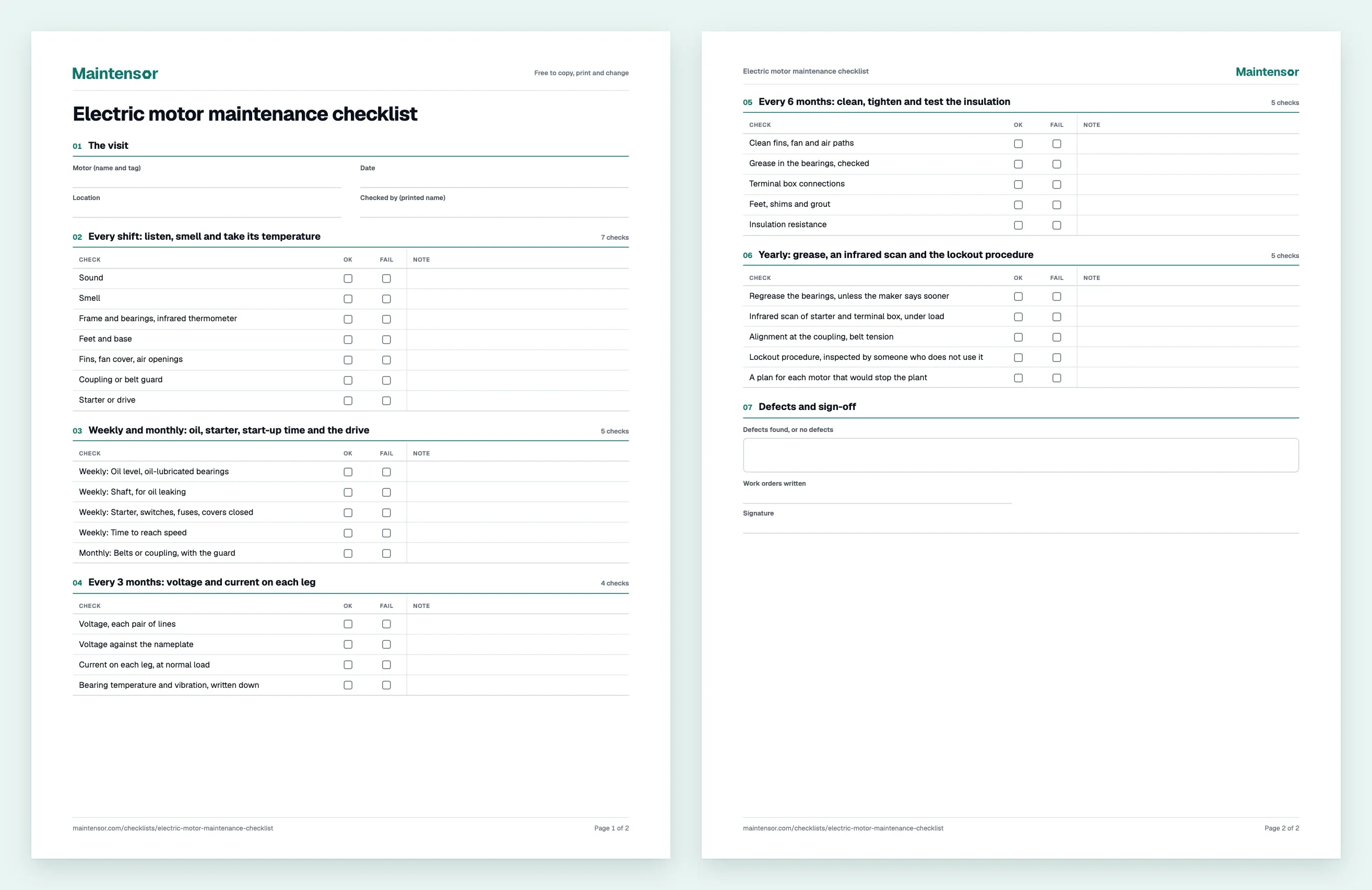
The checks, by visit
One sheet per motor and visit, for a three-phase AC induction motor up to a few hundred horsepower, driving a pump, a fan, a conveyor or a compressor. A failed check gets a work order with the reading and a photo, and the motor’s manual wins where it differs.
Every shift: listen, smell and take its temperature7 checks
- Sound
- Smell
- Frame and bearings, infrared thermometer
- Feet and base
- Fins, fan cover, air openings
- Coupling or belt guard
- Starter or drive
Weekly and monthly: oil, starter, start-up time and the drive5 checks
- Weekly: Oil level, oil-lubricated bearings
- Weekly: Shaft, for oil leaking
- Weekly: Starter, switches, fuses, covers closed
- Weekly: Time to reach speed
- Monthly: Belts or coupling, with the guard
Every 3 months: voltage and current on each leg4 checks
- Voltage, each pair of lines
- Voltage against the nameplate
- Current on each leg, at normal load
- Bearing temperature and vibration, written down
Every 6 months: clean, tighten and test the insulation5 checks
- Clean fins, fan and air paths
- Grease in the bearings, checked
- Terminal box connections
- Feet, shims and grout
- Insulation resistance
Yearly: grease, an infrared scan and the lockout procedure5 checks
- Regrease the bearings, unless the maker says sooner
- Infrared scan of starter and terminal box, under load
- Alignment at the coupling, belt tension
- Lockout procedure, inspected by someone who does not use it
- A plan for each motor that would stop the plant
What counts as a fail, check by checkThe full tables, and where each interval comes from.
The intervals follow Table 1 of the Department of Energy’s motor and drive sourcebook (page 29), which lists weekly, six-monthly and yearly tasks. In the last column, Rule links the regulation, Maker is the motor maker’s manual or NEMA MG 1, the motor makers’ standard, DOE is that sourcebook, and Practice is common plant practice.
Every shift: listen, smell and take its temperature
| Check | Fail when | Basis |
|---|---|---|
| Sound | A new hum, growl, squeal or knock | Practice |
| Smell | Hot varnish or burning: stop it | Practice |
| Frame and bearings, infrared thermometer | Hotter than usual at the same load | Practice |
| Feet and base | Shaking more than usual; a loose bolt | Practice |
| Fins, fan cover, air openings | Caked with dust, blocked, a dented fan cover | Maker |
| Coupling or belt guard | Missing or loose | Rule |
| Starter or drive | A fault showing, a trip that repeats | Practice |
The TECO-Westinghouse motor manual says dirt on the external fan of a fan-cooled motor leads to unbalance and vibration, and that dirt on screens and louvers restricts the air. The guard row rests on OSHA 1910.212(a)(1), which requires guarding against rotating parts.
Weekly and monthly: oil, starter, start-up time and the drive
| When | Check | Fail when | Basis |
|---|---|---|---|
| Weekly | Oil level, oil-lubricated bearings | Below the mark | DOE |
| Weekly | Shaft, for oil leaking | Oil on the shaft or inside | DOE |
| Weekly | Starter, switches, fuses, covers closed | A hot smell, buzzing, a fuse blown again | DOE |
| Weekly | Time to reach speed | Longer than usual | DOE |
| Monthly | Belts or coupling, with the guard | Cracked belt, worn insert, loose guard | Rule |
1910.219(p)(1) requires power-transmission equipment to be inspected at intervals not exceeding 60 days. A motor that is slower to come up to speed than it used to be is carrying more load, seeing low voltage, or wearing.
Every 3 months: voltage and current on each leg
| Check | Fail when | Basis |
|---|---|---|
| Voltage, each pair of lines | Unbalance over 1% | Maker |
| Voltage against the nameplate | Outside 10% of rated | Maker |
| Current on each leg, at normal load | A leg over nameplate amps, or legs further apart than last time | Practice |
| Bearing temperature and vibration, written down | Up from the motor’s baseline | Practice |
The limits are NEMA MG 1’s, listed with the worked example below. A vibration reading taken at the same point each time catches bearing wear early.
Every 6 months: clean, tighten and test the insulation
| Check (locked out) | Fail when | Basis |
|---|---|---|
| Clean fins, fan and air paths | Dirt left in the air paths | Rule |
| Grease in the bearings, checked | Hard, dark, gritty or leaking out | DOE |
| Terminal box connections | Loose, discolored or burnt | DOE |
| Feet, shims and grout | A rocking foot, a loose bolt, cracked grout | DOE |
| Insulation resistance | Below the maker’s minimum, or falling | DOE |
Vacuum, or blow out with dry air: 1910.242(b) allows compressed air for cleaning only below 30 psi, with chip guarding and protective equipment, and the DOE table says 25 to 30 psig.
The sourcebook also warns about soft foot: a mounting foot that does not sit flat lets the motor flex under load, which misaligns it and wears the bearings (page 30).
Yearly: grease, an infrared scan and the lockout procedure
| Check | Fail when | Basis |
|---|---|---|
| Regrease the bearings, unless the maker says sooner | Not done | DOE |
| Infrared scan of starter and terminal box, under load | A connection hotter than its neighbors | DOE |
| Alignment at the coupling, belt tension | Outside the maker’s limit | Practice |
| Lockout procedure, inspected by someone who does not use it | Not done this year | Rule |
| A plan for each motor that would stop the plant | No spare, and no repair shop picked | DOE |
The scan row comes from the voltage unbalance tip sheet, which suggests annual thermographic inspections; infrared thermography explains what the camera finds. The DOE’s tip sheet on motor life says to choose a motor repair service center before you need one.
The lockout row is 1910.147(c)(6), at least once a year. How much grease, and how to work out the interval from a bearing maker’s chart, is in the bearing lubrication guide.
Voltage unbalance example: three readings worked out
The DOE sourcebook lists NEMA MG 1’s usual service conditions for a motor (page 27):
The DOE’s tip sheet on voltage unbalance says to check voltages at the motor terminals periodically, and that above 1 percent the motor must be derated.
ExampleA cooling tower fan motor, read at its starter
A made-up 480-volt motor driving a cooling tower fan, nameplate 52 amps. The electrician reads, at its starter, under normal load:
| Reading | A to B | B to C | C to A |
|---|---|---|---|
| Voltage | 482 V | 478 V | 470 V |
| Reading | Leg A | Leg B | Leg C |
|---|---|---|---|
| Current | 40 A | 44 A | 48 A |
NEMA’s definition, as the DOE tip sheet gives it: unbalance is 100 times the largest difference from the average voltage, divided by the average.
- Average voltage: (482 + 478 + 470) ÷ 3 = 476.7 V.
- Largest difference: 476.7 minus 470 = 6.7 V.
- Unbalance: 6.7 ÷ 476.7 × 100 = 1.4 percent. Over the 1 percent limit.
- Current, the same way: average 44 A, largest difference 4 A, so 9.1 percent, about six and a half times the voltage figure. The tip sheet says current unbalance may be 6 to 10 times the voltage unbalance.
- Heat: the tip sheet’s estimate multiplies the motor’s temperature rise by
1 + 2 × 1.4² ÷ 100, about 1.04. A motor with an 80 °C rise runs about 3 °C hotter, and the same sheet says winding insulation life halves for every 10 °C.
What it shows. No leg is over 52 amps, so the motor is not overloaded: the supply is uneven.
Where to look. The electrician reads the same three voltages at the panel feeding it. If the unbalance is there too, the cause is upstream; the tip sheet’s list starts with single-phase loads spread unevenly across the phases and faulty power factor correction equipment.
If the panel is balanced and the motor is not, look between them: a loose connection or a worn contactor pole. Fix it, then read all six numbers again.
Insulation resistance: what a megohmmeter test tells you
The test puts a DC voltage, typically 500 or 1,000 V, on the winding and measures the resistance to ground. The DOE sourcebook says expected values are in megohms, as set out in IEEE Standard 43, and that wet insulation is a common cause of low readings (page 28).
The minimum is the maker’s. ABB’s drive installation guide asks its own motors for more than 100 megohms at 25 °C, measured at 1,000 V DC, and sends other motors to their maker’s instructions.
Energizing a motor with weak or wet insulation can lead to catastrophic failure, the sourcebook warns: dry it and test again. On a drive-fed motor, ABB’s guide says to measure the insulation only with the motor cable disconnected from the drive.
The number moves with temperature. The TECO manual corrects readings to 40 °C, and as an approximation for a new winding, resistance halves for each 10 °C (18 °F) rise.
ExampleTwo readings, brought to the same temperature
Made-up readings from one motor.
| Test | Winding temperature | Reading | Brought back to 20 °C |
|---|---|---|---|
| Last spring | 20 °C | 850 megohms | 850 megohms |
| This summer | 30 °C | 400 megohms | About 800 megohms |
No real change. Without the temperature written down, it looks like the winding lost half its insulation.
Motors on a variable frequency drive
On a drive-fed motor, listen for new bearing noise, and check a grounding brush, where fitted, at its maker’s interval.
What a drive does to a motorVoltage spikes, current through the bearings, and running slow.
A drive changes three things, by the DOE’s tip sheet on motors and drives and the motor’s own data:
Before you start
When a check fails
Smoke or a burning smell, a bearing screaming, or a motor that trips again after one reset: stop it, lock it out and call the electrician. Do not keep resetting an overload.
Anything else gets a work order with the reading and a photo.
Electrical safety rules for motor work
OSHA 1910.333(a)(1) requires live parts to be deenergized before work on or near them, unless that adds hazards or is infeasible. Reading current and voltage on a running motor is work near live parts, so it is for a qualified person; everything else is done locked out under 1910.147.
The rules in detailQualified persons, NFPA 70E, stored energy in a motor, and Canada.
A qualified person is defined in 1910.399, and works with the protective equipment that NFPA 70E, the standard for electrical safety in the workplace, sets out.
Paragraph (d)(5) of 1910.147, on stored energy, applies to a drive’s charged capacitors and to a load that can turn the shaft, such as a fan windmilling in a draft.
The lockout/tagout procedure guide covers writing the steps for one machine, and the electrical inspection checklist covers the panels feeding the motors. In Canada, CSA Z462 is the workplace electrical safety standard, and provinces have their own rules.
This is information, not legal advice: check the rules that apply to you and the motor maker’s manual.
Motor checks in Maintensor: six readings and a follow-up job
Make the motor an asset with its nameplate, and write the full-load amps and the bearing numbers in its description. Put it under the machine it drives with Parent asset: the pump maintenance checklist suggests the same for a pump and its motor.
- Build the quarterly procedure as six Number steps, three voltages and three currents, then one more for the unbalance the electrician works out: the app records the numbers but computes nothing. Write the unit and limit into the step: “Voltage unbalance, % (fail over 1)”.
- The six-monthly service opens with a Checkbox marked Required for the lockout, then a Number step for insulation resistance and one for the winding temperature. An outside electrician’s report goes on the work order as an attachment.
- Set the quarterly work order to repeat Monthly, Every 3, and the six-monthly one Monthly, Every 6. A Fail asks for a note and a photo, then offers a follow-up work order and Mark asset down.

What it does not do: there are no meters or sensors, and a Number step has no unit or limits. Its value stays on that work order’s Checklist, not on the asset or in Reporting, so comparing this quarter’s currents with the last means opening last quarter’s work order.
Only Admins and Full users answer checklists. The manufacturing maintenance software page shows the rest of a plant’s setup.