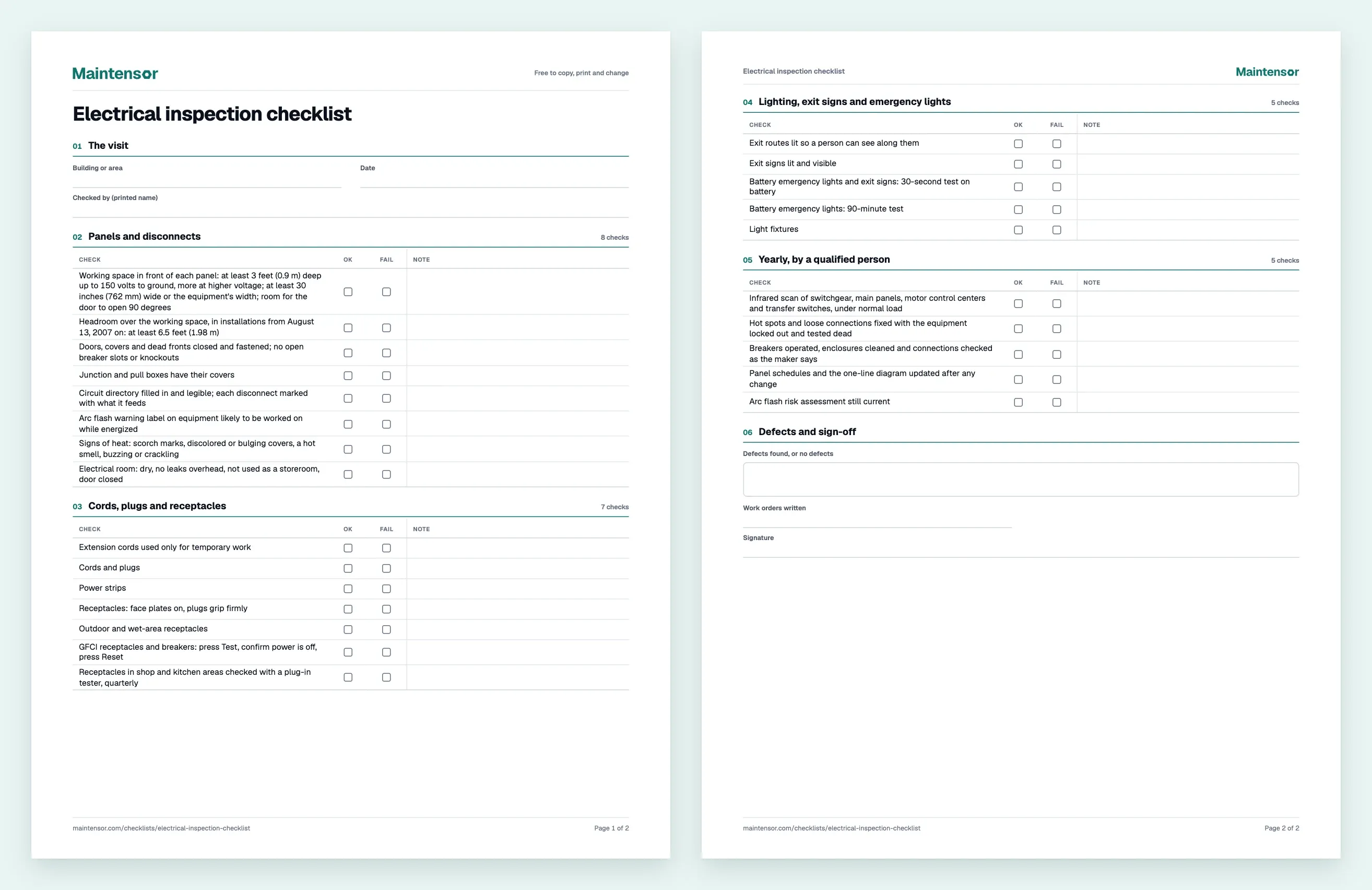
The checks, by area
One sheet per building or area, walked monthly with every cover closed. Each finding goes into one of three piles before the walk ends (below), and the last card is the yearly work of a qualified person.
Panels and disconnects8 checks
- Working space in front of each panel: at least 3 feet (0.9 m) deep up to 150 volts to ground, more at higher voltage; at least 30 inches (762 mm) wide or the equipment's width; room for the door to open 90 degrees
- Headroom over the working space, in installations from August 13, 2007 on: at least 6.5 feet (1.98 m)
- Doors, covers and dead fronts closed and fastened; no open breaker slots or knockouts
- Junction and pull boxes have their covers
- Circuit directory filled in and legible; each disconnect marked with what it feeds
- Arc flash warning label on equipment likely to be worked on while energized
- Signs of heat: scorch marks, discolored or bulging covers, a hot smell, buzzing or crackling
- Electrical room: dry, no leaks overhead, not used as a storeroom, door closed
Cords, plugs and receptacles7 checks
- Extension cords used only for temporary work
- Cords and plugs
- Power strips
- Receptacles: face plates on, plugs grip firmly
- Outdoor and wet-area receptacles
- GFCI receptacles and breakers: press Test, confirm power is off, press Reset
- Receptacles in shop and kitchen areas checked with a plug-in tester, quarterly
Lighting, exit signs and emergency lights5 checks
- Exit routes lit so a person can see along them
- Exit signs lit and visible
- Battery emergency lights and exit signs: 30-second test on battery
- Battery emergency lights: 90-minute test
- Light fixtures
Yearly, by a qualified person5 checks
- Infrared scan of switchgear, main panels, motor control centers and transfer switches, under normal load
- Hot spots and loose connections fixed with the equipment locked out and tested dead
- Breakers operated, enclosures cleaned and connections checked as the maker says
- Panel schedules and the one-line diagram updated after any change
- Arc flash risk assessment still current
What counts as a fail, check by checkThe full tables, and the OSHA paragraph or standard behind each check.
The Basis column gives the OSHA paragraph or the standard behind a check. “Practice” means common practice, and “Maker” means the equipment maker’s instructions.
Panels and disconnects
Monthly, covers closed.
| Check | Fail if | Basis |
|---|---|---|
| Working space in front of each panel: at least 3 feet (0.9 m) deep up to 150 volts to ground, more at higher voltage; at least 30 inches (762 mm) wide or the equipment’s width; room for the door to open 90 degrees | Anything stored in the space, even for a day | OSHA 1910.303(g)(1) |
| Headroom over the working space, in installations from August 13, 2007 on: at least 6.5 feet (1.98 m) | Shelving or ductwork brought in low over it | OSHA 1910.303(g)(1)(vi) |
| Doors, covers and dead fronts closed and fastened; no open breaker slots or knockouts | An open slot or hole a finger could reach through | OSHA 1910.305(b)(1)(ii) |
| Junction and pull boxes have their covers | A box with its cover off and wires showing | OSHA 1910.305(b)(2) |
| Circuit directory filled in and legible; each disconnect marked with what it feeds | Blank lines, “spare” breakers that are in use, a disconnect with no label | OSHA 1910.303(f) |
| Arc flash warning label on equipment likely to be worked on while energized | Missing, faded or painted over | NFPA 70E; your electrical code |
| Signs of heat: scorch marks, discolored or bulging covers, a hot smell, buzzing or crackling | Any of them: stop and call a qualified person | Practice |
| Electrical room: dry, no leaks overhead, not used as a storeroom, door closed | Water, stored stock or cleaning supplies, a propped door | Practice |
Cords, plugs and receptacles
Monthly.
| Check | Fail if | Basis |
|---|---|---|
| Extension cords used only for temporary work | A cord used as permanent wiring, or run through a wall, ceiling, floor or doorway | OSHA 1910.305(g)(1)(iv) |
| Cords and plugs | Cut or taped insulation, a missing ground pin, a cord pulled out of its plug’s grip | OSHA 1910.305(g)(2)(iii); 1910.334(a)(2) |
| Power strips | Plugged into another strip or an extension cord, or feeding a heater or microwave | Practice |
| Receptacles: face plates on, plugs grip firmly | Cracked or scorched face, a loose outlet, a plug that falls out | Practice |
| Outdoor and wet-area receptacles | Missing or broken weatherproof cover | Practice |
| GFCI receptacles and breakers: press Test, confirm power is off, press Reset | Does not trip, or will not reset; a qualified person replaces it | CPSC: test at least monthly |
| Receptacles in shop and kitchen areas checked with a plug-in tester, quarterly | Open ground, reversed polarity | Practice |
Lighting, exit signs and emergency lights
| Check | How often | Fail if | Basis |
|---|---|---|---|
| Exit routes lit so a person can see along them | Monthly | Dark stretches, failed lamps in stairwells | OSHA 1910.37(b)(1) |
| Exit signs lit and visible | Monthly | A sign out, blocked, or obscured by decorations | OSHA 1910.37(b) |
| Battery emergency lights and exit signs: 30-second test on battery | Monthly | A lamp that does not come on or dims | NFPA 101 (2006 edition), 7.9.3, as the Kansas State Fire Marshal’s log sets out |
| Battery emergency lights: 90-minute test | Yearly | A unit that does not last 90 minutes | NFPA 101, 7.9.3 |
| Light fixtures | Monthly | Hanging fixtures, broken lenses, heat-browned housings | Practice |
Yearly, by a qualified person
| Check | Fail if | Basis |
|---|---|---|
| Infrared scan of switchgear, main panels, motor control centers and transfer switches, under normal load | A connection or breaker hotter than its neighbors on the same load | NFPA 70B; Practice |
| Hot spots and loose connections fixed with the equipment locked out and tested dead | Work done live without a justification and permit | NFPA 70E; OSHA 1910.333 |
| Breakers operated, enclosures cleaned and connections checked as the maker says | A breaker that sticks; dust, moisture or rodent damage inside | NFPA 70B; Maker |
| Panel schedules and the one-line diagram updated after any change | A circuit added or moved and not recorded | Practice |
| Arc flash risk assessment still current | Older than five years, or written before a major change to the system | NFPA 70E |
The yearly infrared scan
An infrared scan shows a loose lug or an overloaded breaker as a hot spot before it fails, but only on circuits carrying load at the time, and only through the covers that are opened. The infrared thermography entry explains what it finds and what it misses.
Locking the equipment out before anyone fixes what it found is covered in the lockout tagout procedure guide.
Before you start
When a check fails
Sort each finding into one of three piles as you go.
- Fix it on the spot. Pallets in front of a panel, a power strip plugged into another: clear it or unplug it now, and note it so you can see if it keeps happening.
- Take it out of service. A cord with cut insulation, a tool with a cracked housing: tag it and remove it. OSHA 1910.334(a)(2) requires damaged items that could cause injury to be removed from service.
- Call a qualified person now. A scorched receptacle, a buzzing panel, a burning smell, a breaker that keeps tripping: keep people away and make a High priority work order. Do not reset a breaker again and again: OSHA 1910.334(b)(2) forbids manual reclosing until someone has found it safe.
This list is a starting point, not a substitute for training, a qualified person or the equipment makers’ instructions. In Canada, your province’s occupational health and safety rules and electrical safety authority apply.
What the rules say
OSHA’s electrical rules for general industry are Subpart S, 1910.301 to 1910.399. NFPA 70B covers the maintenance of electrical equipment and NFPA 70E how work near live equipment is done; in Canada, CSA Z462 is the workplace electrical safety standard and CSA Z463 covers maintenance.
This page is information. Check the rules and editions that apply to you, and nothing here makes a building compliant.
Each rule, and what it asksOSHA Subpart S, NFPA 70B and 70E, and the Canadian standards.
- OSHA. The electrical rules for general industry are Subpart S, 1910.301 to 1910.399. The ones this walk-through leans on are 1910.303 (working space and marking), 1910.305 (covers, boxes and flexible cords), 1910.334 (inspecting cord-and-plug equipment, and not resetting tripped circuits blindly) and 1910.333, which requires live parts to be de-energized before anyone works on or near them, unless the employer can show that de-energizing adds hazards or is not feasible, and allows only qualified persons to work on parts that are not.
- NFPA 70B, the standard for electrical equipment maintenance, became a standard rather than a recommended practice in its 2023 edition. It calls for a written electrical maintenance program and sets how often equipment is inspected, tested and serviced from its condition: equipment in poor condition is looked at more often.
- NFPA 70E, the standard for electrical safety in the workplace, sets how work near live equipment is done: an electrically safe work condition (disconnected, locked out and tested for absence of voltage) wherever possible, a justification and usually an energized work permit where it is not, PPE chosen from an arc flash risk assessment that is reviewed at least every five years, and labels on equipment likely to be worked on live.
- Canada. CSA Z462 is the workplace electrical safety standard, closely aligned with NFPA 70E, and CSA Z463 covers the maintenance of electrical systems.
The monthly electrical walk in Maintensor: rooms, panels and photos
Set up each electrical room as a location and each panel, switchboard and transfer switch as an asset in it, so a finding lands in that panel’s history.
- The walk. One procedure with a Heading step per room, an Inspection check (Pass, Flag or Fail) per line of the tables above, and a Photo step for the space in front of each main panel, which shows what was there better than a tick does.
- The repeats. Attach it to a work order that repeats monthly; the emergency lighting tests and the yearly items get their own monthly and yearly repeats. The yearly thermography report goes into a File step on that job.
- A failed check. The app holds the next step until there is a note and a photo, then offers a follow-up work order, so “buzzing in panel LP-2” becomes a job with a priority and a person.

Between walks, anyone you invite as a requester (free on every plan) can report a flickering light or a warm outlet from their phone with Report a problem, and an Admin approves it into a work order.
What it does not do: it does not read a thermal image, hold an arc flash study, or tell you whether someone is qualified. It records who did what and when. Only Admins and Full users answer checklists, and a request carries words, not a photo.
The facility maintenance software page shows how the electrical rooms fit in with the rest of the building, and the generator maintenance checklist and the safety inspection checklist cover the neighboring rounds.