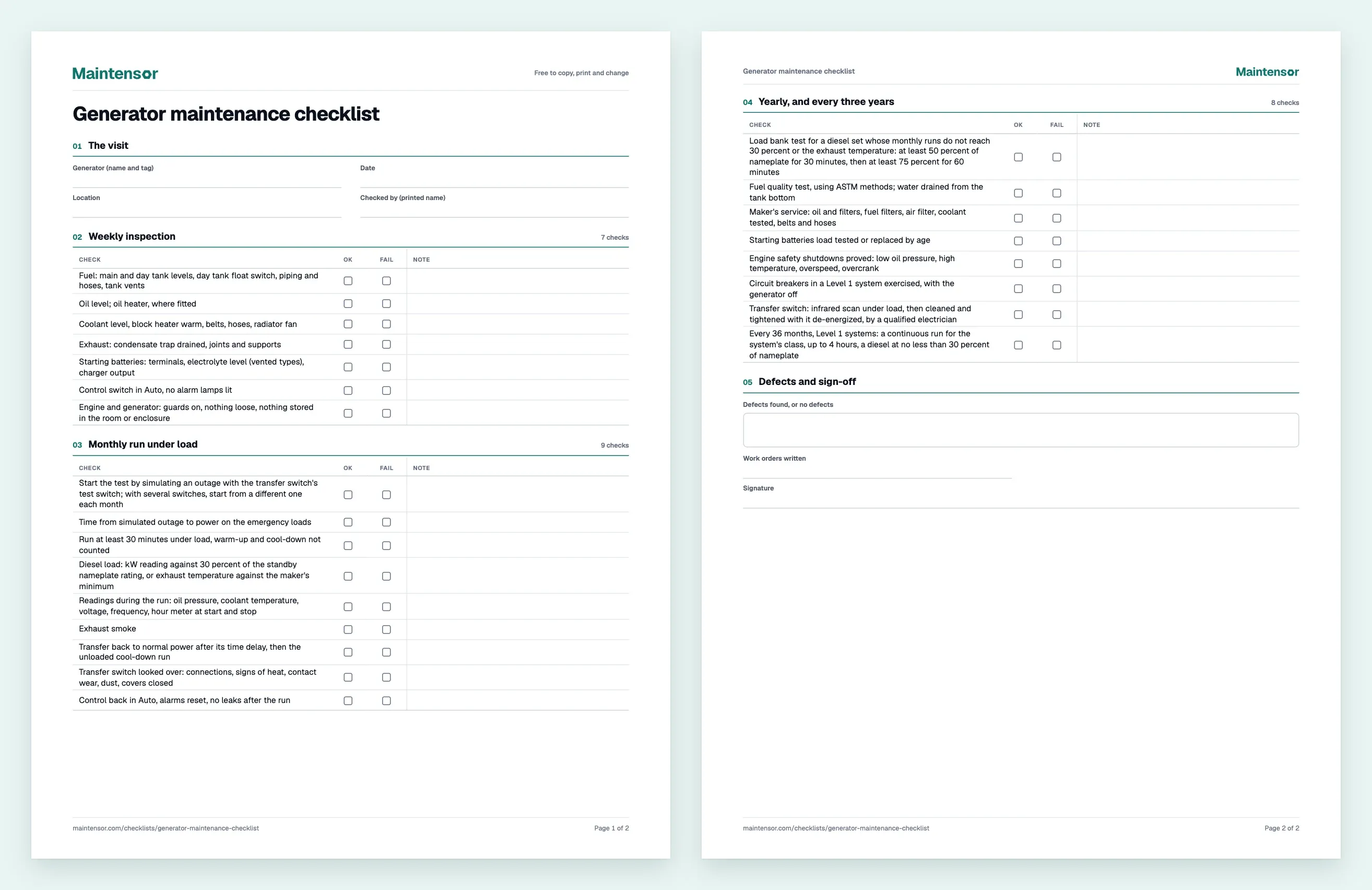
The checks, by visit
One sheet per generator and visit: the weekly inspection, the monthly run under load, or the yearly service. A failed check gets a work order, and the maker’s manual can ask for more than this list.
Weekly inspection7 checks
- Fuel: main and day tank levels, day tank float switch, piping and hoses, tank vents
- Oil level; oil heater, where fitted
- Coolant level, block heater warm, belts, hoses, radiator fan
- Exhaust: condensate trap drained, joints and supports
- Starting batteries: terminals, electrolyte level (vented types), charger output
- Control switch in Auto, no alarm lamps lit
- Engine and generator: guards on, nothing loose, nothing stored in the room or enclosure
Monthly run under load9 checks
- Start the test by simulating an outage with the transfer switch's test switch; with several switches, start from a different one each month
- Time from simulated outage to power on the emergency loads
- Run at least 30 minutes under load, warm-up and cool-down not counted
- Diesel load: kW reading against 30 percent of the standby nameplate rating, or exhaust temperature against the maker's minimum
- Readings during the run: oil pressure, coolant temperature, voltage, frequency, hour meter at start and stop
- Exhaust smoke
- Transfer back to normal power after its time delay, then the unloaded cool-down run
- Transfer switch looked over: connections, signs of heat, contact wear, dust, covers closed
- Control back in Auto, alarms reset, no leaks after the run
Yearly, and every three years8 checks
- Load bank test for a diesel set whose monthly runs do not reach 30 percent or the exhaust temperature: at least 50 percent of nameplate for 30 minutes, then at least 75 percent for 60 minutes
- Fuel quality test, using ASTM methods; water drained from the tank bottom
- Maker's service: oil and filters, fuel filters, air filter, coolant tested, belts and hoses
- Starting batteries load tested or replaced by age
- Engine safety shutdowns proved: low oil pressure, high temperature, overspeed, overcrank
- Circuit breakers in a Level 1 system exercised, with the generator off
- Transfer switch: infrared scan under load, then cleaned and tightened with it de-energized, by a qualified electrician
- Every 36 months, Level 1 systems: a continuous run for the system's class, up to 4 hours, a diesel at no less than 30 percent of nameplate
What counts as a fail, check by checkThe full tables, and the NFPA 110 section behind each check.
“NFPA 110” gives the section in the 2010 edition, the one the 2012 Life Safety Code references; later editions may number some sections differently. “Maker” means the manual decides. “Practice” means common practice.
Weekly inspection
NFPA 110 (8.4.1) requires the emergency power supply to be inspected weekly. The lines follow the list in Minnesota’s Department of Health guidance.
| Check | Fail if | Basis |
|---|---|---|
| Fuel: main and day tank levels, day tank float switch, piping and hoses, tank vents | Below the level your run-time plan needs, any leak, a blocked vent | NFPA 110 (8.4.1); Maker |
| Oil level; oil heater, where fitted | Below the mark, oil under the engine | Maker |
| Coolant level, block heater warm, belts, hoses, radiator fan | Low coolant, a cold block, a cracked hose or belt | Maker |
| Exhaust: condensate trap drained, joints and supports | Soot at a joint, a loose support, water in the trap | Maker |
| Starting batteries: terminals, electrolyte level (vented types), charger output | Corrosion, low electrolyte, a charger fault or no charge | NFPA 110 (8.4.1); Maker |
| Control switch in Auto, no alarm lamps lit | Switch left in Off or Manual, any alarm | Practice |
| Engine and generator: guards on, nothing loose, nothing stored in the room or enclosure | Debris, loose fittings, blocked air louvers | Maker |
Monthly run under load
| Check | Fail if | Basis |
|---|---|---|
| Start the test by simulating an outage with the transfer switch’s test switch; with several switches, start from a different one each month | Generator does not start, or the switch does not transfer | NFPA 110 (8.4.3); rotating is NFPA handbook advice Minnesota quotes |
| Time from simulated outage to power on the emergency loads | Longer than the system’s type: 10 seconds for a Type 10 system, which NFPA 101 expects for emergency lighting | NFPA 110; NFPA 101 |
| Run at least 30 minutes under load, warm-up and cool-down not counted | Shorter than 30 minutes | NFPA 110 (8.4.2) |
| Diesel load: kW reading against 30 percent of the standby nameplate rating, or exhaust temperature against the maker’s minimum | Neither reached: plan the yearly load bank test | NFPA 110 (8.4.2) |
| Readings during the run: oil pressure, coolant temperature, voltage, frequency, hour meter at start and stop | Outside the maker’s range | NFPA 110; Maker |
| Exhaust smoke | Continuous black smoke, which NFPA 110’s annex describes as a sign of wet stacking | NFPA 110 |
| Transfer back to normal power after its time delay, then the unloaded cool-down run | Will not retransfer, or shuts down without at least 5 minutes of unloaded cool-down (small air-cooled sets excepted) | NFPA 110 (6.2.10, 8.4.5, 8.4.6) |
| Transfer switch looked over: connections, signs of heat, contact wear, dust, covers closed | Discolored terminals, heavy pitting, a cover off | NFPA 110 (8.3.5) |
| Control back in Auto, alarms reset, no leaks after the run | Left in Off or Manual | Practice |
Yearly, and every three years
| Check | Fail if | Basis |
|---|---|---|
| Load bank test for a diesel set whose monthly runs do not reach 30 percent or the exhaust temperature: at least 50 percent of nameplate for 30 minutes, then at least 75 percent for 60 minutes | Cannot hold the load, overheats, alarms | NFPA 110 (8.4.2.3) |
| Fuel quality test, using ASTM methods; water drained from the tank bottom | Water, sludge or a failed result | NFPA 110 (8.3.8); Maker |
| Maker’s service: oil and filters, fuel filters, air filter, coolant tested, belts and hoses | Anything past its hours or age in the manual | Maker |
| Starting batteries load tested or replaced by age | Fails the test, or past the maker’s service life | Maker |
| Engine safety shutdowns proved: low oil pressure, high temperature, overspeed, overcrank | A shutdown that does not trip | Maker |
| Circuit breakers in a Level 1 system exercised, with the generator off | A breaker that will not operate | NFPA 110 (8.4.7) |
| Transfer switch: infrared scan under load, then cleaned and tightened with it de-energized, by a qualified electrician | Hot spots, loose connections, worn contacts | Practice |
| Every 36 months, Level 1 systems: a continuous run for the system’s class, up to 4 hours, a diesel at no less than 30 percent of nameplate | Cannot finish the run | NFPA 110 (8.4.9) |
Minnesota’s guidance recommends the yearly infrared scan of transfer switches; infrared thermography explains what the camera finds and what it misses.
A run log, with the arithmetic
Minnesota’s guidance lists what a monthly test record should hold. Here it is as a log, one line per monthly run.
ExampleA 200 kW diesel generator, March to May
Made-up figures.
| Date | Initials | Transfer switch | Transfer time (s) | Hours start | Hours stop | Load (kW) | Oil pressure (psi) | Coolant (°F) | Notes |
|---|---|---|---|---|---|---|---|---|---|
| Mar 4 | KB | ATS-1 | 8 | 412.6 | 413.2 | 46 | 52 | 182 | None |
| Apr 1 | KB | ATS-2 | 9 | 413.2 | 413.8 | 44 | 52 | 181 | Light black smoke |
| May 6 | GT | ATS-1 | 8 | 413.8 | 414.4 | 47 | 51 | 183 | Battery terminal cleaned |
The target. 30 percent of the 200 kW standby rating is 60 kW. Use the standby rating, not the prime rating: NFPA 110’s annex points out that a 100 kW standby set is often rated 80 kW for prime power, which would wrongly lower the target.
The shortfall. This building’s emergency loads draw 44 to 47 kW, so the monthly runs count only if the exhaust reaches the maker’s minimum temperature, and the April smoke says it may not. The yearly load bank test is then at least 100 kW for 30 minutes and 150 kW for 60 minutes.
The hours. Each run is 0.6 hours on the meter, which includes warm-up and cool-down. Twelve of them plus the load bank test come to about 9 hours a year, far inside the 100 hours EPA allows for maintenance and testing under 63.6640(f).
When a real outage counts
A real outage or peak load shaving can stand in for the monthly run if the set runs as the test requires and the data are recorded, as Minnesota’s guidance explains. But EPA’s engine rule, 40 CFR 63.6640(f), does not allow an emergency engine to be used for peak shaving.
Before you start
When a check fails
A generator that will not start, will not transfer or will not carry its load is out of service for the next outage, not just this test. Make it a High priority work order the same day.
If the generator feeds life safety loads such as exit lighting, tell whoever needs to know and line up temporary power as your authority having jurisdiction expects.
NFPA 110 asks that testing and maintenance be overseen by a properly trained person, as Minnesota’s Department of Health guidance sets out. This list is a starting point, not a substitute for training or the maker’s manual, which can ask for more.
Add it to an inspection calendar
Put these checks, and the rest of the building's, on a year plan with the usual minimums for the United States or Canada, then print it or add it to your calendar: open the inspection calendar with emergency generator ticked.
What NFPA 110 requires
NFPA 110, the standard for emergency and standby power systems, applies when another code points to it: the 2012 edition of NFPA 101 does that for generators that power emergency lighting, as Minnesota’s guidance explains. Which edition applies, and to which generator, is for your authority having jurisdiction to say.
In Canada the 30 minutes are not enough: CSA C282, which the National Fire Code calls on (2020, 6.5.1.1), asks for a monthly run of at least 60 minutes at 30% of rated load or more, through every transfer switch, and a full-load test every year, as the Weyburn Fire Department’s summary gives them.
The standard in shortLevels 1 and 2, what NFPA 110 requires, NFPA 99 in health care, and CSA C282 in Canada.
NFPA 110 sorts systems into Level 1, where a failure could cost lives or cause serious injury, and Level 2, for less critical loads. In short, it requires:
- a written schedule of maintenance and testing;
- a weekly inspection and a monthly run under load;
- monthly operation of every transfer switch;
- yearly fuel testing;
- a written record of every inspection, test and repair, ready for the authority having jurisdiction.
Health care facilities under the 2012 edition of NFPA 99 test 12 times a year, 20 to 40 days apart. In Canada, CSA C282 covers emergency generators in buildings where the National Building Code requires emergency power, as your province adopts it.
The National Fire Code of Canada also asks for the fuel to be renewed within 12 months (2020, 6.5.1.5).
This page is information, not a substitute for the standard, and a record of tests does not make a system compliant.
Generator tests in Maintensor: the run log as Number steps
Set the generator up as an asset with its nameplate, and its transfer switches as assets with the generator as their parent asset, so their history sits together. Build three procedures: weekly, monthly and yearly. Attach the load bank contractor’s report and the fuel lab’s results to the yearly work order as files.
- Every reading in the run log becomes a Number step, named with its unit and target because a Number step has no limits of its own: “Load, kW (target 60)”. Each check becomes an Inspection check, and “Control back in Auto” a required one.
- For the monthly run, a repeat of every 4 weeks puts each due date 28 days after the last, which suits a test window like NFPA 99’s. A monthly repeat on a weekday, such as the first Tuesday, works as well.
- A check answered Fail needs the finding and a photo before moving on, then offers a follow-up work order and Mark asset down, so the generator shows as Down until someone sets it back.

What it does not do: oil changes at so many run hours cannot come due from the hour meter. Work comes due by the calendar only, which is time-based maintenance; the hour meter is recorded in a Number step, and someone has to read it.
Each reading also lives only on its own work order, so the log above is built by opening past work orders. For a building with several generators and switches, the facility maintenance software page shows the setup, and the electrical inspection checklist covers the panels the generator feeds.