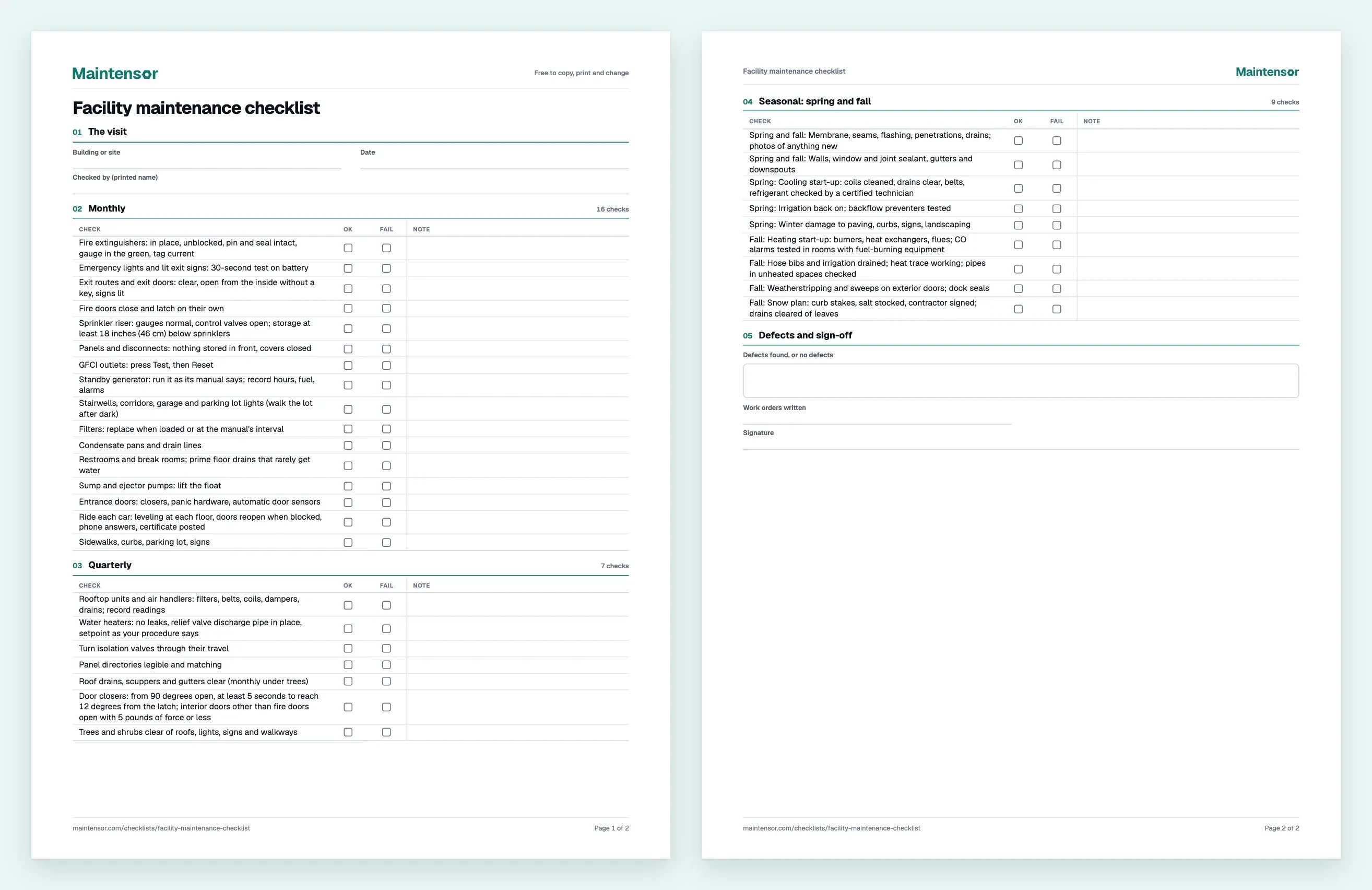
The checks, by visit
One sheet per building and visit, for an office, school, clinic or small commercial building. Anything that fails gets a work order with a priority and a due date. The yearly contractor tests are at the end of the tables below.
Monthly16 checks
- Fire extinguishers: in place, unblocked, pin and seal intact, gauge in the green, tag current
- Emergency lights and lit exit signs: 30-second test on battery
- Exit routes and exit doors: clear, open from the inside without a key, signs lit
- Fire doors close and latch on their own
- Sprinkler riser: gauges normal, control valves open; storage at least 18 inches (46 cm) below sprinklers
- Panels and disconnects: nothing stored in front, covers closed
- GFCI outlets: press Test, then Reset
- Standby generator: run it as its manual says; record hours, fuel, alarms
- Stairwells, corridors, garage and parking lot lights (walk the lot after dark)
- Filters: replace when loaded or at the manual's interval
- Condensate pans and drain lines
- Restrooms and break rooms; prime floor drains that rarely get water
- Sump and ejector pumps: lift the float
- Entrance doors: closers, panic hardware, automatic door sensors
- Ride each car: leveling at each floor, doors reopen when blocked, phone answers, certificate posted
- Sidewalks, curbs, parking lot, signs
Quarterly7 checks
- Rooftop units and air handlers: filters, belts, coils, dampers, drains; record readings
- Water heaters: no leaks, relief valve discharge pipe in place, setpoint as your procedure says
- Turn isolation valves through their travel
- Panel directories legible and matching
- Roof drains, scuppers and gutters clear (monthly under trees)
- Door closers: from 90 degrees open, at least 5 seconds to reach 12 degrees from the latch; interior doors other than fire doors open with 5 pounds of force or less
- Trees and shrubs clear of roofs, lights, signs and walkways
Seasonal: spring and fall9 checks
- Spring and fall: Membrane, seams, flashing, penetrations, drains; photos of anything new
- Spring and fall: Walls, window and joint sealant, gutters and downspouts
- Spring: Cooling start-up: coils cleaned, drains clear, belts, refrigerant checked by a certified technician
- Spring: Irrigation back on; backflow preventers tested
- Spring: Winter damage to paving, curbs, signs, landscaping
- Fall: Heating start-up: burners, heat exchangers, flues; CO alarms tested in rooms with fuel-burning equipment
- Fall: Hose bibs and irrigation drained; heat trace working; pipes in unheated spaces checked
- Fall: Weatherstripping and sweeps on exterior doors; dock seals
- Fall: Snow plan: curb stakes, salt stocked, contractor signed; drains cleared of leaves
What counts as a fail, check by checkThe full tables by system, the yearly tests, and the rule behind each interval.
“Rule” names the regulation or code behind an interval, linked where the text is public. Codes such as NFPA 101 apply where your jurisdiction has adopted them, in the edition it adopted, so ask your fire marshal. “Maker” means the manufacturer’s manual decides. “Practice” means common practice, a starting point to adjust.
Monthly
| System | Check | Fail if | Basis |
|---|---|---|---|
| Life safety | Fire extinguishers: in place, unblocked, pin and seal intact, gauge in the green, tag current | Missing, blocked, discharged, damaged or out of date | Rule: OSHA 1910.157(e)(2); the fire extinguisher inspection checklist has the detail |
| Life safety | Emergency lights and lit exit signs: 30-second test on battery | Any lamp out, or dims before 30 seconds | Rule: NFPA 101, section 7.9.3 |
| Life safety | Exit routes and exit doors: clear, open from the inside without a key, signs lit | Anything stored in an exit route; an exit door locked from the inside | Rule: OSHA 1910.36(d) for the doors; 1910.37(a)(3) and (b) for the routes and signs |
| Life safety | Fire doors close and latch on their own | Wedged open, or does not latch | Practice; yearly test below |
| Life safety | Sprinkler riser: gauges normal, control valves open; storage at least 18 inches (46 cm) below sprinklers | Valve shut, gauge off, storage too high | Rule: NFPA 25 and your fire code; OSHA 1910.159(c)(10) sets the 18 inches for a sprinkler system installed to meet an OSHA standard |
| Electrical | Panels and disconnects: nothing stored in front, covers closed | Anything in the working space | Rule: OSHA 1910.303(g)(1) |
| Electrical | GFCI outlets: press Test, then Reset | Power does not cut, or will not reset | Maker |
| Electrical | Standby generator: run it as its manual says; record hours, fuel, alarms | Fails to start, carry load or transfer | Rule for emergency systems: NFPA 110, section 8.4 (2010 edition); otherwise Maker |
| Lighting | Stairwells, corridors, garage and parking lot lights (walk the lot after dark) | Any light out on an exit route or a stair | Practice |
| HVAC | Filters: replace when loaded or at the manual’s interval | Loaded, bypassing or missing | Maker |
| HVAC | Condensate pans and drain lines | Standing water, overflow, slime | Practice |
| Plumbing | Restrooms and break rooms; prime floor drains that rarely get water | Any drip, running toilet or sewer smell | Practice |
| Plumbing | Sump and ejector pumps: lift the float | Pump does not start or alarm does not sound | Practice |
| Doors and hardware | Entrance doors: closers, panic hardware, automatic door sensors | Door slams, does not latch, or will not open from inside in one motion | Practice |
| Elevators | Ride each car: leveling at each floor, doors reopen when blocked, phone answers, certificate posted | A step at the sill, a door that does not reopen, a dead phone: call the elevator contractor | Practice |
| Grounds | Sidewalks, curbs, parking lot, signs | A change in level over 1/4 inch (6 mm) that is not beveled, or any over 1/2 inch (13 mm) | Rule: 2010 ADA Standards 303; the parking lot maintenance checklist has the rest |
Quarterly
| System | Check | Fail if | Basis |
|---|---|---|---|
| HVAC | Rooftop units and air handlers: filters, belts, coils, dampers, drains; record readings | Cracked belt, dirty coil, stuck damper | Maker; the HVAC maintenance checklist has the full service |
| Plumbing | Water heaters: no leaks, relief valve discharge pipe in place, setpoint as your procedure says | Leak, rust at fittings, missing discharge pipe | Maker |
| Plumbing | Turn isolation valves through their travel | Valve seized or leaking at the stem | Practice |
| Electrical | Panel directories legible and matching | Unlabeled or wrong circuits | Practice |
| Roof and envelope | Roof drains, scuppers and gutters clear (monthly under trees) | Blocked drain, ponding water | Practice |
| Doors and hardware | Door closers: from 90 degrees open, at least 5 seconds to reach 12 degrees from the latch; interior doors other than fire doors open with 5 pounds of force or less | Closes faster, or needs more force | Rule: 2010 ADA Standards 404.2.8.1 and 404.2.9 |
| Grounds | Trees and shrubs clear of roofs, lights, signs and walkways | Branches on the roof or blocking a light | Practice |
Seasonal: spring and fall
| Season | System | Check | Fail if | Basis |
|---|---|---|---|---|
| Spring and fall | Roof | Membrane, seams, flashing, penetrations, drains; photos of anything new | Blisters, open seams, punctures, ponding | Practice: the roofing contractors’ association recommends spring and fall, and after severe weather; the roof inspection checklist has every check |
| Spring and fall | Envelope | Walls, window and joint sealant, gutters and downspouts | Cracked sealant, open joints, gutter pulling away | Practice |
| Spring | HVAC | Cooling start-up: coils cleaned, drains clear, belts, refrigerant checked by a certified technician | Low charge, iced coil, failed contactor | Maker; EPA Section 608 for refrigerant |
| Spring | Plumbing | Irrigation back on; backflow preventers tested | Failed test, broken heads | Rule: your water utility |
| Spring | Grounds | Winter damage to paving, curbs, signs, landscaping | Potholes, broken curbs | Practice |
| Fall | HVAC | Heating start-up: burners, heat exchangers, flues; CO alarms tested in rooms with fuel-burning equipment | Cracked exchanger, blocked flue or dead CO alarm: shut it down | Maker |
| Fall | Plumbing | Hose bibs and irrigation drained; heat trace working; pipes in unheated spaces checked | Heat trace dead, pipe exposed to cold | Practice |
| Fall | Envelope | Weatherstripping and sweeps on exterior doors; dock seals | Daylight around a closed door | Practice |
| Fall | Grounds | Snow plan: curb stakes, salt stocked, contractor signed; drains cleared of leaves | No contract by the first forecast | Practice |
Yearly
| System | Check | Who | Basis |
|---|---|---|---|
| Life safety | Fire extinguisher maintenance, date recorded | Contractor or trained staff | Rule: OSHA 1910.157(e)(3); NFPA 10 |
| Life safety | Emergency lights: 90-minute battery test | Crew | Rule: NFPA 101, section 7.9.3 |
| Life safety | Fire alarm system inspected and tested | Contractor | Rule: NFPA 72 and your local code |
| Life safety | Sprinkler system inspections and tests, including the main drain test | Contractor | Rule: NFPA 25; OSHA 1910.159(c)(2) also asks for a yearly main drain test on systems installed to meet an OSHA standard |
| Life safety | Fire door assemblies inspected and tested, signed record | Qualified person | Rule: NFPA 80; see the fire door inspection checklist |
| Elevators | Periodic inspection and tests; certificate posted | Inspector and elevator contractor | Rule: your state, province or city; ASME A17.1 |
| HVAC | Boiler inspection and certificate | Commissioned inspector, where required | Rule: your state or province |
| Plumbing | Water heaters flushed; relief valves tested | Crew | Maker |
| Electrical | Infrared scan of main panels and switchgear under load | Qualified electrician | Practice; NFPA 70B covers electrical maintenance programs |
| Electrical | Generator full service | Contractor | Maker; NFPA 110 for emergency systems |
| Roof | Roofer’s inspection, if the warranty asks for one | Roofer | Warranty terms |
| Water | Review the Legionella water management program, where the building has one | Owner and crew | CDC toolkit, based on ASHRAE 188 |
Before you start
When a check fails
If it is unsafe, take it out of service the same day: tag the extinguisher, close the stair, shut the unit down. Then write a work order with a priority and a due date. A failed check that does not become a job is just a note in a drawer.
This list is a reminder of what is due, not a substitute for training, a qualified person or the equipment maker’s manual. Cross out what your building does not have, add the tasks from your equipment manuals, and split it by building.
The facility maintenance guide shows how to spread it across a year for a small team. For an apartment property, the apartment maintenance checklist adds the unit visits and the alarm rules.
What the rules say
In a workplace, OSHA sets the monthly extinguisher check and asks for clear exits and clear working space in front of electrical equipment. The NFPA codes apply as your state, province or city adopts them, in the edition it adopted, and the ADA asks for accessible features to be kept in working order.
In Canada, your province’s fire code and its safety authorities set the rules. None of this is legal advice.
The OSHA, fire code and ADA rules behind the listExtinguishers, exits and electrical rooms, the NFPA codes and their sections, accessibility, elevators and boilers.
- Extinguishers. Where an employer provides portable extinguishers for employees, OSHA 1910.157(e)(2) requires a monthly visual inspection and (e)(3) a yearly maintenance check, with its date recorded.
- Exits and electrical rooms. OSHA 1910.36(d) requires that employees can open an exit route door from the inside at all times without keys, tools or special knowledge, and 1910.37 requires exit routes to be unobstructed and lit, with exits marked. OSHA 1910.303(g)(1) requires clear working space in front of electrical equipment (at least 3 feet, or 0.9 m, deep for equipment up to 150 volts to ground) and says it “may not be used for storage.”
- Fire codes. NFPA 101 (emergency lighting tests), NFPA 72 (fire alarms), NFPA 25 (sprinklers), NFPA 80 (fire doors) and NFPA 110 (emergency generators) apply as your state, province or city adopts and enforces them, in the edition it adopted. For one worked list of yearly items with their sections, South Dakota’s health department gives NFPA 10 (2010 edition) 7.3.1.1.1 for extinguisher maintenance, NFPA 25 (2011) table 5.1.1.2 for the main drain test, NFPA 72 (2010) 14.4.2.2 for alarm device testing and NFPA 101 (2012) 7.9.3.1.1 for the 90-minute emergency light test. NFPA 80 sets the yearly fire door inspection in section 5.2.1 of its 2007 and 2010 editions, and NFPA 110 (2010) section 8.4 the monthly generator exercise, as Minnesota’s health department sets out.
- Accessibility. For businesses open to the public, 28 CFR 36.211 requires accessible features to be kept in working order. That is why the door closer and walkway checks are here.
- Elevators and boilers. Your state, province or city sets who inspects them and how often.
Facility checks in Maintensor: one procedure per routine
There is no ready-made checklist library in Maintensor, so build this list once as procedures, one per routine: a monthly building walk, a quarterly rooftop unit service, a spring roof and exterior round, a fall heating start-up.
- The steps. A Heading step for each system and an Inspection check (Pass, Flag or Fail) for each line. A Number step for readings such as generator hours has no units or limits, so write the limit into the step’s name. Add a Photo step for the roof and a Signature step where you want a sign-off.
- The repeats. Attach each procedure to a work order on the building or the asset, set to repeat monthly on a weekday such as the first Monday, every 3 months, every 6 months for the roof, or yearly for the heating start-up. When one is completed, the next is created with a blank checklist.
- Fails and contractor tests. A Fail needs a note and a photo before moving on, then offers a follow-up work order and, on an asset, Mark asset down. A contractor test needs no checklist: attach the contractor’s report as a PDF and make a follow-up work order for each deficiency.

Only Admins and Full users answer checklists, so whoever does the walk needs a user seat. The Free plan holds 3 procedures and 5 recurring work orders, enough to start with one building’s monthly walk, quarterly service and one seasonal round; more is on Pro. The setup for a whole building is on the facility maintenance software page.