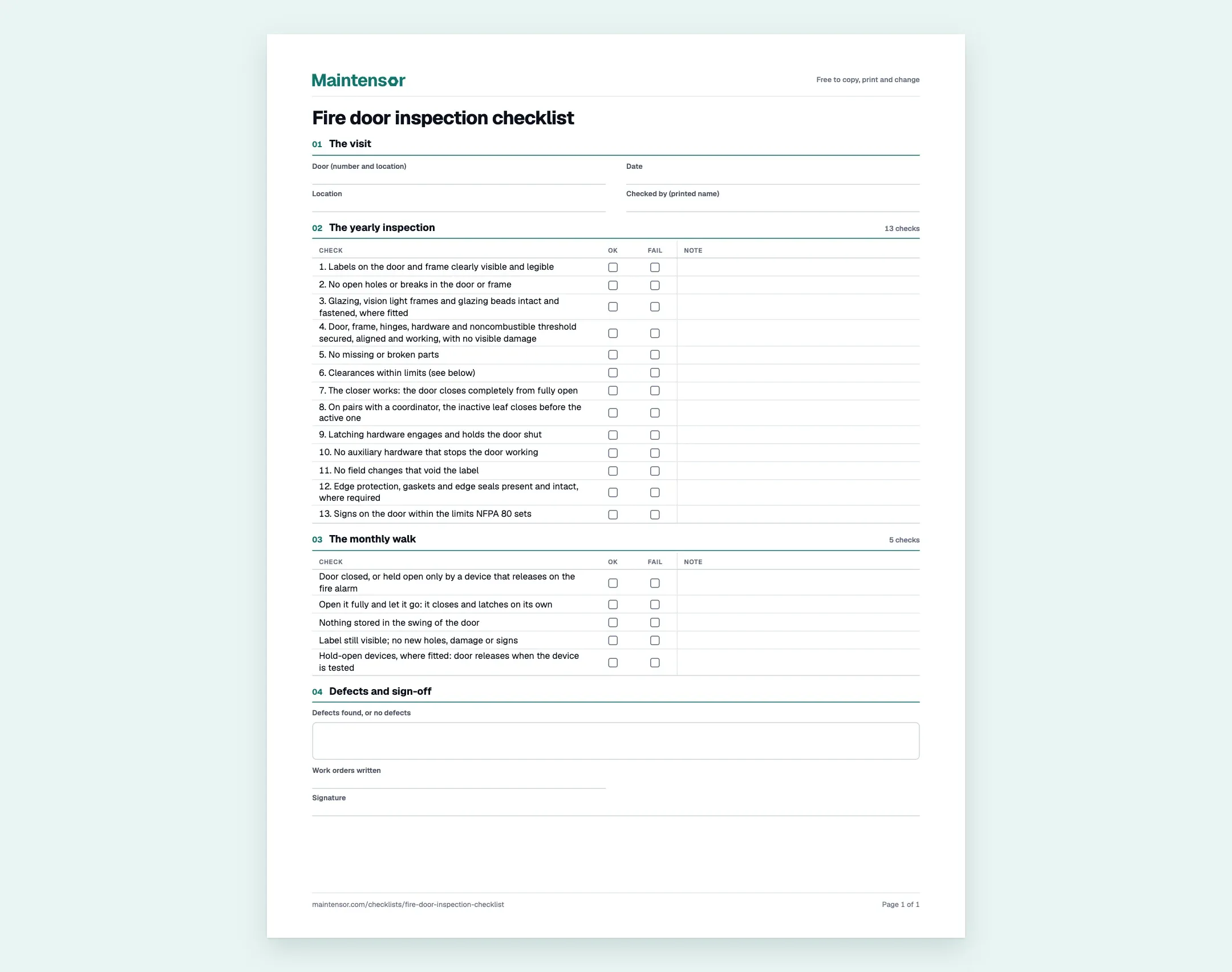
The checks, yearly and monthly
One sheet per door, checked from both sides. A qualified person does the yearly inspection; anyone on your crew who knows what a fire door is supposed to do can do the monthly walk. A door that fails is fixed the same day or gets a work order, and repairs keep to the door’s listing.
The yearly inspection13 checks
- 1. Labels on the door and frame clearly visible and legible
- 2. No open holes or breaks in the door or frame
- 3. Glazing, vision light frames and glazing beads intact and fastened, where fitted
- 4. Door, frame, hinges, hardware and noncombustible threshold secured, aligned and working, with no visible damage
- 5. No missing or broken parts
- 6. Clearances within limits (see below)
- 7. The closer works: the door closes completely from fully open
- 8. On pairs with a coordinator, the inactive leaf closes before the active one
- 9. Latching hardware engages and holds the door shut
- 10. No auxiliary hardware that stops the door working
- 11. No field changes that void the label
- 12. Edge protection, gaskets and edge seals present and intact, where required
- 13. Signs on the door within the limits NFPA 80 sets
The monthly walk5 checks
- Door closed, or held open only by a device that releases on the fire alarm
- Open it fully and let it go: it closes and latches on its own
- Nothing stored in the swing of the door
- Label still visible; no new holes, damage or signs
- Hold-open devices, where fitted: door releases when the device is tested
What counts as a fail, check by checkThe full tables, and where the 13 yearly items come from.
The yearly items are the ones NFPA 80 lists for swinging doors, in its 2013 and later editions, in plain words. Its 2007 text listed eleven of them; the 2013 edition added the first and last, as a Fire and Smoke Containment Association presentation by a Door and Hardware Institute educator shows.
The yearly inspection
| Check | Fail if |
|---|---|
| 1. Labels on the door and frame clearly visible and legible | Painted over, removed, or worn so the rating cannot be read |
| 2. No open holes or breaks in the door or frame | Holes left from removed hardware, a dent that has split the skin, a broken frame |
| 3. Glazing, vision light frames and glazing beads intact and fastened, where fitted | Cracked glass, loose beads, ordinary glass put in as a replacement |
| 4. Door, frame, hinges, hardware and noncombustible threshold secured, aligned and working, with no visible damage | Loose hinge screws, a sagging door, a frame pulled from the wall |
| 5. No missing or broken parts | Missing screws, strike plate, closer arm or cover |
| 6. Clearances within limits (see below) | Any gap over the limit |
| 7. The closer works: the door closes completely from fully open | Stops short, slams, or needs a push |
| 8. On pairs with a coordinator, the inactive leaf closes before the active one | Leaves close out of order and do not latch |
| 9. Latching hardware engages and holds the door shut | The door can be pulled open without working the latch |
| 10. No auxiliary hardware that stops the door working | Kick-down holders, hooks, surface bolts, added locks that are not part of the listing |
| 11. No field changes that void the label | Cut-outs, welding, a bigger hole for an access reader, trimming beyond what the listing allows |
| 12. Edge protection, gaskets and edge seals present and intact, where required | Torn or missing gasket or seal |
| 13. Signs on the door within the limits NFPA 80 sets | Signs fastened with screws, or covering too much of the face |
The monthly walk
In the US, common practice between yearly inspections, not a rule. In Canada, where a province follows the National Fire Code, it is a rule: see below. It takes a minute a door.
| Check | Fail if |
|---|---|
| Door closed, or held open only by a device that releases on the fire alarm | Wedged, tied, propped with a chair or held on a kick-down holder |
| Open it fully and let it go: it closes and latches on its own | Stops short or does not latch |
| Nothing stored in the swing of the door | Carts, boxes or furniture in the way |
| Label still visible; no new holes, damage or signs | Paint on the label, a new hole, a taped-up notice that hides it |
| Hold-open devices, where fitted: door releases when the device is tested | Does not release; test it with whoever services your fire alarm |
The gaps NFPA 80 allows
Measure with the door closed. These are the limits in NFPA 80’s 2007 text for swinging doors; the door’s listing and later editions can add to them.
ExampleA fire door log
One line per door, per inspection. These lines are made up.
| Door | Location | Rating on label | Label legible | Gap under door | Closes and latches | Deficiency | Fixed |
|---|---|---|---|---|---|---|---|
| FD-201 | Stair A, level 2 | 90 min | Yes | 5/8 in. | Yes | None | |
| FD-202 | Stair A, level 3 | 90 min | Painted over | 1/2 in. | Yes | Label painted | Ask the lab about a field label |
| FD-214 | Corridor, east wing | 20 min | Yes | 7/8 in. | No | Gap over 3/4 in., latch misses strike | Strike adjusted; door bottom on order |
FD-202. The label is painted over, so the fix is to ask the lab about a field label.
FD-214. The gap under the door is over 3/4 inch and the latch misses the strike. The strike was adjusted, and a door bottom is on order.
What not to do
The most common deficiencies are things people did to the door, not things that wore out. The Fire and Smoke Containment Association presentation lists painted or missing labels, wide gaps, kick-down holders and wedges, missing fasteners and holes left by removed hardware among the top ones.
Before you start
When a door fails
NFPA 80 calls for repairs to be made without delay. A door that will not close or latch is no longer a fire door, so fix it the same day if you can; if you cannot, make a High priority work order and ask your fire marshal whether the opening needs a fire watch or other measure meanwhile.
Repairs have to keep to the door’s listing: replacement parts must be suitable for fire doors, and some fixes need the door maker or the lab whose label is on it.
This list is a starting point. It does not replace NFPA 80, the door and hardware makers’ instructions, or a qualified inspector, and your fire code decides which edition applies.
Add it to an inspection calendar
Put these checks, and the rest of the building's, on a year plan with the usual minimums for the United States or Canada, then print it or add it to your calendar: open the inspection calendar with fire doors ticked.
Who requires it
NFPA 80, the standard for fire doors and other opening protectives, sets the yearly inspection and test. It applies through the fire and building codes your state, province or city adopts, in the edition they adopt.
What the rules sayThe section by edition, health care, the record to keep, and Canada.
- The section. The yearly inspection and test is section 5.2.1 in the 2007 and 2010 editions of NFPA 80.
- Health care. CMS’s memo S&C 17-38-LSC requires every fire door assembly to be inspected and tested each year in line with the 2010 edition.
- The record. It is signed by the inspector and kept for the authority having jurisdiction. Since 2013, NFPA 80 has asked for the records to be kept for at least three years.
- NFPA’s form. NFPA’s own inspection form for the 2019 edition, posted by South Carolina’s State Fire Marshal, asks for the date, the facility, the inspector’s name, company and signature, each door’s location or number, and the deficiencies found.
- Canada. Your province’s fire code sets the rules for doors in fire separations.
- The National Fire Code of Canada. Its 2020 edition, which provinces adopt or follow, asks for doors in fire separations to be operated at least once a month (2.2.2.4(3)), and for self-closing doors without hold-open devices to be checked shut every 24 hours (2.2.2.4(2)). It sets no yearly inspection like NFPA 80’s; your province may.
This is information, and a signed record does not make a door compliant; only a door that closes and latches does that.
Fire door inspections in Maintensor: one asset, up to 100 doors
Make one asset for the fire doors and give it the doors as units, up to 100 on one asset. Units share the asset’s location, so name each by its number and place (“FD-201 Stair A L2”). One yearly job then creates a work order per door, with the checklist, and each door keeps its own history and status.
- The 13 items as one procedure. Inspection checks for the items, Number steps for the gaps (“Gap under door, inches, max 0.75”), a Photo step for the label, then a Text step for the inspector’s name and a Signature step. The monthly walk is a second procedure on a monthly repeat.
- A door that fails gets a note and a photo before the inspector can move on, then a follow-up work order, and Mark asset down for that one door. A doors-by-number list ticked in twenty minutes is pencil whipping, and a photo per failed door is the cheapest cure.
- An outside inspector. Attach their report to the work order, and turn each deficiency into a follow-up work order so it does not wait a year.

On Pro and Max, each door can carry its own QR label, printed from the Assets list; scanning it with a phone’s camera opens that door’s record, with its open work. What it does not do: the Signature step stores the drawn signature and the time, not which user signed, so the name step matters when a contractor inspects. Only Admins and Full users answer checklists, so an in-house inspector needs a seat.
Each work order’s history shows who completed it and when; it certifies nothing. The facility maintenance software page shows the rest of the building’s setup.