What the log holds
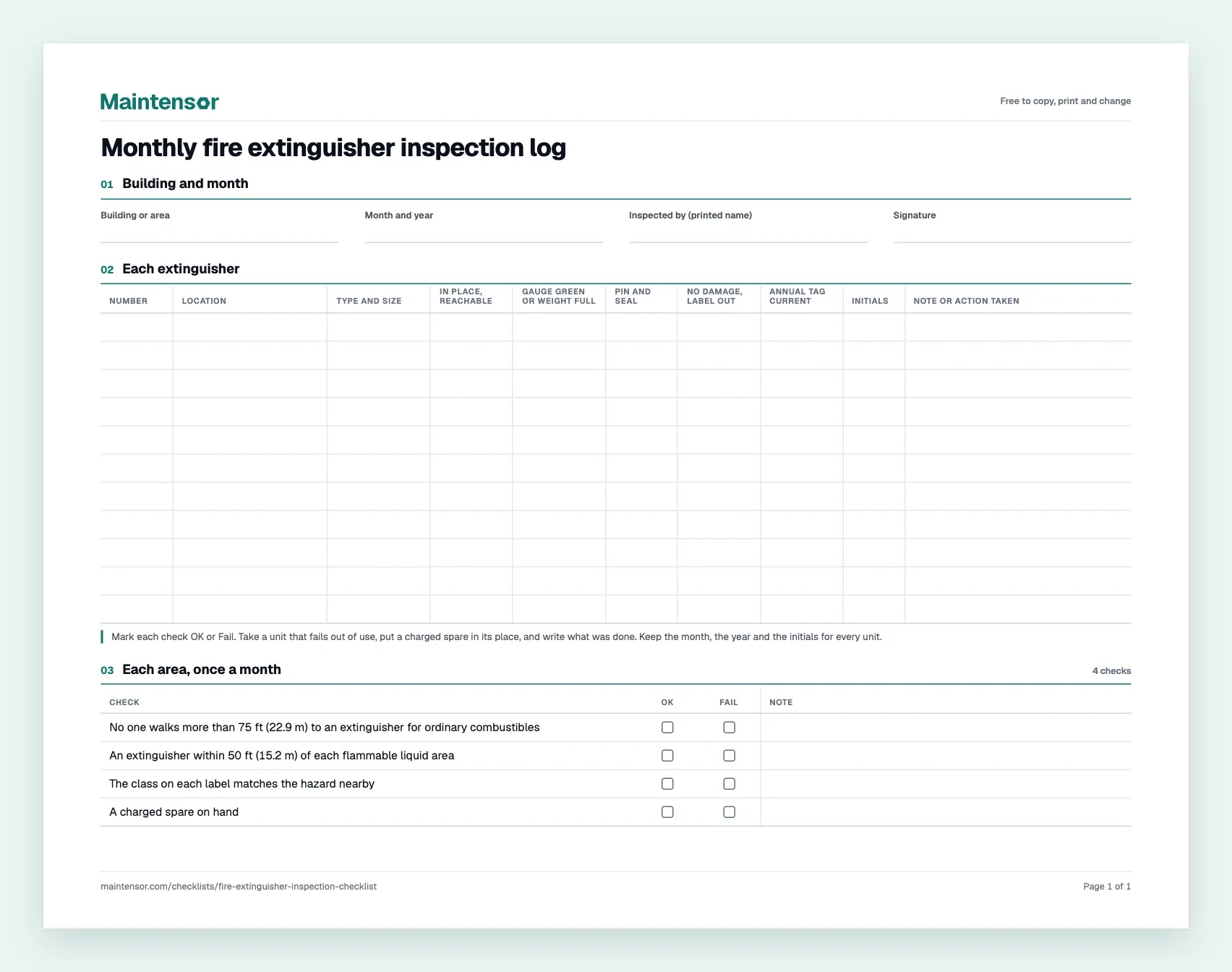
One landscape page for a building or an area, each month: who inspected and when, a line for each extinguisher with OK or Fail for each check, and four checks made once for the whole area. The Excel file has forty lines and OK or Fail lists.
NFPA 10 lets the monthly record live on a tag on the extinguisher, on a checklist kept on file, or in an electronic record (7.2.4.1.1). A log by area makes the month’s fails easy to see.
ExampleOctober in a warehouse: four extinguishers
A made-up warehouse, with Kevin Brooks walking.
| Number | Location | Type and size | In place, reachable | Gauge green or weight full | Pin and seal | No damage, label out | Annual tag current | Initials | Note or action taken |
|---|---|---|---|---|---|---|---|---|---|
| FE-01 | Dock 1, by the door | ABC, 10 lb | OK | OK | OK | OK | OK | KB | |
| FE-02 | Dock 4 | ABC, 10 lb | OK | OK | Fail | OK | OK | KB | Seal missing. Swapped with spare; sent for service |
| FE-03 | Battery charging | ABC, 20 lb | Fail | OK | OK | OK | OK | KB | Blocked. Pallet moved during the walk |
| FE-07 | Maintenance shop | CO2, 10 lb | OK | OK | OK | OK | OK | KB | No gauge: weighed. Weight matches label |
FE-02. A missing seal means it may have been used, so a charged spare went up before the unit went for service.
FE-03. A pallet blocked it and was moved during the walk; the Fail stays on the log with what was done. All four annual tags come due in March.
The checks for each area
Once a month, the walker also checks the area as a whole: how far anyone walks to an extinguisher, whether the types match the hazards, and the spare.
Each area, once a month4 checks
- No one walks more than 75 ft (22.9 m) to an extinguisher for ordinary combustibles
- An extinguisher within 50 ft (15.2 m) of each flammable liquid area
- The class on each label matches the hazard nearby
- A charged spare on hand
What counts as a fail, check by checkThe full tables, with the NFPA 10 or OSHA section behind each check.
The NFPA 10 section numbers are from the 2013 edition, as NFPA’s own extract of it lists them; later editions renumber some.
Monthly inspection, each extinguisher
| Check | Fail if | Source |
|---|---|---|
| In its place | Missing, moved, or not at its marked spot | NFPA 10 7.2.2(1); OSHA 1910.157(c)(4) |
| Visible and reachable | Blocked by stock, carts or pallets; hidden behind a door or post with no sign | NFPA 10 7.2.2(2); OSHA 1910.157(c)(1) |
| Pressure gauge | Needle outside the green (operable) band | NFPA 10 7.2.2(3) |
| Full | Light when you lift it, or below the weight on its label when weighed (units with no gauge, such as carbon dioxide) | NFPA 10 7.2.2(4) |
| Pin and tamper seal | Pin missing or seal broken: it may have been used | NFPA 10 7.2.2.2(2); practice everywhere |
| Damage | Dents, rust, leaks, a cracked hose, a clogged nozzle | NFPA 10 7.2.2.2(3) |
| Label | Operating instructions worn off or facing the wall | NFPA 10 7.2.2.2(1) |
| Wheeled units | Tires, wheels, carriage, hose or nozzle damaged | NFPA 10 7.2.2(5) |
| Push-to-test indicator | On a non-rechargeable unit, the indicator does not show pressure | NFPA 10 7.2.2(6) |
| Mounting | Bracket loose, or the unit standing where it can be kicked over | OSHA 1910.157(c)(1) |
| Service tag | Last annual maintenance more than 12 months ago | OSHA 1910.157(e)(3) |
| Record | Month, year and initials not recorded | NFPA 10 7.2.4.1.2 |
NFPA 10 (2013) asks for the label, seal and damage checks where extinguishers face damage, corrosion, heat or a history of fires. They take seconds, so most crews do them on every extinguisher, every month.
Once a month for each area
| Check | Fail if | Source |
|---|---|---|
| Distance, ordinary combustibles | Anyone would walk more than 75 ft (22.9 m) to reach an extinguisher for Class A fires | OSHA 1910.157(d)(2) |
| Distance, flammable liquids | More than 50 ft (15.2 m) from a Class B hazard area to an extinguisher | OSHA 1910.157(d)(4) |
| Right type | The class on the label does not match the hazard nearby | OSHA 1910.157(d)(1) |
| Spare | No charged spare on hand to swap for a failed unit | Practice |
Extinguishers are one line of the monthly safety inspection checklist; fire doors have their own fire door inspection checklist.
The yearly service and the shell tests
The service company marks the test on the extinguisher; your job is to know which units come due this year.
The yearly service, the 6-year service and the test intervalsWho may service them, the records to keep, and OSHA's Table L-1.
Every year, each extinguisher gets a maintenance check. Stored-pressure units do not need an internal examination at this check. The employer records the date and keeps the record for one year after the last entry or for the life of the shell, whichever is less (1910.157(e)(3)).
Who does it. A trained person with the maker’s service manual, the right tools and the maker’s parts (NFPA 10 7.1.2.2). NFPA’s notes list factory training, certification by an organization your authority accepts, or a state or local license as ways a technician qualifies, and your authority may require one of them.
The preventive maintenance checklist lists this yearly service beside the other fire and life safety tests.
Every 6 years, stored-pressure dry chemical extinguishers that need a 12-year hydrostatic test are emptied and given the applicable maintenance. Non-refillable disposable units are exempt, and the 6-year count restarts after a recharge or a hydrostatic test (1910.157(e)(4)).
The hydrostatic test. The shell is tested under water pressure by a trained person with the right equipment (1910.157(f)(1)), after an internal and external examination ((f)(3)). OSHA’s Table L-1 sets the intervals:
| Extinguisher type | Test every |
|---|---|
| Stored-pressure water or antifreeze, cartridge-operated water, wetting agent | 5 years |
| Foam or soda acid with a stainless steel shell; AFFF; loaded stream | 5 years |
| Dry chemical with a stainless steel shell | 5 years |
| Carbon dioxide | 5 years |
| Dry chemical, stored pressure, mild steel, brazed brass or aluminum shell | 12 years |
| Dry chemical, cartridge or cylinder operated, mild steel shell | 12 years |
| Halon 1211 and Halon 1301 | 12 years |
| Dry powder, cartridge or cylinder operated, mild steel shell | 12 years |
A shell that shows new corrosion or damage is tested again before its date, unless the damage is one of the kinds in (f)(2), such as pitting or a burn in a fire, that rule out a test and take the unit out of service ((f)(4), (f)(14)).
The test record gives the date, the tester’s signature and the serial number, and is kept until the next test or until the unit leaves service ((f)(16)).
Before you start
When a check fails
Take the extinguisher off its hook, put a charged spare of the same type in its place, and write a work order for the service company. An extinguisher missing from its spot with no spare is a fail you fix before you walk on.
OSHA requires “alternate equivalent protection” while an extinguisher is away for maintenance or recharging (1910.157(e)(5)), and NFPA 10 calls for immediate corrective action.
This list is a starting point to adapt with the extinguisher maker’s manual, the edition of NFPA 10 your fire code adopts, and your fire inspector. It is information, not a substitute for training or for the service company.
Add it to an inspection calendar
Put these checks, and the rest of the building's, on a year plan with the usual minimums for the United States or Canada, then print it or add it to your calendar: open the inspection calendar with fire extinguishers ticked.
In Canada
Each province and territory adopts its own fire code. British Columbia’s 2018 code, for one, required portable extinguishers to be inspected, tested and maintained to NFPA 10 (BC Fire Code 2018, Division B, 6.2.1.1); a 2024 edition replaced it in March 2024, so read the current text. Check which code and which NFPA 10 edition apply where you are.
Monthly extinguisher rounds in Maintensor
Most building teams walk extinguishers by floor or area, and facility maintenance software can carry the same round. In Maintensor, build one procedure per area and attach it to a work order that repeats monthly; when it is completed, the next one is created on its schedule with the checklist blank.
- The steps. A Heading for each extinguisher (FE-01, Dock 1), an Inspection check for “in place, visible, reachable”, another for “gauge in the green, pin and seal on, no damage”, and a Photo step of the gauge.
- On a date, not a weekday. Choose “On a date” rather than “On a weekday”: the first Monday of one month to the first Monday of the next can be 35 days, past NFPA 10’s 31. A made-up count: 14 extinguishers at about 2 minutes each is a half-hour walk, so give the work order a 30-minute estimate.
- A Fail on any check asks for a note and a photo before the next step, and offers a follow-up work order for the service company. The yearly service becomes a work order repeating yearly, with a File step for the service company’s report.

What it does not do: there is no ready-made checklist library, so you type it once from this page. An extinguisher here is a heading in its area’s checklist, not a record, so it has no QR label of its own (labels, on Pro and Max, are for assets, parts and locations), and the app prints no inspection tags. Only Admins and Full users answer checklists, so whoever walks needs a user seat.
NFPA 10 allows an electronic record, but ask your fire inspector whether one kept in an app is accepted where you are. Maintensor records what was checked; it certifies nothing.