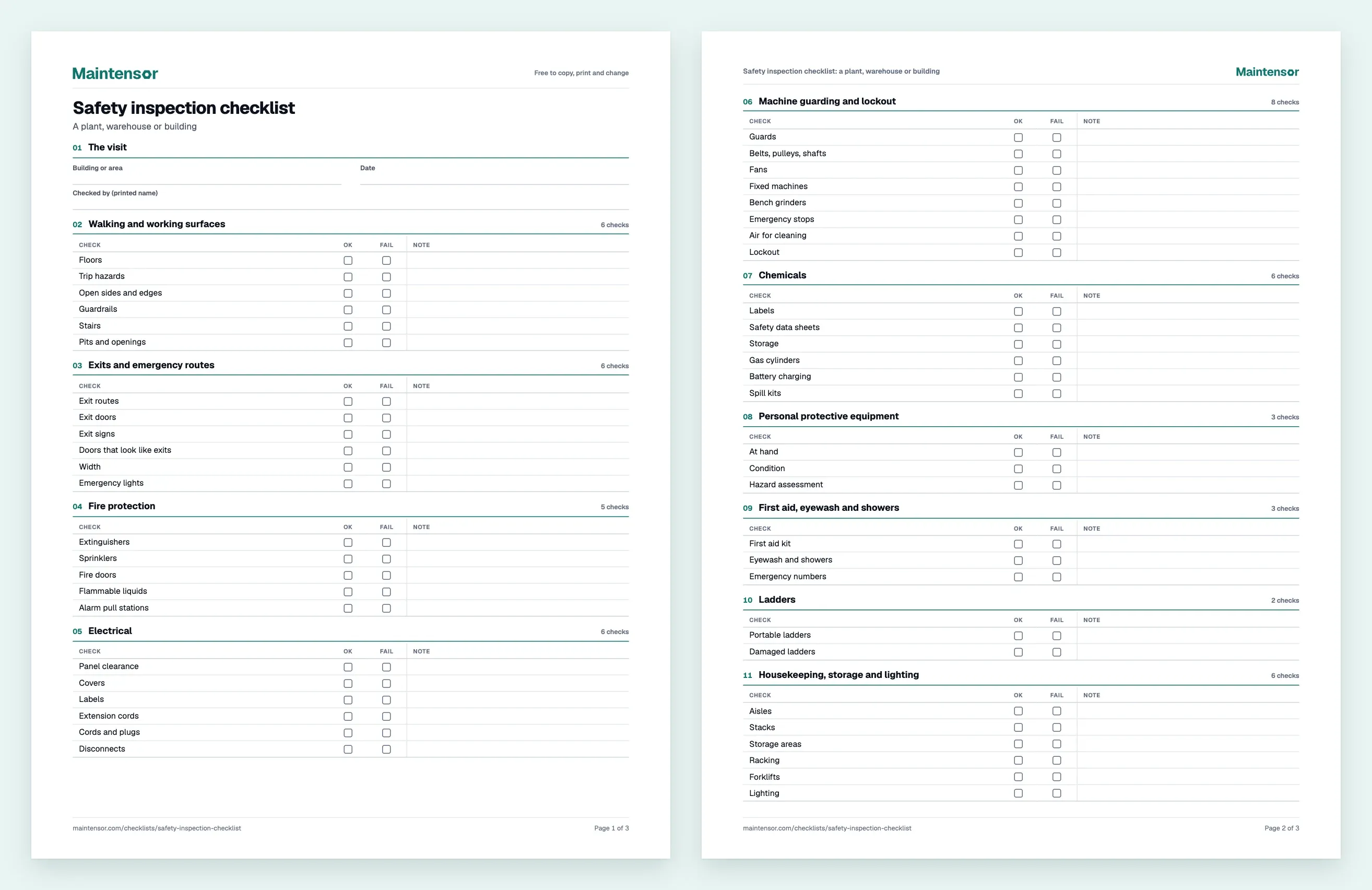
The checks, area by area
One sheet per walk, through ten areas. Every fail becomes a fix on the spot or a work order. It is a starting point, to cut and add to for your site with your own rules, your insurer and the equipment makers’ manuals.
Walking and working surfaces6 checks
- Floors
- Trip hazards
- Open sides and edges
- Guardrails
- Stairs
- Pits and openings
Exits and emergency routes6 checks
- Exit routes
- Exit doors
- Exit signs
- Doors that look like exits
- Width
- Emergency lights
Fire protection5 checks
- Extinguishers
- Sprinklers
- Fire doors
- Flammable liquids
- Alarm pull stations
Electrical6 checks
- Panel clearance
- Covers
- Labels
- Extension cords
- Cords and plugs
- Disconnects
Machine guarding and lockout8 checks
- Guards
- Belts, pulleys, shafts
- Fans
- Fixed machines
- Bench grinders
- Emergency stops
- Air for cleaning
- Lockout
Chemicals6 checks
- Labels
- Safety data sheets
- Storage
- Gas cylinders
- Battery charging
- Spill kits
Personal protective equipment3 checks
- At hand
- Condition
- Hazard assessment
First aid, eyewash and showers3 checks
- First aid kit
- Eyewash and showers
- Emergency numbers
Ladders2 checks
- Portable ladders
- Damaged ladders
Housekeeping, storage and lighting6 checks
- Aisles
- Stacks
- Storage areas
- Racking
- Forklifts
- Lighting
What counts as a fail, check by checkThe full tables for the ten areas, with the OSHA section behind each check.
In the tables, a section number is OSHA’s general industry rule (29 CFR 1910); “Practice” means common good practice with no single rule behind it.
1. Walking and working surfaces
| Check | Fail if | Source |
|---|---|---|
| Floors | Spill, oil, water or loose material on a walkway, with no cleanup, mat or drain | 1910.22(a) |
| Trip hazards | Cord or hose across a walkway, curled mat, broken floor plate, hole | 1910.22(a)(3) |
| Open sides and edges | Mezzanine, platform or edge 4 ft (1.2 m) or more above a lower level with no guardrail or other protection | 1910.28(b)(1) |
| Guardrails | Top rail loose, missing, or lower than 39 in. (99 cm) | 1910.29(b)(1) |
| Stairs | Loose or broken tread; a flight of 4 or more risers with no handrail | 1910.25, 1910.28(b)(11) |
| Pits and openings | Open pit, tank or floor opening with no cover or guardrail | 1910.176(g) |
2. Exits and emergency routes
| Check | Fail if | Source |
|---|---|---|
| Exit routes | Anything stored in a route to an exit, even for an hour | 1910.37(a)(3) |
| Exit doors | Locked, chained, or needs a key or tool to open from inside | 1910.36(d)(1) |
| Exit signs | Missing, unlit, or hidden behind stock | 1910.37(b) |
| Doors that look like exits | Not marked “Not an Exit” or with what they are | 1910.37(b)(5) |
| Width | Exit access narrower than 28 in. (71 cm) at any point | 1910.36(g)(2) |
| Emergency lights | Lamp does not light when the test button is held | Practice; your fire code sets the tests |
3. Fire protection
| Check | Fail if | Source |
|---|---|---|
| Extinguishers | Missing, blocked, gauge out of the green, pin or seal gone, no record of last month’s check | 1910.157(c)(1), (e)(2); NFPA 10 for the gauge, seal and record |
| Sprinklers | Storage within 18 in. (46 cm) of the deflectors; heads painted, damaged or hung with anything | 1910.159(c)(10) for the 18 in.; practice for the rest |
| Fire doors | Wedged open, or does not close and latch by itself | 1910.37(a)(4) |
| Flammable liquids | Open containers; more outside a flammable storage cabinet or room than allowed (where use is incidental: 25 gal of Category 1, 120 gal of Category 2 to 4 per fire area) | 1910.106(e)(2)(ii) |
| Alarm pull stations | Blocked or hidden | Practice |
The fire extinguisher inspection checklist and the fire door inspection checklist go further.
4. Electrical
| Check | Fail if | Source |
|---|---|---|
| Panel clearance | Anything stored in the working space in front of a panel: at least 3 ft (0.9 m) deep, more in some layouts above 150 V to ground | 1910.303(g)(1) |
| Covers | Panel open with live parts exposed, missing knockout, junction box without a cover | 1910.305(b) |
| Labels | Breaker or disconnect not marked with what it feeds | 1910.303(f) |
| Extension cords | Used as permanent wiring, or run through a wall, ceiling or doorway | 1910.305(g)(1)(iv) |
| Cords and plugs | Cut jacket, missing ground pin, taped repair, cord pulled from the plug | 1910.334(a)(2) |
| Disconnects | Cannot take a lock in the off position | 1910.303(f)(4) |
5. Machine guarding and lockout
| Check | Fail if | Source |
|---|---|---|
| Guards | Missing, open or bypassed at a point of operation, nip point or rotating part | 1910.212(a)(1) |
| Belts, pulleys, shafts | Exposed within 7 ft (2.1 m) of the floor or platform | 1910.219 |
| Fans | Blades lower than 7 ft with guard openings over 1/2 in. (13 mm) | 1910.212(a)(5) |
| Fixed machines | Not anchored; walks or rocks in use | 1910.212(b) |
| Bench grinders | Work rest more than 1/8 in. (3 mm) from the wheel, or top guard more than 1/4 in. (6 mm) | 1910.215(a)(4), (b)(9) |
| Emergency stops | Machine does not stop when tested as the maker’s manual says | Practice |
| Air for cleaning | 30 psi (207 kPa) or more, or no chip guard and PPE | 1910.242(b) |
| Lockout | No locks and tags at hand; machine serviced with no written procedure; yearly inspection overdue | 1910.147(c)(4), (c)(6) |
Our guide to writing a lockout tagout procedure covers the written procedure and the yearly inspection.
6. Chemicals
| Check | Fail if | Source |
|---|---|---|
| Labels | Container with no label, including a spray bottle filled from a drum, unless it is for the immediate use of the person who filled it | 1910.1200(f)(6), (f)(8) |
| Safety data sheets | Missing, or nobody on shift can find them | 1910.1200(g)(8) |
| Storage | Incompatibles together; open or leaking containers | Practice; section 7 of each SDS |
| Gas cylinders | Stored where they can be knocked over; cap off on a cylinder not in use; oxygen within 20 ft (6.1 m) of fuel gas with no 5 ft (1.5 m) fire-rated barrier | 1910.253(b)(2), (b)(4)(iii) |
| Battery charging | No way to flush and neutralize spilled electrolyte; poor ventilation | 1910.178(g)(2) |
| Spill kits | Missing or used up | Practice |
7. Personal protective equipment
| Check | Fail if | Source |
|---|---|---|
| At hand | Required PPE for the area missing, or not in sizes that fit | 1910.132(a) |
| Condition | Cracked face shield, torn gloves, damaged hearing protection in use | 1910.132(e) |
| Hazard assessment | No written certification for the area | 1910.132(d)(2) |
8. First aid, eyewash and showers
| Check | Fail if | Source |
|---|---|---|
| First aid kit | Items missing against its contents list | 1910.151(b); its non-mandatory Appendix A points to ANSI Z308.1 for contents |
| Eyewash and showers | None where corrosives are used; not run this week; path blocked | 1910.151(c); the weekly run is ANSI/ISEA Z358.1 |
| Emergency numbers | Not posted by phones and first aid stations | Practice |
The eyewash station inspection checklist has the weekly and yearly checks.
9. Ladders
| Check | Fail if | Source |
|---|---|---|
| Portable ladders | Cracked rail, loose or missing rung, missing feet, label gone | 1910.23(b)(9): inspected before first use each shift |
| Damaged ladders | Still in use, not tagged “Dangerous: Do Not Use” | 1910.23(b)(10) |
10. Housekeeping, storage and lighting
| Check | Fail if | Source |
|---|---|---|
| Aisles | Blocked or damaged | 1910.176(a) |
| Stacks | Leaning, unbanded or stacked higher than is stable | 1910.176(b) |
| Storage areas | Piled debris or cardboard, signs of pests | 1910.176(c) |
| Racking | Bent upright, missing beam lock, no load sign | Practice; see the warehouse safety checklist |
| Forklifts | A truck in use not examined before use today, or after each shift where trucks run around the clock | 1910.178(q)(7); the rule asks for the check, a written record is practice |
| Lighting | Lamps out on an exit route, stair or work area | 1910.37(b)(1) for exit routes; practice elsewhere |
After the walk
Sort what you found into three piles: fixed during the walk, fix this week, fix at the next shutdown. Count fails by area each month.
ExampleTwo months of walks
Made-up numbers.
The first month. 50 checks, 7 fails: 2 fixed on the spot, 5 work orders.
The next month. 4 fails, 2 of them the same blocked exit route. A repeat find means the fix was a cleanup, not a cause removed, so it is a conversation with the shift that stores pallets there, not another work order.
Before you start
When a check fails
If it can hurt someone now, deal with it before you walk on: clear the exit, tag the ladder, stop the machine. Otherwise take a photo and write a work order with a priority and an owner.
What OSHA and the provinces expect
Federal OSHA does not set one general walk-through for general industry; it sets intervals for particular things, and asks for walking-working surfaces to be inspected “regularly and as necessary” (1910.22(d)(1)). Some provinces require the inspection itself.
What the rules sayOntario's monthly inspection, British Columbia's regular inspections, and the other provinces.
- Ontario. The health and safety representative or a worker member of the committee must inspect the workplace at least once a month, or, where that is not practical, part of it each month and all of it at least once a year (Ontario’s guide to the Act, sections 8 and 9).
- British Columbia requires regular inspections at intervals that prevent unsafe conditions (OHS Regulation 3.5).
- Other provinces have their own rules.
This is information, not legal advice.
The safety walk in Maintensor: one procedure for all ten areas
Build the walk-through once as a procedure and attach it to a work order that repeats monthly, on a date or on a weekday such as the first Tuesday, assigned to the person who walks. When the work order is completed, the next one is created with the checklist blank.
- The steps. A Heading for each of the ten areas, an Inspection check for each line with the “fail if” in its words, a Photo step where a picture settles an argument, and a Signature at the end. One procedure holds up to 350 steps and headings, so the whole walk fits in one.
- A Fail on any check asks for a note and a photo before moving on, then offers a follow-up work order and, when the work order is on an asset, Mark asset down.
- Reporting. On Pro and Max, an Admin can see inspection check results in Reporting.

What it does not do: there is no ready-made checklist library, and procedures cannot be imported, so this page is the source you type from. Only Admins and Full users answer checklists, so whoever walks needs a user seat. Maintensor records what was found and fixed; it certifies nothing.