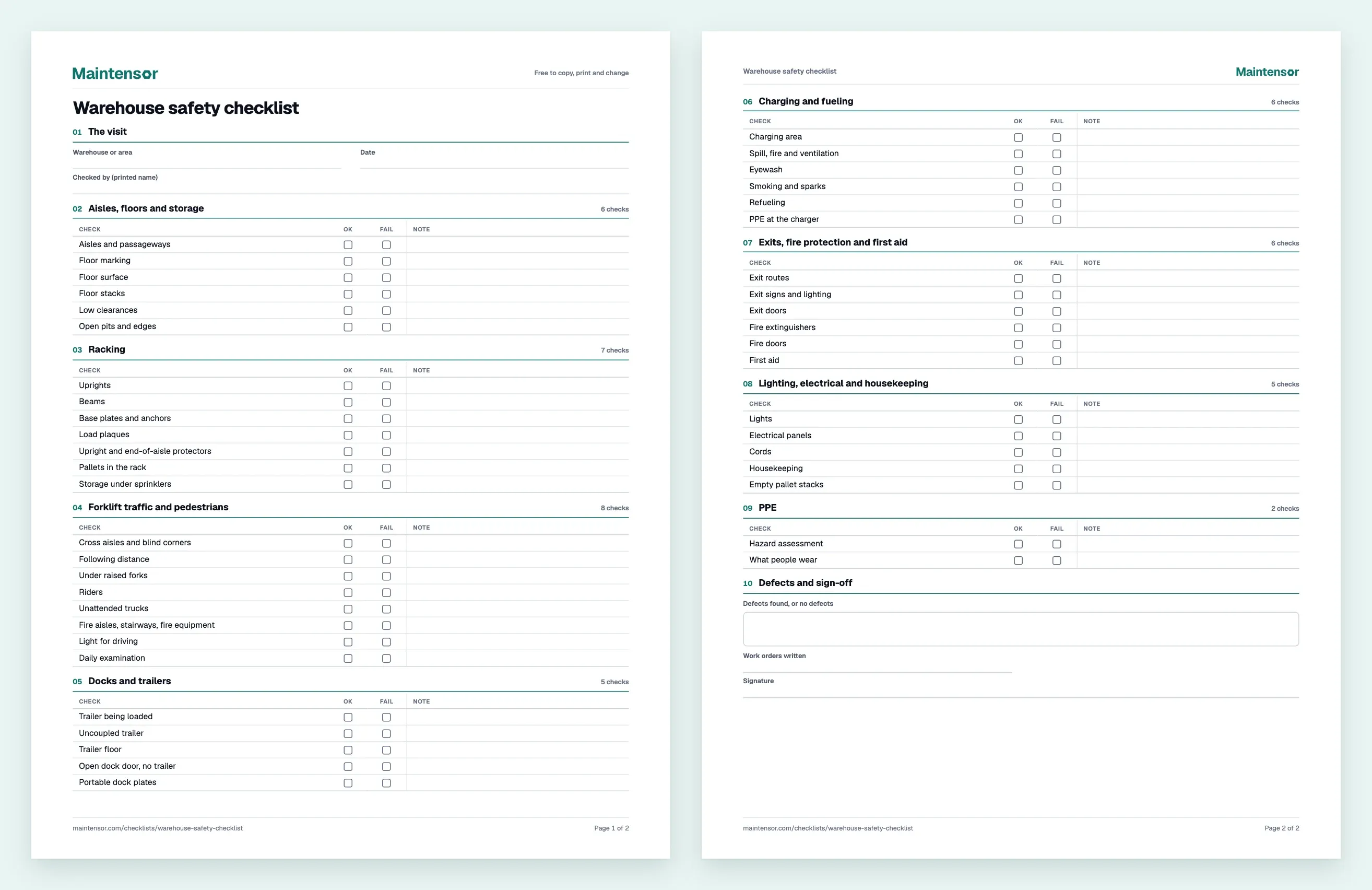
The checks, area by area
Pick a set day each month, such as the first Tuesday, and walk the whole building: every aisle, the back corners, the docks, the charging room, the mezzanine. Each line names what a fail looks like, so a fail becomes a repair job instead of a note.
Aisles, floors and storage6 checks
- Aisles and passageways
- Floor marking
- Floor surface
- Floor stacks
- Low clearances
- Open pits and edges
Racking7 checks
- Uprights
- Beams
- Base plates and anchors
- Load plaques
- Upright and end-of-aisle protectors
- Pallets in the rack
- Storage under sprinklers
Forklift traffic and pedestrians8 checks
- Cross aisles and blind corners
- Following distance
- Under raised forks
- Riders
- Unattended trucks
- Fire aisles, stairways, fire equipment
- Light for driving
- Daily examination
Docks and trailers5 checks
- Trailer being loaded
- Uncoupled trailer
- Trailer floor
- Open dock door, no trailer
- Portable dock plates
Charging and fueling6 checks
- Charging area
- Spill, fire and ventilation
- Eyewash
- Smoking and sparks
- Refueling
- PPE at the charger
Exits, fire protection and first aid6 checks
- Exit routes
- Exit signs and lighting
- Exit doors
- Fire extinguishers
- Fire doors
- First aid
Lighting, electrical and housekeeping5 checks
- Lights
- Electrical panels
- Cords
- Housekeeping
- Empty pallet stacks
PPE2 checks
- Hazard assessment
- What people wear
What counts as a fail, check by checkThe full tables, area by area, with the OSHA rule behind each check.
Where an OSHA rule sits behind a check, the last column cites it.
Aisles, floors and storage
| Check | What counts as a fail | Rule |
|---|---|---|
| Aisles and passageways | Pallets or stock left in an aisle; too little room for trucks to pass or turn | 1910.176(a) |
| Floor marking | Permanent aisles not marked, or lines worn away | 1910.176(a) |
| Floor surface | Holes, broken joints, spills, loose stretch wrap or banding | 1910.22(a) |
| Floor stacks | Leaning, crushed bottom layer, not stable against sliding or collapse | 1910.176(b) |
| Low clearances | No warning sign | 1910.176(e) |
| Open pits and edges | No cover or guardrail | 1910.176(g) |
Racking
| Check | What counts as a fail |
|---|---|
| Uprights | Dents, bends, creases or twists; out of plumb past the maker’s limit |
| Beams | Bent or sagging; beam locks or safety pins missing |
| Base plates and anchors | Anchor missing, loose or sheared off |
| Load plaques | Missing, or a load heavier than the plaque allows |
| Upright and end-of-aisle protectors | Missing or crushed |
| Pallets in the rack | Broken pallets, loads hanging off the beams |
| Storage under sprinklers | Within 18 inches (46 cm) of the sprinkler heads, the minimum in 1910.159(c)(10) |
Forklift traffic and pedestrians
Every line here comes from 1910.178.
| Check | What counts as a fail | Paragraph |
|---|---|---|
| Cross aisles and blind corners | Drivers not slowing and sounding the horn | (n)(4) |
| Following distance | Trucks closer than about three truck lengths, or over the site’s speed limit | (n)(1) |
| Under raised forks | Anyone standing or walking under them | (m)(2) |
| Riders | Anyone riding a truck with no seat for them, or on the forks | (m)(3) |
| Unattended trucks | Forks up, controls not in neutral, power on, brake off | (m)(5) |
| Fire aisles, stairways, fire equipment | Blocked by a truck or a load | (m)(14) |
| Light for driving | Where general lighting is less than 2 lumens per square foot (about 22 lux), trucks without their own lights | (h)(2) |
| Daily examination | A truck in use with no examination that shift | (q)(7) |
Docks and trailers
| Check | What counts as a fail | Rule |
|---|---|---|
| Trailer being loaded | Brakes not set, no wheel chocks and no restraint holding it | 1910.178(k)(1), (m)(7) |
| Uncoupled trailer | No trailer stand where one is needed to stop it upending | 1910.178(k)(3) |
| Trailer floor | Not checked for breaks before a truck drives in | 1910.178(m)(7) |
| Open dock door, no trailer | Nothing across the opening | Practice; see 1910.28 for edges |
| Portable dock plates | Not secured, no handholds, not rated for the load | 1910.26 |
Charging and fueling
| Check | What counts as a fail | Rule |
|---|---|---|
| Charging area | Batteries charged outside the marked area | 1910.178(g)(1) |
| Spill, fire and ventilation | No means to flush and neutralize spilled electrolyte, no fire protection, chargers not guarded from trucks, ventilation off | 1910.178(g)(2) |
| Eyewash | None within the work area, or blocked | 1910.151(c) |
| Smoking and sparks | No-smoking rule not posted or not kept; open flame or sparks near chargers | 1910.178(g)(10), (g)(11) |
| Refueling | Engine running while the tank is filled | 1910.178(p)(2) |
| PPE at the charger | Face shield, apron and gloves missing | Practice |
Exits, fire protection and first aid
| Check | What counts as a fail | Rule |
|---|---|---|
| Exit routes | Anything stored in them, even for a day | 1910.37(a)(3) |
| Exit signs and lighting | Sign missing, not lit, or the route too dark to see | 1910.37(b) |
| Exit doors | Locked, chained or needing a key from the inside | 1910.36(d)(1) |
| Fire extinguishers | Blocked, missing, or the monthly inspection not done | 1910.157(c)(1), (e)(2) |
| Fire doors | Wedged open, or do not close and latch | Practice and fire code |
| First aid | Supplies not readily available, no one trained where no clinic is near | 1910.151(b) |
The fire extinguisher inspection checklist has the monthly extinguisher check in full.
Lighting, electrical and housekeeping
| Check | What counts as a fail | Rule |
|---|---|---|
| Lights | Fixtures out in aisles, at docks or over stairs | Practice |
| Electrical panels | Stock or pallets in the working space in front of them | 1910.303(g)(1) |
| Cords | Run across aisles, damaged, or chained power strips | Practice |
| Housekeeping | Wrap, banding, broken pallets or trash piling up where it is a trip or fire hazard | 1910.176(c) |
| Empty pallet stacks | Leaning, or stacked higher than your site allows | Practice |
PPE
| Check | What counts as a fail | Rule |
|---|---|---|
| Hazard assessment | No written certification of the PPE hazard assessment | 1910.132(d) |
| What people wear | High-visibility vests, safety shoes or gloves not worn where your assessment calls for them | 1910.132(d) |
Racking: inspections and a hit upright
The damage limits come from your rack maker. ANSI MH16.1 is the US standard for the design, testing and use of industrial steel storage racks, published by the Rack Manufacturers Institute (RMI), and RMI gives the inspection intervals and the warnings on repairs below.
Before you start
When a check fails
Some fails cannot wait for a work order: a blocked exit, a crushed rack upright, a leaking battery. Fix them or block the area off before you walk on. Everything else becomes a work order with a priority and a due date, the same day.
Add what your building has and this list does not (cold storage, hazardous materials, conveyors), and check your local fire code and your insurer’s list.
The monthly warehouse walk in Maintensor
Build the walk as one procedure, with a Heading step for each area above and an Inspection check (Pass, Flag, Fail) for each line. Put it on a work order for the building’s location rather than an asset, and set it to repeat monthly on a weekday, such as the first Tuesday.
- A failed line asks for a note and a photo, then offers a follow-up work order, whose description starts with the walk’s number and the failed step. After the walk, the Checklist tab offers one follow-up for every failed or flagged step; only that one is marked “From a failed inspection step”, a filter in the work order list.
- Reporting. On Pro and Max, an Admin’s Reporting shows an inspection checks card: how many checks passed, were flagged or failed on work orders completed in the period, filtered by location if you have more than one building. A walk that passes every line, every month, in a busy warehouse, is worth a second look; pencil whipping explains why.
- Between walks. Give shift leads a Requester sign-in, free on every plan, so a hazard is reported in one line, with how urgent it is and where.

What it does not do: the app has no ready-made safety checklist, so this page is the source you type in once, and whoever answers the walk needs a Full user or Admin seat.
“Mark asset down” appears only when the work order is on an asset, so keep the things you would take out of service, such as a rack run or a dock plate, as assets with their own checks. How the rest of a warehouse runs in the app is on the page for warehouse maintenance software.