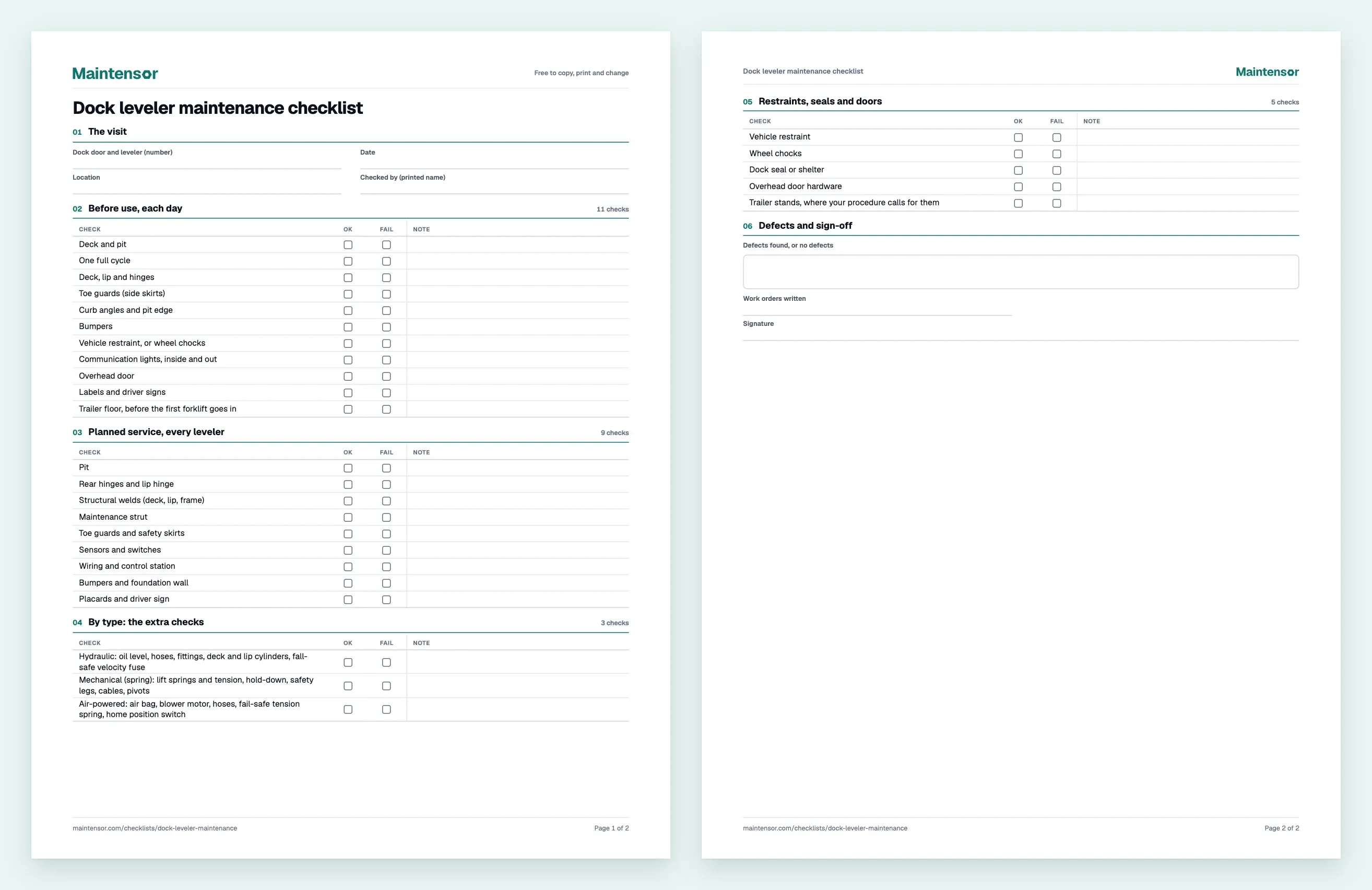
The checks, by visit
One sheet per door and visit. The check before use comes first each day; the planned service adds the checks for the leveler’s type, and its restraint, seal and door. A failed check closes the door and gets a work order, and your leveler’s manual comes first.
Before use, each day11 checks
- Deck and pit
- One full cycle
- Deck, lip and hinges
- Toe guards (side skirts)
- Curb angles and pit edge
- Bumpers
- Vehicle restraint, or wheel chocks
- Communication lights, inside and out
- Overhead door
- Labels and driver signs
- Trailer floor, before the first forklift goes in
Planned service, every leveler9 checks
- Pit
- Rear hinges and lip hinge
- Structural welds (deck, lip, frame)
- Maintenance strut
- Toe guards and safety skirts
- Sensors and switches
- Wiring and control station
- Bumpers and foundation wall
- Placards and driver sign
By type: the extra checks3 checks
- Hydraulic: oil level, hoses, fittings, deck and lip cylinders, fall-safe velocity fuse
- Mechanical (spring): lift springs and tension, hold-down, safety legs, cables, pivots
- Air-powered: air bag, blower motor, hoses, fail-safe tension spring, home position switch
Restraints, seals and doors5 checks
- Vehicle restraint
- Wheel chocks
- Dock seal or shelter
- Overhead door hardware
- Trailer stands, where your procedure calls for them
What counts as a fail, check by checkThe full tables, for every leveler and by type.
Before use, each day
| Check | What counts as a fail |
|---|---|
| Deck and pit | Debris, snow or ice on the deck or in the pit; trash under the lip |
| One full cycle | Deck does not rise smoothly, the lip does not fully extend or fold, or the deck does not return to stored |
| Deck, lip and hinges | Cracked welds, bent lip plate, a lip that sags or does not lie flat on the bed |
| Toe guards (side skirts) | Bent, torn off, or dragging on the pit wall |
| Curb angles and pit edge | Cracked concrete, loose or bent steel |
| Bumpers | Missing, torn, or worn so the trailer hits steel or concrete |
| Vehicle restraint, or wheel chocks | Restraint does not engage the trailer’s rear guard, or its lights do not change; no chocks at the door |
| Communication lights, inside and out | Out, or not in the right sequence |
| Overhead door | Does not open or close fully; the photo eye or reversing edge does not stop and reverse it |
| Labels and driver signs | Warning labels, operating placard or outside driver sign missing or unreadable |
| Trailer floor, before the first forklift goes in | Holes, soft or broken boards. 1910.178(m)(7) has the flooring checked before trucks drive onto it |
Planned service, every leveler
Every three months on a single-shift dock, monthly on a multi-shift dock, or as your manual says. Barricade, lock out and set the strut first.
| Item | What counts as a fail |
|---|---|
| Pit | Debris under the deck and around the hinges not cleared |
| Rear hinges and lip hinge | Stiff, dry, worn pins, keepers missing. Lubricate as the manual says |
| Structural welds (deck, lip, frame) | Any crack |
| Maintenance strut | Bent, or does not seat |
| Toe guards and safety skirts | Bent, loose or missing |
| Sensors and switches | Loose, damaged, or out of position |
| Wiring and control station | Damaged cable, loose connections, a button that sticks |
| Bumpers and foundation wall | Bumpers worn past the bolt heads, cracked wall |
| Placards and driver sign | Missing or unreadable |
By type
| Type | Extra checks | What counts as a fail |
|---|---|---|
| Hydraulic | Oil level, hoses, fittings, deck and lip cylinders, fall-safe velocity fuse | Oil below the mark, any leak, rubbed hose, fall-safe not working as the manual describes |
| Mechanical (spring) | Lift springs and tension, hold-down, safety legs, cables, pivots | Broken coil, deck rises too fast or not at all, hold-down slips, frayed cable. Springs store a lot of energy: adjusting them is a technician’s job |
| Air-powered | Air bag, blower motor, hoses, fail-safe tension spring, home position switch | Torn or chafed bag, blower that does not run or has a blocked intake, any air leak |
Restraints, seals and doors
| Item | When | What counts as a fail |
|---|---|---|
| Vehicle restraint | Planned service | Hook or arm slow, does not reach the trailer’s rear guard, lights do not match its state |
| Wheel chocks | Daily | Missing, cracked, or not where the driver can reach them |
| Dock seal or shelter | Monthly | Torn pads or curtains, worn wear strips, daylight around a parked trailer |
| Overhead door hardware | Monthly | Frayed cables, rusted or unseated rollers, loose hinges, bent track. Leave spring work to a trained door technician |
| Trailer stands, where your procedure calls for them | Daily | Missing at a door where an uncoupled trailer is being loaded |
How much service work: technician hours for 10 doors
Example10 doors, one shift or two
A made-up warehouse has 10 doors, each with a hydraulic leveler and a restraint. Say a technician needs 1 hour per door for the planned service.
| Single shift | Two shifts | |
|---|---|---|
| Interval in the manual quoted below | Every 3 months | Monthly |
| Visits per door per year | 4 | 12 |
| Door services per year | 40 | 120 |
| Technician hours per year, at 1 hour each | 40 | 120 |
Adding a second shift triples the planned dock work. Plan it before the shift starts, not after the first leveler drops.
Before you start
When a check fails
The door is closed to traffic. In the manual’s terms, if damage is seen or the restraint does not work, the leveler comes out of service and maintenance is told at once. Leave the leveler stored, close the door, put a barrier or cone across it, tag the control station, and write a work order.
Dockboards, chocks and trailer brakes: what OSHA requires
OSHA defines dock levelers as dockboards (1910.21). Under 1910.26, a dockboard supports its maximum intended load, and measures such as wheel chocks or sand shoes keep the trailer from moving while people are on the dockboard.
What the rules sayRun-off protection, chocks and trailer brakes, guardrails, ANSI MH30.1, Canada.
- Run-off protection. Under 1910.26, a dockboard put into service on or after January 17, 2017 is designed, built and maintained to stop vehicles running off its edge.
- Chocks and trailer brakes. 1910.178(k)(1) has a highway trailer’s brakes set and wheel chocks under its rear wheels while forklifts board it. In a 2005 letter about Postal Service docks, OSHA said it would not cite missing chocks where alternatives such as dock locks prevent the trailer from moving.
- Guardrails. People on a dockboard 4 feet (1.2 m) or more above a lower level need a guardrail or handrails under 1910.28(b)(4), except where it is used only for materials handling with motorized equipment, the fall is 10 feet (3 m) or less, and the workers are trained.
- ANSI MH30.1. The standard for the performance and testing of dock leveling devices is published by the leveler makers’ group at MHI; it is also meant to make clear what makers, sellers, installers, owners and users are each responsible for.
- Canada. Provinces set their own rules.
None of this page is legal advice: read the rules that apply to your dock.
Leveler service in Maintensor: a unit and a history for each door
Keep the levelers as one asset with a unit for each door, Door 1 to Door 10. One job then makes a planned service work order for every door, each with its own checklist, repeating monthly or every 3 months on the same date.
- Each door keeps its own history, and a leveler that fails is marked Down on its own while the other nine stay Operational.
- Build the service as a procedure with Inspection checks (Pass, Flag, Fail) and a Heading step for each leveler type you have. On a Fail, the technician adds a note and a photo, then can create a follow-up work order for the repair and mark that door’s leveler down.
- The check before use can stay on paper at the door. The dock lead, signed in as a Requester (free on every plan), reports a fault in one line, and you approve it into a work order or decline it with a reason.

What it does not do: the app does not count leveler cycles or schedule by them, and answering checklists takes a Full user or Admin seat. More on running a dock in the app is on the warehousing page, and the forklift inspection checklist covers the trucks that cross the leveler.