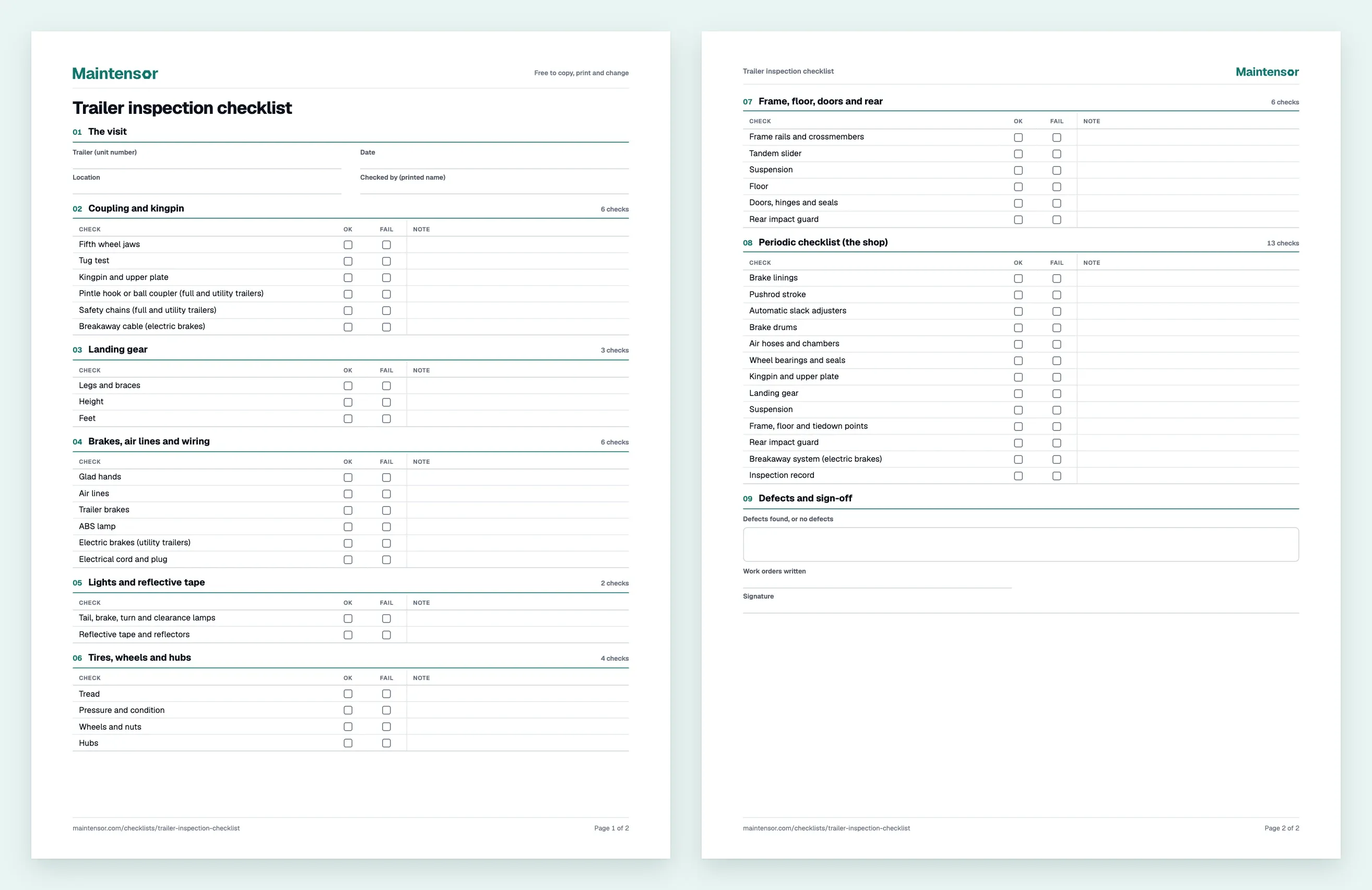
The checks, by area
The driver ticks the first six cards every day the trailer is pulled, after coupling and before driving; the pre-trip inspection checklist covers the tractor or truck. The shop does the periodic checks at the trailer’s own service and before its annual inspection.
Coupling and kingpin6 checks
- Fifth wheel jaws
- Tug test
- Kingpin and upper plate
- Pintle hook or ball coupler (full and utility trailers)
- Safety chains (full and utility trailers)
- Breakaway cable (electric brakes)
Landing gear3 checks
- Legs and braces
- Height
- Feet
Brakes, air lines and wiring6 checks
- Glad hands
- Air lines
- Trailer brakes
- ABS lamp
- Electric brakes (utility trailers)
- Electrical cord and plug
Lights and reflective tape2 checks
- Tail, brake, turn and clearance lamps
- Reflective tape and reflectors
Tires, wheels and hubs4 checks
- Tread
- Pressure and condition
- Wheels and nuts
- Hubs
Frame, floor, doors and rear6 checks
- Frame rails and crossmembers
- Tandem slider
- Suspension
- Floor
- Doors, hinges and seals
- Rear impact guard
Periodic checklist (the shop)13 checks
- Brake linings
- Pushrod stroke
- Automatic slack adjusters
- Brake drums
- Air hoses and chambers
- Wheel bearings and seals
- Kingpin and upper plate
- Landing gear
- Suspension
- Frame, floor and tiedown points
- Rear impact guard
- Breakaway system (electric brakes)
- Inspection record
What counts as a defect, check by checkThe full tables, pre-trip and periodic, with the limits and where they come from.
The first six tables are the driver’s pre-trip check. The last is the shop’s. A utility trailer has fewer parts, with no air system and often no brakes, and the rows that apply to it say so.
Coupling and kingpin
| Check | What counts as a defect |
|---|---|
| Fifth wheel jaws | Not closed around the kingpin; release handle not locked; light showing between the trailer’s upper plate and the fifth wheel |
| Tug test | The trailer moves away when the tractor pulls gently against the set trailer brakes |
| Kingpin and upper plate | Kingpin bent, cracked or loose; upper plate cracked or bent |
| Pintle hook or ball coupler (full and utility trailers) | Latch not closed and pinned; ball size does not match the coupler |
| Safety chains (full and utility trailers) | Missing, not attached to the towing vehicle, or repaired with wire, bolts or tape |
| Breakaway cable (electric brakes) | Not attached to the towing vehicle; the trailer’s breakaway battery not charged |
Landing gear
| Check | What counts as a defect |
|---|---|
| Legs and braces | Bent, cracked, or a brace missing |
| Height | Not fully raised; crank handle not stowed |
| Feet | Missing or broken |
Brakes, air lines and wiring
| Check | What counts as a defect |
|---|---|
| Glad hands | Seal torn or missing; air leaking at the connection |
| Air lines | Chafed through the outer cover, kinked, bulging, leaking or dragging |
| Trailer brakes | Do not apply with the trailer hand valve or when the trailer air supply is cut; an air leak you can hear at a chamber |
| ABS lamp | Does not light briefly when power comes on, or stays on |
| Electric brakes (utility trailers) | No braking felt in a slow test with the brake controller; wiring loose |
| Electrical cord and plug | Plug loose, pins corroded, cord chafed or dragging |
Lights and reflective tape
| Check | What counts as a defect |
|---|---|
| Tail, brake, turn and clearance lamps | Out, cracked, or covered by dirt or load |
| Reflective tape and reflectors | Sections missing or peeling, faded, or too dirty to shine back in headlights |
Tires, wheels and hubs
| Check | What counts as a defect |
|---|---|
| Tread | Less than 2/32 inch (1.6 mm) in a major groove |
| Pressure and condition | Flat or leaking; cut to the cords; bulge; duals touching each other |
| Wheels and nuts | Loose, missing or broken nut; rust streaks from a nut; cracked rim |
| Hubs | Oil below the sight glass mark; oil or grease on the inside of the wheel |
Frame, floor, doors and rear
| Check | What counts as a defect |
|---|---|
| Frame rails and crossmembers | Cracked, broken or sagging |
| Tandem slider | Locking pins not fully engaged |
| Suspension | Broken leaf; loose U-bolt; air bag flat or leaking |
| Floor | Holes, broken boards, or soft spots under where a forklift will drive |
| Doors, hinges and seals | Door will not latch or lock; hinge cracked; seal torn, which lets in water and, on a refrigerated trailer, heat |
| Rear impact guard | Missing, loose or bent |
Periodic checklist (the shop)
Do these at the trailer’s service and before its annual inspection. The limits quoted come from Appendix A to Part 396 unless the row says otherwise.
| Check | What counts as a defect |
|---|---|
| Brake linings | Air drum brakes: less than 1/4 inch at the shoe center. Air disc brakes: less than 1/8 inch. Electric or hydraulic drum brakes: 1/16 inch or less. Lining loose, or soaked with oil or grease |
| Pushrod stroke | Past the readjustment limit for the chamber size in 393.47(e) |
| Automatic slack adjusters | A brake out of adjustment: find the cause before adjusting. Appendix A does not allow adjusting an automatic adjuster by hand without correcting the problem first |
| Brake drums | A crack that opens when the brake is applied; any part missing |
| Air hoses and chambers | Damage through the outer reinforcement; a bulge under pressure; a leak you can hear; a splice with tube and clamps |
| Wheel bearings and seals | Play, rough turning or a leaking seal, judged against the maker’s limits |
| Kingpin and upper plate | Kingpin worn past the maker’s limit on a gauge; upper plate cracked, bent or loose |
| Landing gear | Gearbox not lubricated to the maker’s schedule; loose mounting bolts; legs that bind |
| Suspension | Broken leaf, cracked hanger, loose U-bolt or torque arm; air suspension that will not hold height |
| Frame, floor and tiedown points | A cracked or sagging member; a floor or anchor point damaged enough to weaken cargo securement (393.104) |
| Rear impact guard | On a trailer built since January 26, 1998: missing or loose; its horizontal bar more than 22 inches (560 mm) above the ground or more than 12 inches (305 mm) forward of the rear; does not reach within 4 inches (100 mm) of each side |
| Breakaway system (electric brakes) | Pulling the pin does not set the brakes; the battery does not hold a charge |
| Inspection record | No current annual report or decal on the trailer. The report is kept 14 months (396.21) |
Write each service in the trailer’s own vehicle maintenance log, with the lining and tread measurements. Equipment trailers that haul machines also need the machines’ own checks, which the heavy equipment inspection checklist covers.
Before you start
When a check fails
A trailer with a defect that affects brakes, coupling, a tire or wheel, its brake lamps or turn signals, or its tail lamps after dark does not leave the yard. Tag it, write the defect on the driver’s report and open a repair. Smaller defects go on the report for the shop to fix.
What the rules say about trailers
In the US, Part 393 sets what a commercial trailer must have, and Part 396 how it is inspected, including a periodic inspection of each trailer at least once every 12 months. In Canada, trailers over 4,500 kg get a trip inspection and a periodic inspection at least yearly under the National Safety Code.
What the rules sayBrakes, lamps, tires, coupling, the rear guard and the yearly inspection, in the US and Canada.
The pre-trip rule in 49 CFR 392.7 names coupling devices and trailer brake connections among the items the driver must find in good working order. What a trailer must have, in summary:
- Brakes on all wheels (393.42). A semitrailer or full trailer of 3,000 pounds (1,361 kg) gross weight or less may go without, if its axle weight is no more than 40% of the towing vehicle’s.
- Breakaway brakes (393.43(d)) that apply on their own if the trailer breaks away, and hold for at least 15 minutes.
- Lamps that work and are not hidden by the load or dirt (393.9). Trailers 80 inches (2,032 mm) wide or more, rated over 10,000 pounds and built since December 1, 1993, carry red and white reflective sheeting or reflectors to the federal lighting standard (393.11); older ones follow 393.13.
- Tires with at least 2/32 inch (1.6 mm) of tread, and no flat, exposed cords or separation (393.75).
- Coupling that locks, and safety chains or cables on a full trailer’s tow bar (393.70).
- A rear impact guard on trailers rated at 10,000 pounds or more and built since January 26, 1998, with exceptions (393.86).
- A periodic inspection of each semitrailer, full trailer and converter dolly at least once every 12 months, with the report or a decal on the trailer (396.17), to the standards in Appendix A to Part 396.
These apply to commercial motor vehicles in interstate commerce. A combination counts when its rating is 10,001 pounds or more, so a pickup and trailer together can reach it.
In Canada, trailers over 4,500 kg get a trip inspection to Schedule 1 of NSC Standard 13 and a periodic inspection at least yearly under Standard 11; British Columbia inspects log and dump trailers every six months.
These are summaries for information: read the rule that applies to your trailers.
Trailers in Maintensor: VINs, statuses and two procedures
In Maintensor, each trailer is an asset of its own, with Trailer as its Type and the VIN as its serial number. There is no built-in trailer checklist, so build two procedures from this page: the pre-trip one, with an Inspection check per row (Pass, Flag or Fail), and the periodic one.
- Mark a trailer In maintenance while it is in the bay, and Down when it must not leave the yard. The fleet page shows trailers in a yard’s asset list.
- Attach the periodic procedure to a work order on each trailer that repeats on the calendar, for example Monthly every 6, plus a Yearly work order for the annual inspection. Completing one creates the next.
- A Number step records a reading, such as lining thickness at each wheel, but has no unit or limit. Put both in its name and follow it with an Inspection check, so a thin lining is answered Fail. A Fail asks for a note and a photo, and offers a follow-up work order and Mark asset down.

What it does not do: only Full users and Admins answer checklists, so a driver who does the pre-trip in the app needs a Full user seat; a driver with the free Requester role can only report a problem. The app does not print or export an inspection, and schedules come due by the calendar, never by miles.