What the form holds
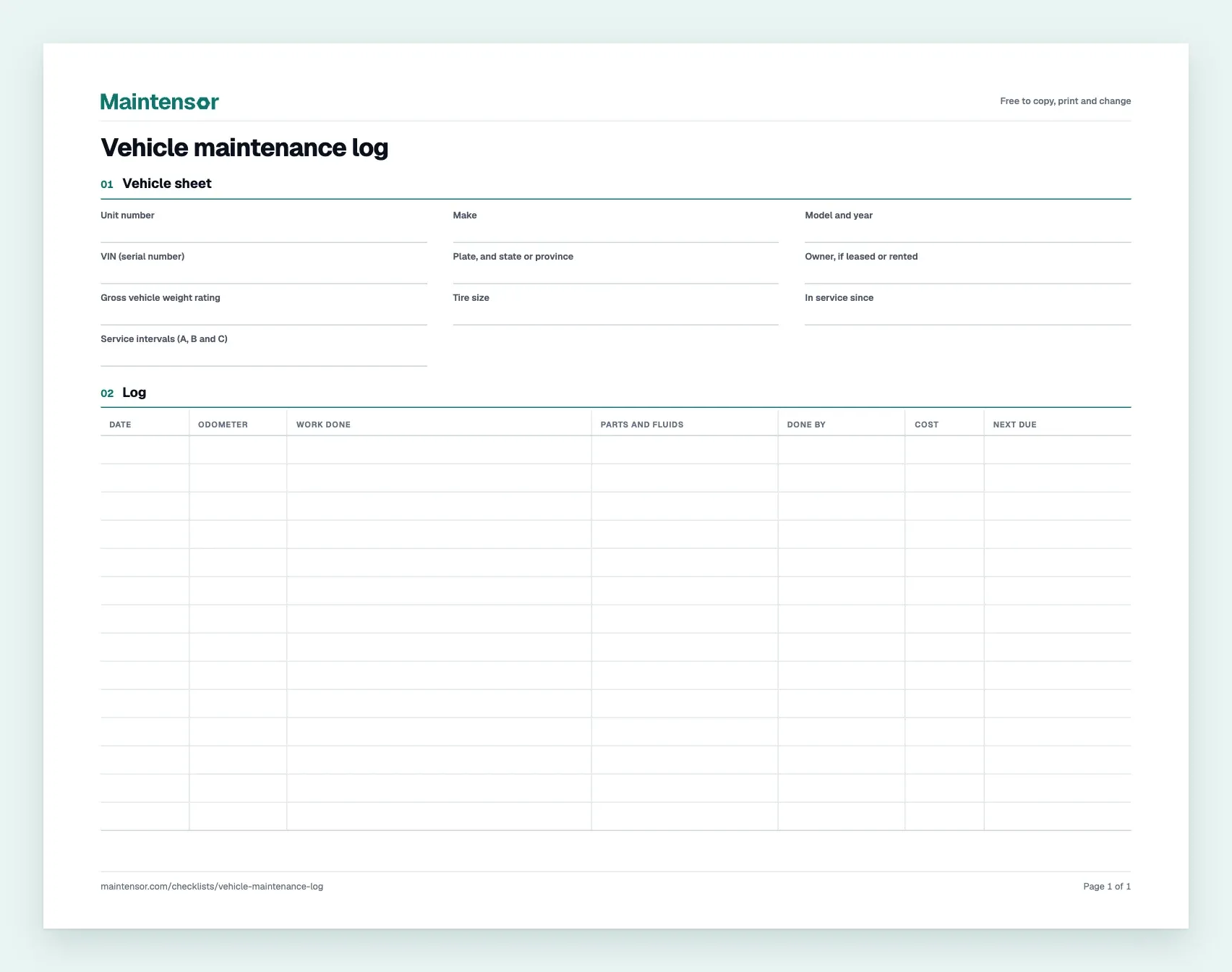
Two parts on one page: the vehicle sheet, filled in once, and a line for every job. The Excel file has room for thirty jobs and adds up the cost.
This is a starting point. Add columns your fleet needs, and take service intervals from each vehicle maker’s manual. For machines and plant equipment, use the equipment maintenance log instead.
A filled example
ExampleUnit 7, a box truck, January to June
Unit 7 is a made-up 26 foot box truck at Cedar Valley Delivery, rated at 26,000 pounds (about 11,800 kg) and running local routes at about 2,500 miles a month. Every name, number and cost below is made up.
Its A service is monthly, its B every 3 months (the maker’s interval for B, in this example, is 10,000 miles) and its C yearly, with the annual inspection.
| Date | Odometer | Work done | Parts and fluids | Done by | Cost | Next due |
|---|---|---|---|---|---|---|
| Jan 12 | 84,210 | A service: lights, tires and pressures, leaks, fluids, chassis grease. Replaced right marker lamp from the Jan 9 driver report | 1 marker lamp, grease | Chris Walsh | $46 | A: Feb 9 |
| Feb 9 | 86,690 | A service. Nothing found | Grease | Chris Walsh | $9 | B: Mar 9, near 89,000 mi |
| Mar 9 | 89,350 | B service: oil and filters, fuel filters, air dryer cartridge. Brake linings measured, all over 3/8 in; pushrod strokes within limits | Oil, oil filter, 2 fuel filters, dryer cartridge | Chris Walsh | $412 | A: Apr 6 |
| Mar 24 | 90,480 | Repair: right rear brake chamber leaking air, from Sam Ortiz’s driver report of Mar 23. Chamber replaced and tested; report signed as repaired | 1 brake chamber | Chris Walsh | $165 | |
| Apr 6 | 91,700 | A service. Front tires at 7/32 in | Grease | Chris Walsh | $9 | A: May 4 |
| May 4 | 94,000 | A service. Two rear outer tires at 5/32 in; ordered | Grease | Chris Walsh | $9 | Tires: by May 18 |
| May 18 | 95,110 | Two rear outer tires replaced at 4/32 in, the shop’s own replacement point | 2 tires | Outside tire shop | $820 | C and annual: Jun 8 |
| Jun 8 | 96,900 | C service with the B tasks, and the annual inspection: passed. Report filed, decal on the truck | Wiper blades, air filter, oil and filters | Rob Hansen, qualified inspector | $488 | Annual inspection: Jun 2027 |
The brake chamber was found by a driver and fixed the next day, with the report to show it.
The tires came off at the shop’s own point, 4/32 inch, above the legal minimum of 2/32 inch for rear tires in 49 CFR 393.75.
The odometer shows about 7,550 miles from March 9 to June 8, which confirms that a 3 month B service still fits this truck’s route.
How to keep it
A lighter log for a personal car, van or pickup
A facilities team’s pickups or a plumber’s vans are usually rated under 10,001 pounds, outside the federal Part 396 rules unless a trailer they tow brings the combination to that rating. A log still pays: the maker’s schedule runs by miles and months, a warranty claim may ask for proof of service, and a buyer will ask what was done.
ExampleOne van's year
Made up. The entries are mostly the same few: oil and filter changes, tire rotations, brake pads and rotors, and fluids such as coolant, brake fluid and transmission fluid. Drop two columns, Parts and fluids and Done by.
| Date | Odometer | Work done | Cost | Next due (date or miles) |
|---|---|---|---|---|
| Mar 4 | 41,260 | Oil and filter, tire rotation | $98 | Sep 4 or 46,000 mi |
| Jun 18 | 43,900 | Front brake pads and rotors replaced | $540 | Check the brakes at the next oil change |
| Sep 2 | 46,150 | Oil and filter, cabin air filter | $112 | Mar 2 or 51,000 mi |
Keep the master copy in the shop or office, not the glovebox, and keep it as long as you own the vehicle. A maintenance spreadsheet with a tab per vehicle does the same job for a handful of vans.
What the rules ask a fleet to keep
In the US, 49 CFR 396.3 asks a motor carrier to keep maintenance records for each vehicle it controls for 30 consecutive days or more: for 1 year where the vehicle is housed or maintained, and 6 months after it leaves. In Canada, NSC Standard 11 asks for at least two years.
What the rules sayWhat 396.3 asks for, how long each US record is kept, and Canada's NSC Standard 11.
In the US, 49 CFR 396.3(b) asks a motor carrier to keep records for each vehicle it controls for 30 consecutive days or more:
- The vehicle’s identity: company number if it has one, make, serial number and year, and the owner’s name if the carrier does not own it.
- A means to show the nature and due date of the inspections and maintenance to be done.
- A record of inspections, repairs and maintenance, showing their date and nature.
- For buses, a record of the tests of pushout windows, emergency doors and their marking lights.
Older forms also ask for tire size, which the rule listed until a July 2026 amendment removed it. It is still worth writing down.
| Record | US rule | Keep it for |
|---|---|---|
| The vehicle’s maintenance records above | 396.3(c) | 1 year where the vehicle is housed or maintained, and 6 months after it leaves your control |
| Driver vehicle inspection reports that listed defects, with the repair sign-off and the next driver’s review | 396.11(a)(4) | 3 months |
| Annual inspection report | 396.21(b) | 14 months |
| Roadside inspection reports | 396.9(d)(3) | 12 months |
These rules apply to commercial motor vehicles in interstate commerce, mainly those rated at 10,001 pounds or more; states set the rules for trucks that stay in the state.
In Canada, NSC Standard 11 asks for a file on each truck, trailer and bus with its make, model, year and VIN, the lessor if any, and the date and nature of every repair and service with parts and invoices.
The file also holds the odometer reading at each one, the type and frequency of its regular maintenance, a lubrication record, and any axle or suspension change that affects its weight ratings. The standard asks for the file to be kept at least two years, and six months after the vehicle leaves.
It also notes that many jurisdictions want brake repair invoices kept four or five years. Your province’s rules decide.
The pre-trip inspection checklist covers the daily reports that sit behind this log, and the fleet maintenance guide covers the program around it. These are summaries for information. Read the rule that applies to your vehicles.
Keeping it in Maintensor
In Maintensor, each vehicle is an asset, and the log builds itself from the work orders done on it. The fleet page shows a yard set up this way.
- The vehicle sheet is the asset: its location, a Type such as Truck, and a nameplate with the maker, model and serial number (the VIN). There is no field for year, plate, weight rating or tire size, so those go in its description.
- The log is the asset’s Work orders tab: open work with due dates, then completed work, newest first, each with who finished it, the day and what it cost. Below the Max plan, a job’s cost is its parts; on Max it adds labor and other costs, such as an outside tire shop as a contractor, with the receipt.
- Next due is the open repeating work order with its due date, one of each series at a time. Status changes go to the asset’s History tab with their reason: Down, “brake chamber leaking”, and back to Operational.

What it does not do: there is no odometer field on the asset. A Number step on the service checklist records the reading on that work order, but it does not show on the truck’s record, and nothing comes due from it.
There is no calendar of the year ahead, and no export or print, so the log is read in the app. If an auditor wants a paper file, keep this printed log as well.