What the form holds
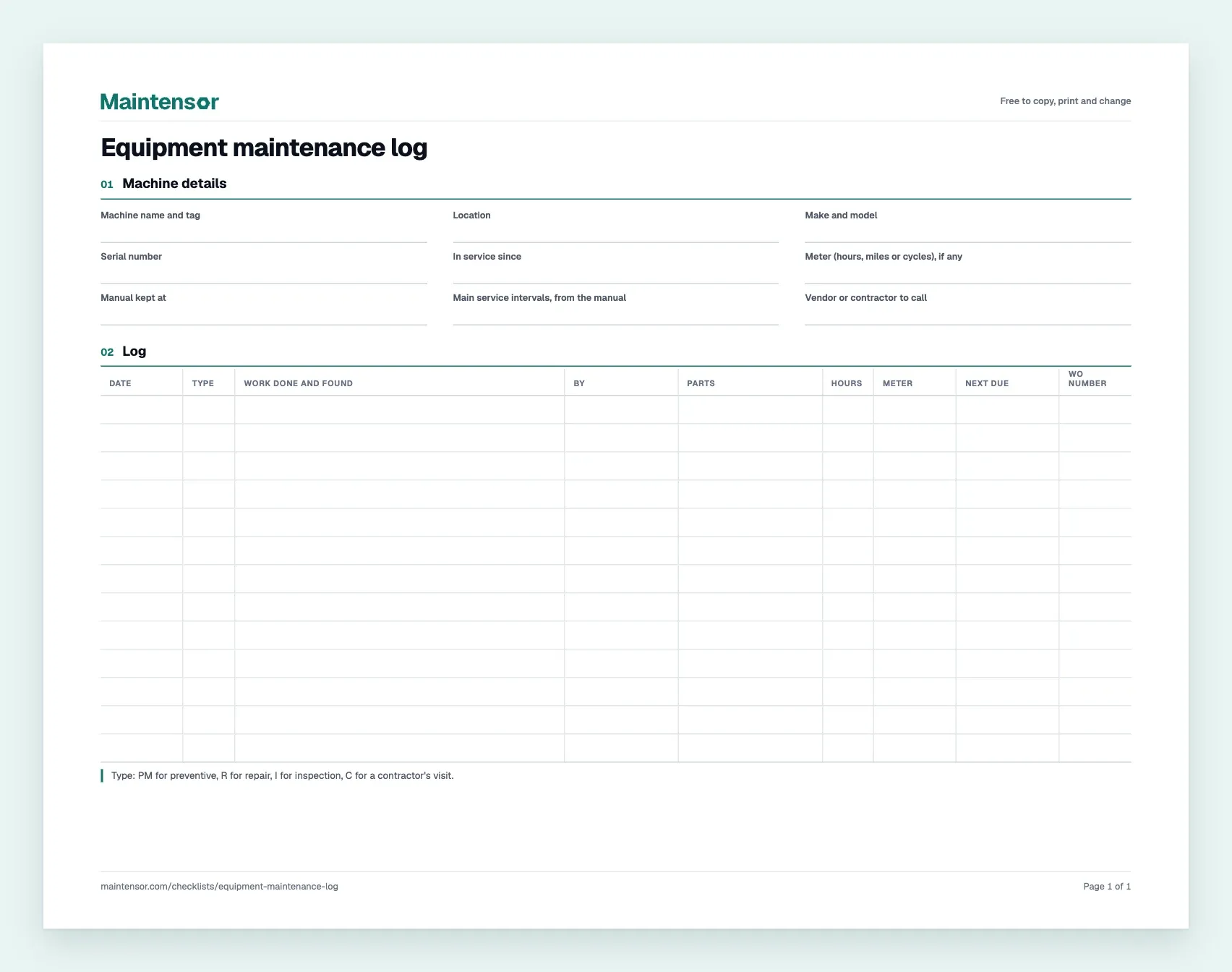
The machine details at the top, filled in once, are the same as the machine’s row in an asset register. Below them, a line for every job. The Excel file has room for thirty jobs, a list for the type of work and a total of the hours.
A blank work order is in the work order template. Add the columns the maker’s manual asks you to record, such as oil analysis results or a torque value, and drop the meter column if the machine has no meter.
A filled-in example: an air compressor
ExampleAir compressor AC-1, January to March
A made-up plant. The machine, the names, the readings and the service intervals are invented; the real intervals come from your compressor’s manual, and the air compressor maintenance checklist lists the checks.
| Field | Entry |
|---|---|
| Machine name and tag | Air compressor AC-1 |
| Location | Compressor room, building services |
| Make and model | Rotary screw, 25 hp (18.6 kW) |
| Serial number | RS25-118734 |
| In service since | March 2019 |
| Meter | Hour meter |
| Main service intervals | Monthly inspection; oil filter and air filter every 2,000 hours; separator element every 4,000 hours |
| Date | Type | Work done and found | By | Parts | Hours | Meter | Next due | WO number |
|---|---|---|---|---|---|---|---|---|
| Jan 6 | PM | Monthly inspection. Intake filter clean, drains cycle, no leaks heard. Discharge 110 psi (7.6 bar), 185 °F (85 °C). | Ben Carter | None | 0.5 | 10,410 | Feb 3; filters at 10,800 h | WO-2210 |
| Jan 22 | R | Shut down on high temperature at 2 p.m. Cooler fins packed with dust; blown out from the clean side. Ran an hour at 186 °F (86 °C). | James O’Neil | None | 1.5 | 10,570 | WO-2264 | |
| Feb 3 | PM | Monthly inspection. Coolers dusty again, cleaned. Air leak at the quick coupler on drop 4, tagged. | Ben Carter | None | 0.75 | 10,690 | Mar 3 | WO-2291 |
| Feb 5 | R | Replaced the leaking quick coupler on drop 4. | Tom Reyes | 1 quick coupler, 3/8 in | 0.25 | 10,710 | WO-2298 | |
| Feb 17 | PM | 2,000-hour service: oil filter and air filter changed, oil topped up, oil sample sent. | Ben Carter | 1 oil filter, 1 air filter, 1 gal (3.8 L) oil | 1.5 | 10,830 | Filters at 12,800 h; separator at 12,000 h | WO-2330 |
| Mar 3 | PM | Monthly inspection. Coolers clean. Oil sample report normal, filed behind this page. | Ben Carter | None | 0.5 | 10,970 | Apr 7 | WO-2361 |
| Mar 18 | I | Receiver tank checked outside: no rust, dents or leaks. Safety valve tested as the manual directs. | Sarah Mitchell | None | 0.5 | 11,120 | Next March | WO-2392 |
About 10 hours a day. From January 6 to March 18 is 71 days, and the meter went from 10,410 to 11,120: 710 hours.
The separator is due around June 14. It is due at 12,000 hours, 880 hours past the March reading: 88 days at 10 hours a day. Put it on the schedule now, for the nearest weekend or shutdown.
The coolers are a pattern. One high-temperature trip in January and dusty coolers again two weeks later is the same problem twice. Either the monthly inspection gets a step to blow out the coolers, or someone finds where the dust comes from.
The labor was small; the trip was not. The log shows 5.5 hours of labor in ten weeks (0.5 + 1.5 + 0.75 + 0.25 + 1.5 + 0.5 + 0.5), but not what the January trip cost the plant in stopped air tools. Note that in the line when it happens.
How to keep it
When a check finds the machine unsafe
Take it out of service and tag it, write a work order for the repair, and log both.
How long to keep it: the rules that exist
For most machines no rule says how long to keep the maintenance log. Keep it for as long as you own the machine, and pass it to the buyer when you sell it: its value is the pattern over years, and an insurer, an inspector or a warranty claim may ask to see it.
What the rules sayFive US federal examples: presses, cranes, extinguishers, trucks and forklifts.
Where a rule does apply, it sets what must be recorded and sometimes for how long. A few US federal examples:
| Equipment | Rule | What it asks to be recorded | How long |
|---|---|---|---|
| Mechanical power presses | OSHA 29 CFR 1910.217(e)(1) | A certification record of periodic inspections and of maintenance and repair: the date, the signature of the person who did the work, and the press’s serial number or other identifier | The paragraph sets no period |
| Overhead and gantry cranes | OSHA 29 CFR 1910.179(j)(2) and (m)(1) | Monthly certification records for hooks, hoist chains and running ropes: the date, the inspector’s signature, and an identifier for what was inspected | Rope records kept on file where readily available; no period set |
| Portable fire extinguishers | OSHA 29 CFR 1910.157(e)(3) | The date of the annual maintenance check | 1 year after the last entry, or the life of the shell, whichever is less |
| Commercial motor vehicles | FMCSA 49 CFR 396.3 | For each vehicle a carrier controls for 30 days in a row: its identification, what inspection and maintenance is due and when, and a record of inspection, repair and maintenance with the date and nature of each | Where the vehicle is housed or maintained, for 1 year, and for 6 months after it leaves the carrier’s control |
| Forklifts | OSHA 29 CFR 1910.178(q)(7) | An examination before use, at least daily. OSHA’s 2000 letter of interpretation says the exam does not have to be documented | The employer’s choice |
Many sites write down the daily forklift check anyway, because a dated sheet shows it was done. Trucks and trailers have their own page: the vehicle maintenance log.
This is information, not legal advice. States that run their own OSHA plans can have different rules, boilers and pressure vessels are inspected under state or provincial rules, and in Canada each province and territory sets its own requirements for cranes, pressure equipment and workplace records.
Read the rule that applies to you, and the maker’s manual, which may set its own records for the warranty.
The log in Maintensor
In Maintensor, nobody writes the log by hand: an asset’s record builds it from the work orders done on the asset. Its Nameplate (Manufacturer, Model, Serial number), Location and Description are the header.
- The Work orders tab is the log lines: what is open now, then what was done, newest first, each with who completed it, the day and its cost. Below the Max plan the cost is parts only; on Max it includes labor and other costs.
- At the top, Last service shows the most recent completed work order, and This year counts the work orders completed this year and what they cost. When one part is used on an asset three or more times this year, the asset warns: check for a recurring fault.
- Each line opens the work order behind it, with its checklist answers, parts, time and notes. The History tab records each change of the asset’s status (Operational, In maintenance, Down or Retired) with the reason typed, and its moves between locations.

What it does not do: an asset has no meter or readings. A Number step on a checklist can record the hour meter at each service, but the value stays on that work order’s checklist, and nothing comes due from it. The log has no export and no print layout.
A log kept in a spreadsheet can be imported on Pro and Max as done work orders, but an old paper log cannot. A Signature step records a signature drawn on the screen; it does not make a record meet a rule.