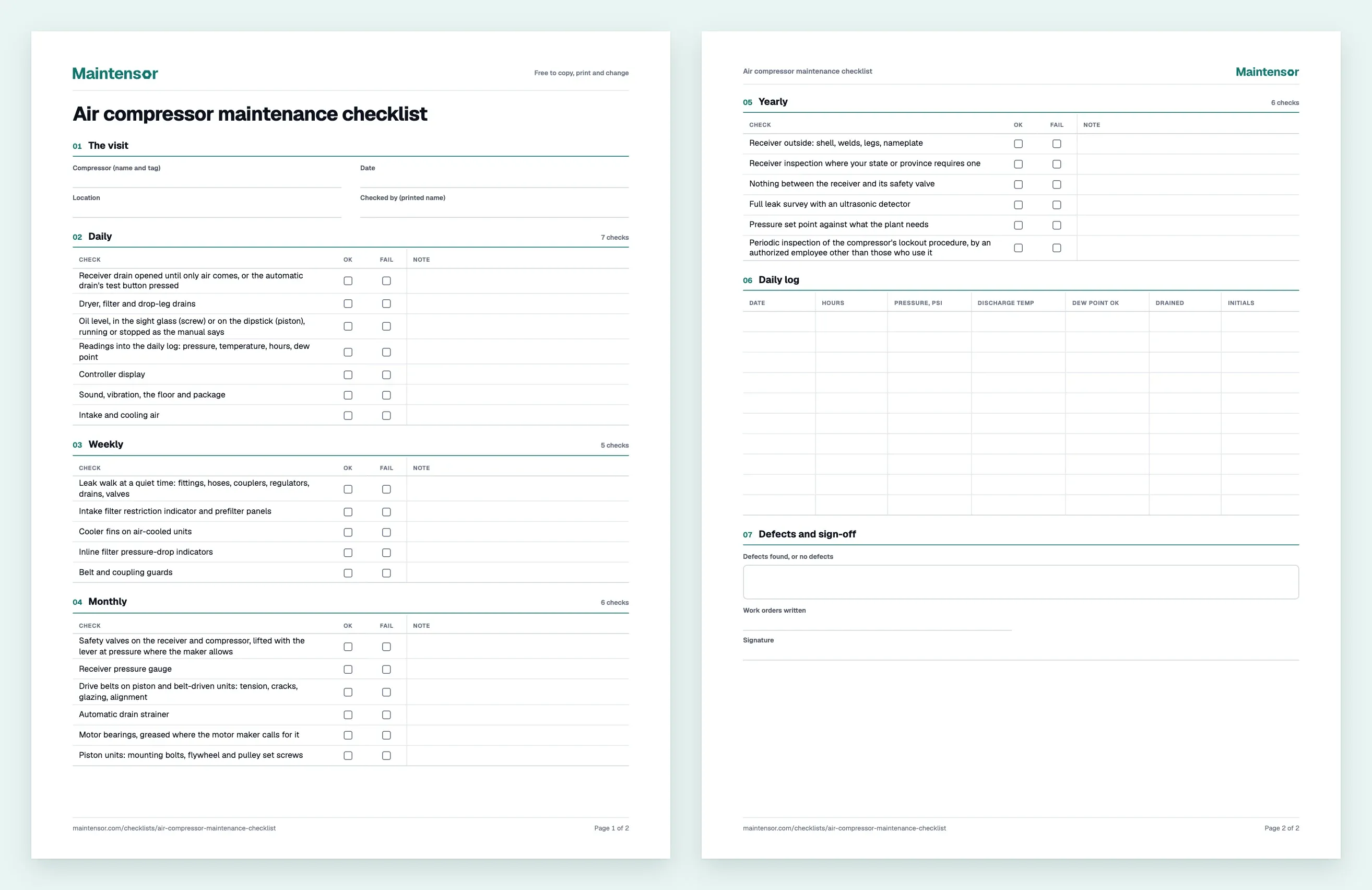
The checks, by visit
One sheet per compressor and visit, for oil-flooded rotary screw and piston units with their receiver, dryer and drains; an oil-free or centrifugal machine follows its own manual. A failed check gets a work order, and where this page and the manual disagree, the manual wins.
Daily7 checks
- Receiver drain opened until only air comes, or the automatic drain's test button pressed
- Dryer, filter and drop-leg drains
- Oil level, in the sight glass (screw) or on the dipstick (piston), running or stopped as the manual says
- Readings into the daily log: pressure, temperature, hours, dew point
- Controller display
- Sound, vibration, the floor and package
- Intake and cooling air
Weekly5 checks
- Leak walk at a quiet time: fittings, hoses, couplers, regulators, drains, valves
- Intake filter restriction indicator and prefilter panels
- Cooler fins on air-cooled units
- Inline filter pressure-drop indicators
- Belt and coupling guards
Monthly6 checks
- Safety valves on the receiver and compressor, lifted with the lever at pressure where the maker allows
- Receiver pressure gauge
- Drive belts on piston and belt-driven units: tension, cracks, glazing, alignment
- Automatic drain strainer
- Motor bearings, greased where the motor maker calls for it
- Piston units: mounting bolts, flywheel and pulley set screws
Yearly6 checks
- Receiver outside: shell, welds, legs, nameplate
- Receiver inspection where your state or province requires one
- Nothing between the receiver and its safety valve
- Full leak survey with an ultrasonic detector
- Pressure set point against what the plant needs
- Periodic inspection of the compressor's lockout procedure, by an authorized employee other than those who use it
What counts as a fail, check by checkThe full tables, the services by hours, and where each check comes from.
The last column says where each check comes from: Rule links the regulation, Maker is the compressor or dryer manual, and Practice is common plant practice.
Daily
| Check | Fail when | Basis |
|---|---|---|
| Receiver drain opened until only air comes, or the automatic drain’s test button pressed | Water or oil keeps coming, or the automatic drain does not discharge. 1910.169(b)(2) requires the receiver completely drained often enough to keep excess liquid from building up | Rule |
| Dryer, filter and drop-leg drains | Not discharging | Maker |
| Oil level, in the sight glass (screw) or on the dipstick (piston), running or stopped as the manual says | Below the mark, milky or foaming | Maker |
| Readings in the log below: pressure, temperature, hours, dew point | Outside the normal range, or moving the same way for several days | Maker |
| Controller display | Any active warning or alarm | Maker |
| Sound, vibration, the floor and package | A new noise or shake, fresh oil | Practice |
| Intake and cooling air | Louvers closed, or anything stored against the package | Maker |
Weekly
| Check | Fail when | Basis |
|---|---|---|
| Leak walk at a quiet time: fittings, hoses, couplers, regulators, drains, valves | Any leak: tag it and write it up | Practice |
| Intake filter restriction indicator and prefilter panels | Indicator in the red, panels clogged | Maker |
| Cooler fins on air-cooled units | Dust or oil mist plugging them | Maker |
| Inline filter pressure-drop indicators | In the red | Maker |
| Belt and coupling guards | Loose or missing, against 1910.219 | Rule |
Monthly
| Check | Fail when | Basis |
|---|---|---|
| Safety valves on the receiver and compressor, lifted with the lever at pressure where the maker allows | Will not lift, or will not reseat. 1910.169(b)(3)(iv) requires safety valves tested frequently and at regular intervals | Rule |
| Receiver pressure gauge | Unreadable, or far from the controller’s reading. 1910.169(b)(3)(i) requires a readily visible gauge | Rule |
| Drive belts on piston and belt-driven units: tension, cracks, glazing, alignment | Cracked, glazed or slipping. 1910.219(p)(1) requires power-transmission equipment inspected at intervals not exceeding 60 days | Rule |
| Automatic drain strainer | Clogged | Maker |
| Motor bearings, greased where the motor maker calls for it | Rough, noisy or hot | Maker |
| Piston units: mounting bolts, flywheel and pulley set screws | Anything loose | Practice |
By the hour meter
These intervals vary by maker, model, lubricant and running temperature, so the last column is left empty for your manual’s figures. Use the hour count the manual names, since a controller may show more than one.
| Task | Rotary screw | Piston | Your manual’s hours |
|---|---|---|---|
| Change compressor oil | Yes | Crankcase oil | |
| Change oil filter | Yes | ||
| Change air/oil separator element | Yes | ||
| Change intake filter element | Yes | Yes | |
| Inspect valves and rings | Yes | ||
| Other items in the manual, such as valves, seals and hoses | Yes | Yes |
Yearly
| Check | Fail when | Basis |
|---|---|---|
| Receiver outside: shell, welds, legs, nameplate | A bulge, crack, weeping weld, pitting rust, or no readable nameplate | Practice |
| Receiver inspection where your state or province requires one (see below) | Overdue | Rule |
| Nothing between the receiver and its safety valve | Any valve fitted there, which 1910.169(b)(3)(ii) forbids | Rule |
| Full leak survey with an ultrasonic detector | Leaks from the last survey still there | Practice |
| Pressure set point against what the plant needs | Set higher than the tools need | Practice |
| Periodic inspection of the compressor’s lockout procedure, by an authorized employee other than those who use it | Not done in the last year; 1910.147(c)(6) requires it at least once a year | Rule |
The daily reading log
A row a day is enough: hours, pressure, discharge temperature, dew point, the drain and initials. Your normal comes from the manual and from the first few weeks of your own readings.
ExampleOne compressor, Monday to Friday
Made-up readings.
| Date | Hours | Pressure, psi | Discharge temp, °F (°C) | Dew point OK | Drained | Initials |
|---|---|---|---|---|---|---|
| Mon | 21,402 | 112 | 178 (81) | Yes | Yes | LO |
| Tue | 21,418 | 111 | 181 (83) | Yes | Yes | LO |
| Wed | 21,434 | 112 | 184 (84) | Yes | Yes | TR |
| Thu | 21,450 | 112 | 187 (86) | Yes | Yes | TR |
| Fri | 21,466 | 111 | 190 (88) | Yes | Yes | LO |
Friday. Every reading is inside the range on the controller, and every box is ticked.
The week. The log still shows a 12 °F (7 °C) climb at the same pressure and hours. That is the time to clean the cooler and check the oil, before a high-temperature shutdown stops the plant.
The equipment maintenance log covers keeping a machine’s history beyond its readings.
Services by the hour meter
Oil, filters and the separator are changed at the hours in the maker’s manual. To put those hours on a calendar, divide them by the hours the compressor runs in a week.
ExampleTurning hours into a calendar repeat
A made-up plant runs two 8-hour shifts five days a week, 80 hours. Its made-up manual says 2,000 hours for filters, 4,000 for oil and 8,000 for the separator.
| Task | Hours | ÷ 80 a week | Repeat |
|---|---|---|---|
| Intake and oil filters | 2,000 | 25 weeks | Every 25 weeks |
| Oil | 4,000 | 50 weeks | Every 50 weeks |
| Separator | 8,000 | 100 weeks | Every 23 months |
The same compressor running around the clock, 168 hours a week, would need those filters every 11 weeks. Round down, record the hour meter at every service, and redo the sums when the plant adds a shift.
Sending an oil sample at each change, as oil analysis describes, tells you whether the interval could be longer.
What leaks cost
Leaks cost more than they sound. The Department of Energy’s compressed air tip sheet on leaks says they can waste as much as 20 to 30 percent of a compressor’s output, and that 5 to 10 percent of total flow is a typical target for leak reduction. By its table, at 100 psig (6.9 bar):
Listen during a quiet shift, then use an ultrasonic detector or soapy water on a brush, as the tip sheet suggests.
Before you start
When a check fails
A safety valve that will not lift or reseat, a receiver that leaks, bulges or is pitted with rust, or repeated high-temperature shutdowns take the unit out of service until fixed. Anything else gets a work order.
The receiver and its safety valve: what the rule says
OSHA 29 CFR 1910.169 covers compressed air receivers: how they are built and placed, their drain, their gauge and their safety valves. Many states and provinces add their own pressure vessel rules.
The rule, point by pointOSHA 1910.169, and two examples of state and provincial rules.
Under 1910.169:
- Receivers installed after the rule took effect are to be built to the 1968 edition of Section VIII of the ASME Boiler and Pressure Vessel Code.
- A receiver may not be buried or placed where its drains and openings cannot be reached.
- It needs a drain at its lowest point, opened often enough to keep excess liquid from building up, and a readily visible pressure gauge.
- Its spring-loaded safety valves must keep the pressure from exceeding the maximum allowable working pressure by more than 10 percent, with no valve of any kind between them and the receiver.
- Safety valves are to be tested frequently and at regular intervals.
Maryland’s labor department, for example, tells owners to drain receivers daily and have them inspected every two years as state law requires. It notes that many small receivers fall below the sizes that need an inspection.
In British Columbia, Technical Safety BC has owners inspect receivers as the maker and codes such as CSA B51 and the National Board Inspection Code require.
This is information, not legal advice: check with your jurisdiction and the maker.
Compressor checks in Maintensor: a daily log and services by hours
Build the daily check as a procedure and attach it to a work order on the compressor that repeats every working day. The services by hours are their own repeating work orders, at the weeks you worked out.
- Make each reading a Number step, and the drains and oil level Inspection checks. A Number step has no unit or limit of its own, so write both in: “Receiver pressure, psi (normal 105 to 115)”.
- A failed check asks for a note and a photo and offers a follow-up work order. On the weekly leak walk, one Fail with every tag listed in its note becomes one follow-up to fix them.
- The filters, oil and separator go on the services as planned parts, and carry to the next work order.

What it does not do: each reading stays on that day’s work order checklist; the app does not chart it, put it on the asset or show it in reporting. To see a week’s trend, open the done work orders one by one, or keep the paper log beside the unit as well.
Nothing comes due from the hour meter. Only Admins and Full users answer checklists, so whoever does the morning drain in the app needs a user seat. The manufacturing maintenance page shows the rest of a plant set up this way.