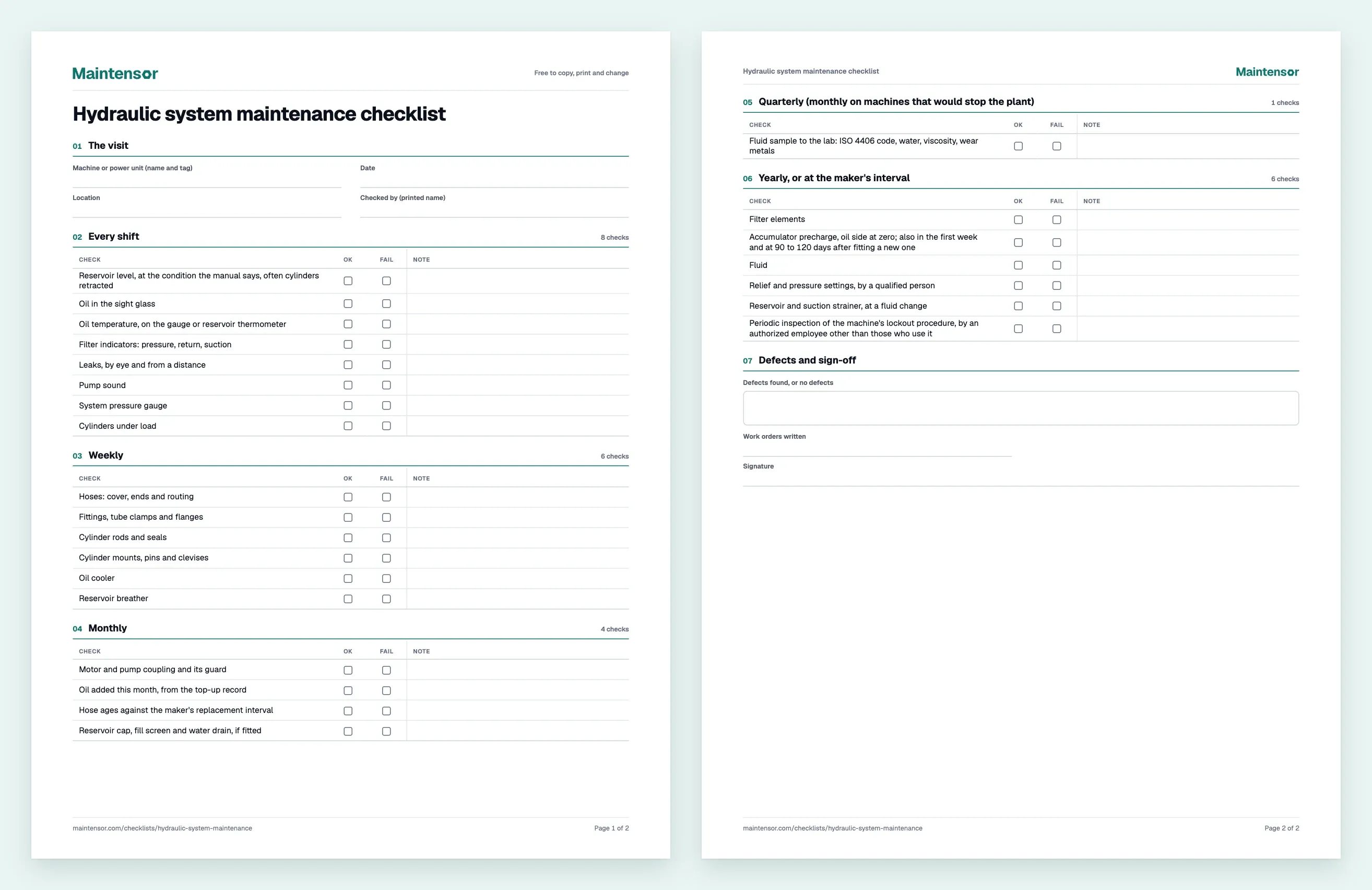
The checks, from every shift to yearly
The list fits an industrial hydraulic power unit (a press, a baler, a molding machine, a lift table, a dock leveler) and, with the maker’s manual beside it, the hydraulics of mobile machines. The heavy equipment inspection checklist has the rest of a loader or excavator. Where this page and the manual disagree, the manual wins.
Every shift8 checks
- Reservoir level, at the condition the manual says, often cylinders retracted
- Oil in the sight glass
- Oil temperature, on the gauge or reservoir thermometer
- Filter indicators: pressure, return, suction
- Leaks, by eye and from a distance
- Pump sound
- System pressure gauge
- Cylinders under load
Weekly6 checks
- Hoses: cover, ends and routing
- Fittings, tube clamps and flanges
- Cylinder rods and seals
- Cylinder mounts, pins and clevises
- Oil cooler
- Reservoir breather
Monthly4 checks
- Motor and pump coupling and its guard
- Oil added this month, from the top-up record
- Hose ages against the maker's replacement interval
- Reservoir cap, fill screen and water drain, if fitted
Quarterly (monthly on machines that would stop the plant)1 checks
- Fluid sample to the lab: ISO 4406 code, water, viscosity, wear metals
Yearly, or at the maker's interval6 checks
- Filter elements
- Accumulator precharge, oil side at zero; also in the first week and at 90 to 120 days after fitting a new one
- Fluid
- Relief and pressure settings, by a qualified person
- Reservoir and suction strainer, at a fluid change
- Periodic inspection of the machine's lockout procedure, by an authorized employee other than those who use it
What counts as a fail, check by checkThe full tables, where each check comes from, and who does it.
The last column says where each check comes from: Rule links the regulation, Maker is the machine or component manual, and Practice is common shop practice.
Every shift
| Check | Fail when | Basis |
|---|---|---|
| Reservoir level, at the condition the manual says, often cylinders retracted | Below the mark | Maker |
| Oil in the sight glass | Milky (water), foamy (air), dark or smelling burnt | Practice |
| Oil temperature, on the gauge or reservoir thermometer | Above the manual’s limit, or hotter than usual for the same work | Maker |
| Filter indicators: pressure, return, suction | In the red, or showing bypass | Maker |
| Leaks, by eye and from a distance | A new wet spot or puddle; any spray or mist means stop | Practice |
| Pump sound | A new whine, rattle or knock | Practice |
| System pressure gauge | Away from its normal reading | Maker |
| Cylinders under load | The load creeps down with the valve centered, or moves in jerks | Practice |
Weekly
| Check | Fail when | Basis |
|---|---|---|
| Hoses: cover, ends and routing | Wire showing, a blister, wet at the crimp, a kink or twist, rubbing on steel or another hose | Practice |
| Fittings, tube clamps and flanges | Wet, a clamp loose or missing, a cracked tube | Practice |
| Cylinder rods and seals | A scored or pitted rod, an oil ring on the rod, a torn wiper | Practice |
| Cylinder mounts, pins and clevises | Worn pins, play, a cracked mount | Practice |
| Oil cooler | Fins plugged (air cooled), low water flow (water cooled) | Maker |
| Reservoir breather | Dirty, desiccant spent, or missing | Maker |
Monthly
| Check | Fail when | Basis |
|---|---|---|
| Motor and pump coupling and its guard | A worn insert, misalignment, a loose guard. 1910.219(p)(1) requires power-transmission equipment inspected at intervals not exceeding 60 days | Rule |
| Oil added this month, from the top-up record | More than usual: a leak is hiding somewhere | Practice |
| Hose ages against the maker’s replacement interval | Past it | Maker |
| Reservoir cap, fill screen and water drain, if fitted | Cap missing, water at the drain | Practice |
Quarterly (monthly on machines that would stop the plant)
| Check | Fail when | Basis |
|---|---|---|
| Fluid sample to the lab: ISO 4406 code, water, viscosity, wear metals | Code above the maker’s target, water present, wear metals rising | Practice |
Yearly, or at the maker’s interval
| Check | Fail when | Basis |
|---|---|---|
| Filter elements | Not changed at the indicator or the maker’s interval | Maker |
| Accumulator precharge, oil side at zero; also in the first week and at 90 to 120 days after fitting a new one | Below the maker’s figure | Maker |
| Fluid | Not changed when analysis or the maker’s interval says | Maker |
| Relief and pressure settings, by a qualified person | Away from the settings in the manual | Maker |
| Reservoir and suction strainer, at a fluid change | Sludge, water or debris inside | Maker |
| Periodic inspection of the machine’s lockout procedure, by an authorized employee other than those who use it | Not done in the last year. 1910.147(c)(6) requires it at least once a year | Rule |
The schedule at a glance
| How often | What | Who |
|---|---|---|
| Every shift | Level, oil look, temperature, filter indicators, leaks by eye, sound, drift | Operator |
| Weekly | Hoses, fittings, rods, mounts, cooler, breather | Technician |
| Monthly | Coupling and guard, top-up record, hose ages | Technician |
| Quarterly | Fluid sample | Technician |
| Yearly | Filters and fluid as due, accumulator precharge, settings, reservoir, lockout inspection | Technician and qualified person |
Finding leaks without your hands
Oil escaping from a pinhole under pressure can go straight through skin, and the wound looks like a pinprick. In a medical case series of eight patients injected with lubricants or solvents, mild early symptoms grew into a severe compartment syndrome of the hand within 4 to 6 hours, and the authors call for immediate surgery.
- If the leak can wait, relieve it first. Shut down and relieve the pressure before looking.
- If it must be found running, use cardboard. Eye protection, gloves, stand to the side, and a piece of cardboard or wood held over the suspect hose or fitting.
- If anyone is injected, go now. Take them to an emergency room and tell the staff it was hydraulic oil under pressure. Do not wait to see if it gets worse.
- After the repair, wipe it clean. Wipe the area so the next leak shows.
The Cooperative Extension safety guidance is plain: never use your hand to check for a hydraulic leak, pass a piece of cardboard or a mirror over the area instead, and get immediate medical attention for any fluid in the skin.
Clean oil: sampling and ISO 4406
ISO 4406:2021 codes solid contamination in hydraulic fluid as three numbers: particles in one milliliter at 4, 6 and 14 micrometers and larger. Each step up the scale roughly doubles the count. On the standard’s scale, 19/16/13 means:
The target comes from your components: BSI notes that most hydraulic component makers require a certain cleanliness level for warranty purposes. Find it for the most sensitive part of the system, usually the pump or a servo or proportional valve.
ExampleA sample two steps over its target
Made-up numbers. The target is 17/15/12 and the sample comes back 19/17/14.
| Particle size | Target | Sample | Steps over |
|---|---|---|---|
| 4 µm and larger | 17 | 19 | 2 |
| 6 µm and larger | 15 | 17 | 2 |
| 14 µm and larger | 12 | 14 | 2 |
What it means. Each number is two steps over, so the oil carries roughly four times the particles allowed at every size.
What to do. Check the breather and the filter indicators, look for an open reservoir or a dirty top-up can, filter the oil, and sample again in a week.
Take every sample the same way, from the same valve, with the machine running at working temperature and a clean bottle, as your lab instructs. Filter new oil on its way in and keep drums sealed. Oil analysis covers reading the lab report, and condition monitoring covers where sampling sits among the other checks on condition.
Before you open the system
- Lock out. Lock out the pump motor.
- Bleed the accumulator. Open its dump valve and watch its gauge reach zero.
- Lower or block loads. Lower raised loads, or block them: a dock leveler’s maintenance strut, press blocks, cribbing.
- Prove it. Try the controls to prove nothing moves, then open the system.
When a check fails
A spraying or misting leak, a hose with its wire showing, or a load that drifts down: stop the machine and lock it out. Anything else gets a work order with a photo.
Precharge accumulators with dry nitrogen only. One accumulator maker’s manual says never to use air or oxygen, because of the danger of combustion or explosion, and to check the precharge in the first week after installation, again at 90 to 120 days, then once a year, with the oil side bled to zero first.
Stored energy: what the rule says
OSHA 29 CFR 1910.147 counts hydraulic energy as an energy source. Its paragraph (d)(5) requires stored or residual energy to be relieved, disconnected or restrained after lockout, and checked for as long as it can build up again; paragraph (d)(6) requires isolation to be verified before work starts.
What the rules sayOSHA's letter on hydraulic energy, NIOSH's guidance, guards, Canada.
- Energy left after shutdown. In a letter of interpretation, OSHA notes that hydraulic systems may hold energy that has to be bled off, and that some can remain after the equipment is shut off.
- NIOSH. NIOSH guidance on lockout lists venting accumulators and blocking fluid flow.
- Guards. Guards on couplings and moving parts fall under 1910.212 and 1910.219.
- Canada. Provinces have their own lockout rules.
This is information, not legal advice: check the rules that apply and the maker’s manual.
Hydraulic care in Maintensor: a procedure for each of four visits
Build a procedure for each visit: the shift check, the weekly hose and cylinder walk, the quarterly sample and the yearly service.
- Open the weekly one with an Instruction step: “Look, do not touch. Use cardboard.” Open the yearly one with the bleed-down steps as Instructions, then a Checkbox marked Required: “Accumulator gauge at zero, loads blocked, controls tried.” A skipped required step does not stop anyone finishing, but it is listed at sign-off and written to the history.
- Give the yearly one a Number step for the precharge, and the quarterly one a File step for the lab’s report.
- A failed check asks for a note and a photo, then offers a follow-up work order and Mark asset down. Filter elements go on the filter change as planned parts, which carry to the next work order and show how many are short when the storeroom cannot cover the job.

What it does not do: the app does no oil analysis and keeps no trend of readings. A Number step’s value and the lab’s file stay on that work order, so comparing this quarter’s code with the last means opening last quarter’s work order from the asset’s Work orders tab.
Only Admins and Full users answer checklists, so an operator doing the shift check in the app needs a user seat. The manufacturing maintenance page shows the rest of a plant’s setup, and the dock leveler checklist covers the leveler in the picture.