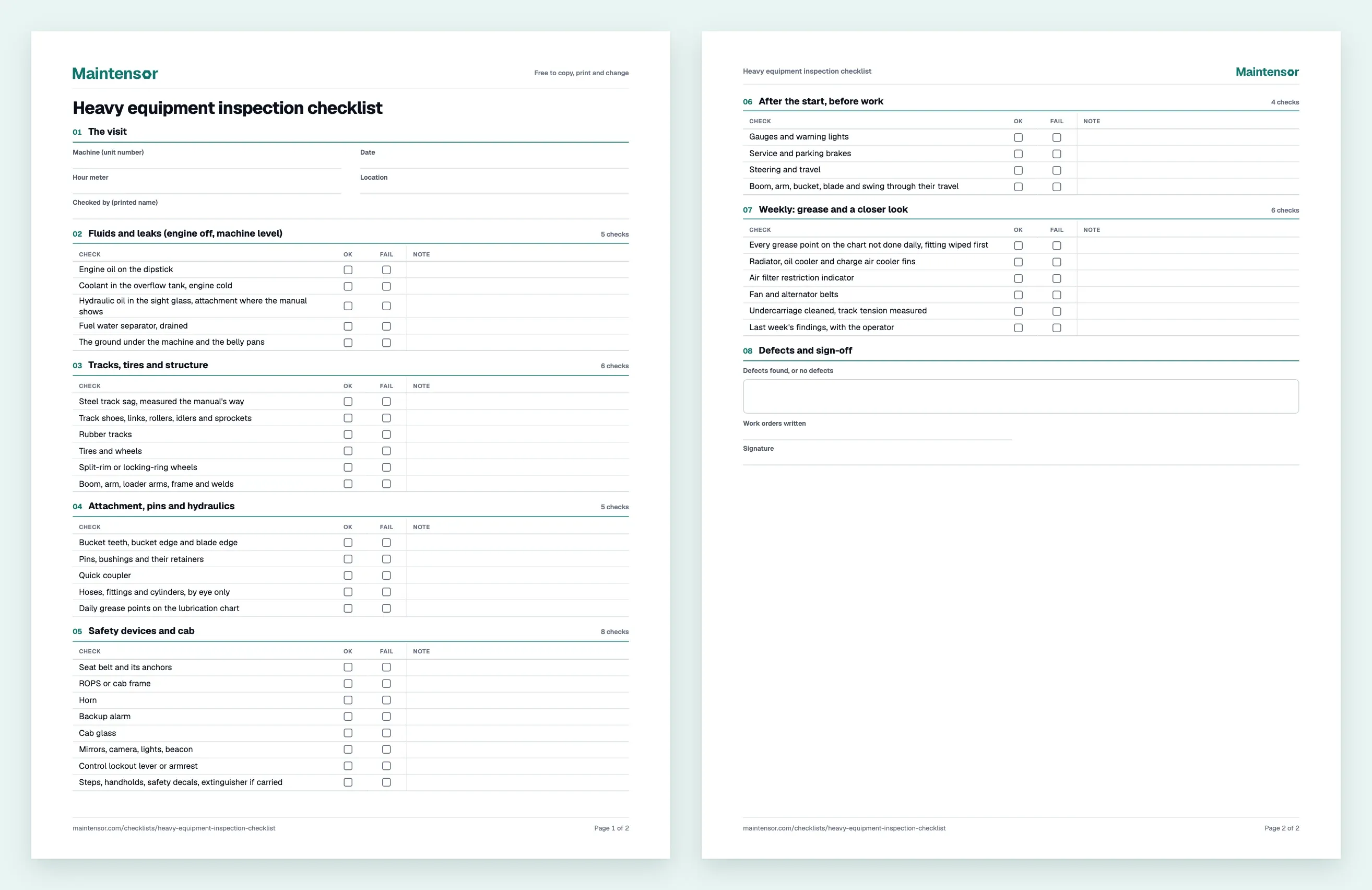
The checks, daily and weekly
One sheet per machine. A machine that fails a safety check stays parked until it is fixed. Cut what your machines do not have and add the daily items from each machine’s manual, which wins where the two disagree.
Fluids and leaks (engine off, machine level)5 checks
- Engine oil on the dipstick
- Coolant in the overflow tank, engine cold
- Hydraulic oil in the sight glass, attachment where the manual shows
- Fuel water separator, drained
- The ground under the machine and the belly pans
Tracks, tires and structure6 checks
- Steel track sag, measured the manual's way
- Track shoes, links, rollers, idlers and sprockets
- Rubber tracks
- Tires and wheels
- Split-rim or locking-ring wheels
- Boom, arm, loader arms, frame and welds
Attachment, pins and hydraulics5 checks
- Bucket teeth, bucket edge and blade edge
- Pins, bushings and their retainers
- Quick coupler
- Hoses, fittings and cylinders, by eye only
- Daily grease points on the lubrication chart
Safety devices and cab8 checks
- Seat belt and its anchors
- ROPS or cab frame
- Horn
- Backup alarm
- Cab glass
- Mirrors, camera, lights, beacon
- Control lockout lever or armrest
- Steps, handholds, safety decals, extinguisher if carried
After the start, before work4 checks
- Gauges and warning lights
- Service and parking brakes
- Steering and travel
- Boom, arm, bucket, blade and swing through their travel
Weekly: grease and a closer look6 checks
- Every grease point on the chart not done daily, fitting wiped first
- Radiator, oil cooler and charge air cooler fins
- Air filter restriction indicator
- Fan and alternator belts
- Undercarriage cleaned, track tension measured
- Last week's findings, with the operator
What counts as a fail, check by checkThe full tables, and where each check comes from.
The last column is where the check comes from. Rule links the regulation. Maker means it belongs on the daily list in the machine’s own service schedule (often headed “every 10 hours”); check that each line is on yours. Practice means common shop practice.
Fluids and leaks (engine off, machine level)
| Check | Fail when | Basis |
|---|---|---|
| Engine oil on the dipstick | Below the add mark, milky, or smelling of fuel | Maker |
| Coolant in the overflow tank, engine cold | Below the cold mark. Never open a hot radiator cap | Maker |
| Hydraulic oil in the sight glass, attachment where the manual shows | Below the mark, foamy or milky | Maker |
| Fuel water separator, drained | Water keeps coming | Maker |
| The ground under the machine and the belly pans | Fresh drips, wet hoses, oil on the tracks or tires | Practice |
Tracks, tires and structure
| Check | Fail when | Basis |
|---|---|---|
| Steel track sag, measured the manual’s way | Outside the manual’s range | Maker |
| Track shoes, links, rollers, idlers and sprockets | A loose or missing shoe bolt, a roller that does not turn, a cracked link, packed rock | Practice |
| Rubber tracks | Cuts that show the steel cords, missing lugs | Practice |
| Tires and wheels | A cut to the cords, a bulge, a loose or missing lug nut, pressure below the manual | Maker |
| Split-rim or locking-ring wheels | A ring not seated. Never inflate one without the cage or rack that 1926.600(a)(2) requires | Rule |
| Boom, arm, loader arms, frame and welds | Any new crack, or paint cracking along a weld | Practice |
Attachment, pins and hydraulics
| Check | Fail when | Basis |
|---|---|---|
| Bucket teeth, bucket edge and blade edge | Teeth missing, an edge worn to the maker’s limit | Practice |
| Pins, bushings and their retainers | A pin walking out, a missing keeper or retainer bolt, play you can see as the bucket curls | Practice |
| Quick coupler | The lock does not show locked, or the attachment shifts when pressed into the ground | Maker |
| Hoses, fittings and cylinders, by eye only | Wet fittings, a cover worn to the wire, a kink, a scored rod, a leaking rod seal | Practice |
| Daily grease points on the lubrication chart | Dry pins, no fresh grease at the joints | Maker |
Safety devices and cab
| Check | Fail when | Basis |
|---|---|---|
| Seat belt and its anchors | Will not latch, webbing cut or sun-faded, an anchor loose. 1926.602(a)(2) requires seat belts on earthmoving equipment | Rule |
| ROPS or cab frame | A loose or missing bolt, a crack, a hole drilled or a bracket welded on. 1926.1000(d) requires a removed ROPS to go back with bolts or welding of equal or better quality | Rule |
| Horn | Cannot be heard over the site noise, as 1926.602(a)(9)(i) requires | Rule |
| Backup alarm | Silent or drowned out on a machine with an obstructed rear view. 1926.602(a)(9)(ii) allows reversing without one only when someone signals it is safe | Rule |
| Cab glass | Cracked or distorted enough to affect operation. 1926.600(a)(5) requires safety glass with no visible distortion | Rule |
| Mirrors, camera, lights, beacon | Missing, cracked or out | Practice |
| Control lockout lever or armrest | The hydraulics move with the lockout engaged | Maker |
| Steps, handholds, safety decals, extinguisher if carried | A loose handhold, steps caked with mud, a decal you cannot read, a discharged extinguisher | Maker |
After the start, before work
| Check | Fail when | Basis |
|---|---|---|
| Gauges and warning lights | A warning stays on, or oil pressure is low | Maker |
| Service and parking brakes | Will not stop the machine, or will not hold it on a grade. 1926.602(a)(4) requires brakes that stop and hold it fully loaded | Rule |
| Steering and travel | Pulls, wanders or lags | Practice |
| Boom, arm, bucket, blade and swing through their travel | Jerky motion, a whine, or the boom drifting down with the lever in neutral | Practice |
Weekly: grease and a closer look
The lubrication chart in the manual is the list: each grease point, the grease and how often. A point the chart sets at every 50 hours comes due weekly on a machine that runs about 50 hours a week. On one that runs more, grease sooner.
| Check | Fail when | Basis |
|---|---|---|
| Every grease point on the chart not done daily, fitting wiped first | A fitting that will not take grease (replace it) | Maker |
| Radiator, oil cooler and charge air cooler fins | Packed with dust, leaves or chaff | Maker |
| Air filter restriction indicator | In the red | Maker |
| Fan and alternator belts | Cracked, glazed or loose | Maker |
| Undercarriage cleaned, track tension measured | Rock packed into rollers and sprockets | Practice |
| Last week’s findings, with the operator | A defect noted twice with no work order | Practice |
Service by the hour meter, on the calendar
Manuals set the bigger services by the hour meter: engine oil and filter, hydraulic filters and fluid, coolant, often with a calendar limit beside the hours, such as “or every 12 months”. The figures differ by maker and model, so take them from your manual.
A calendar can carry them once you know each machine’s weekly hours, turning them into time-based maintenance.
- Measure the hours. Read the hour meter on the same weekday for a few weeks, or take the last 3 months: meter now minus meter then, divided by the weeks between.
- Divide. Weeks between services = service hours ÷ hours a week.
- Round down, so the service comes a little early rather than late.
- Cap it at the manual’s calendar limit, the “or every 12 months”. A machine that barely runs still needs its oil changed.
- Record the hour meter at every service, and redo the arithmetic when a machine moves to a busier or quieter job.
ExampleTurning hours into a calendar repeat
A made-up yard, assuming every machine’s manual says 250 hours for engine oil and 500 for the hydraulics.
| Machine | Hours a week | Service | Weeks between | Repeat on the calendar |
|---|---|---|---|---|
| Excavator EX-1 | 60 | Engine oil and filter, 250 h | 250 ÷ 60 = 4.2 | Every 4 weeks |
| Excavator EX-1 | 60 | Hydraulic filters and fluid, 500 h | 500 ÷ 60 = 8.3 | Every 8 weeks |
| Wheel loader L-2 | 45 | Engine oil and filter, 250 h | 250 ÷ 45 = 5.6 | Every 5 weeks |
| Skid steer SS-3 | 20 | Engine oil and filter, 250 h | 250 ÷ 20 = 12.5 | Every 12 weeks |
| Spare skid steer SS-4 | 4 | Engine oil and filter, 250 h | 250 ÷ 4 = 62.5 | Every 12 months, the cap |
The spare skid steer. At 4 hours a week, the arithmetic gives 62.5 weeks; the manual’s 12 months comes first.
Seasonal work. Set the repeat from the busy season’s hours. In the slow months the service comes early, which costs a filter and some oil; the other way round can cost an engine.
Oil analysis is how to change oil on its condition instead of a count.
Before you start
When a check fails
Unsafe to run (brakes, steering, seat belt, horn, backup alarm, ROPS, a spraying leak, a cracked boom): do not start it. Take the key, tag the controls and tell the supervisor. On construction sites, OSHA 29 CFR 1926.20(b)(3) requires equipment that breaks the construction rules to be tagged, have its controls locked, or be removed.
Wrong but safe (a worn tooth, a weeping fitting, a work light out): write a work order the same day with a photo, and say whether the machine may keep working.
This list is a starting point and does not replace operator training. Machines it does not cover have lists of their own: scissor lifts, and the overhead or gantry crane in a shop that has one.
Who requires the inspection
On US construction sites, 1926.20(b)(2) asks for frequent and regular inspections of equipment by competent persons the employer designates. A loader in a plant yard or a fleet depot sits outside the construction and mining rules, so its manual is the main source.
What the rules sayOSHA's rules for earthmoving equipment and site vehicles, MSHA for mines, and Canada.
- Earthmoving equipment. 1926.602(a), quoted in the tables, covers scrapers, loaders, crawler and wheel tractors, bulldozers, off-highway trucks, graders, agricultural and industrial tractors and similar equipment, and reserves rules for compactors and rubber-tired skid steers.
- Parked equipment. 1926.600(a)(3) requires blades, buckets and dump bodies to be fully lowered or blocked when not in use or under repair, and the parking brake set whenever equipment is parked, with the wheels chocked on an incline.
- Rollover protection. 1926.1000 sets rollover protection for rubber-tired scrapers, loaders and dozers, crawler tractors and loaders, and motor graders, and for compactors and rubber-tired skid steers made after July 15, 2019.
- Haul trucks. Off-highway haul trucks are earthmoving equipment under 1926.602.
- Other site vehicles. Motor vehicles working on a site closed to public traffic, such as pickups and dump trucks, fall under 1926.601(b)(14): brakes, tires, horn, steering, seat belts, controls and safety devices checked at the beginning of each shift, and every defect corrected before the vehicle goes into service. Trucks on public roads have their own pre-trip inspection.
- Mines. In surface metal and nonmetal mines, MSHA’s 30 CFR 56.14100 requires the equipment operator to inspect self-propelled mobile equipment before it goes into operation on that shift, and safety defects not corrected at once to be reported to and recorded by the mine operator.
- Canada. Each province sets its own rules.
All of this is information, not legal advice: check the rules for your site and the maker’s manual.
Walk-arounds and hour-based services in Maintensor
Build one procedure per kind of machine: an excavator and a skid steer do not share a list. Use a Heading step for each table above, an Inspection check (Pass, Flag or Fail) for each line, a Number step for the hour meter and a Signature step to finish.
- The daily repeat. Attach the procedure to a work order for each machine and set the repeat: Daily, or Weekly with Monday to Friday ticked for a five-day crew. The next work order is created when this one is completed. One missed while the machine sat idle shows as overdue; once it is completed, the next is due on the first scheduled date after today, so missed days do not pile up.
- The services by hours are separate repeating work orders, every so many weeks as worked out above, with the filters and oil as planned parts, so the work order says when the storeroom is short.
- A Fail asks for a note and a photo before the next step, then offers a follow-up work order and Mark asset down, so the machine shows as Down until someone sets it back to Operational.

What it does not do: nothing comes due from the hour meter. The reading in a Number step stays on that work order’s checklist, not on the asset or in reporting, so the hours-to-weeks arithmetic stays with you. The app runs in a phone’s browser and needs a signal: there is no offline mode, which matters on a remote site.
Only Admins and Full users answer checklists, so an operator who does the walk-around in the app needs a user seat; a Requester, free on every plan, can report a problem but cannot answer the checklist. Trucks and trailers in the yard get the same records, as the page on fleet maintenance software shows.