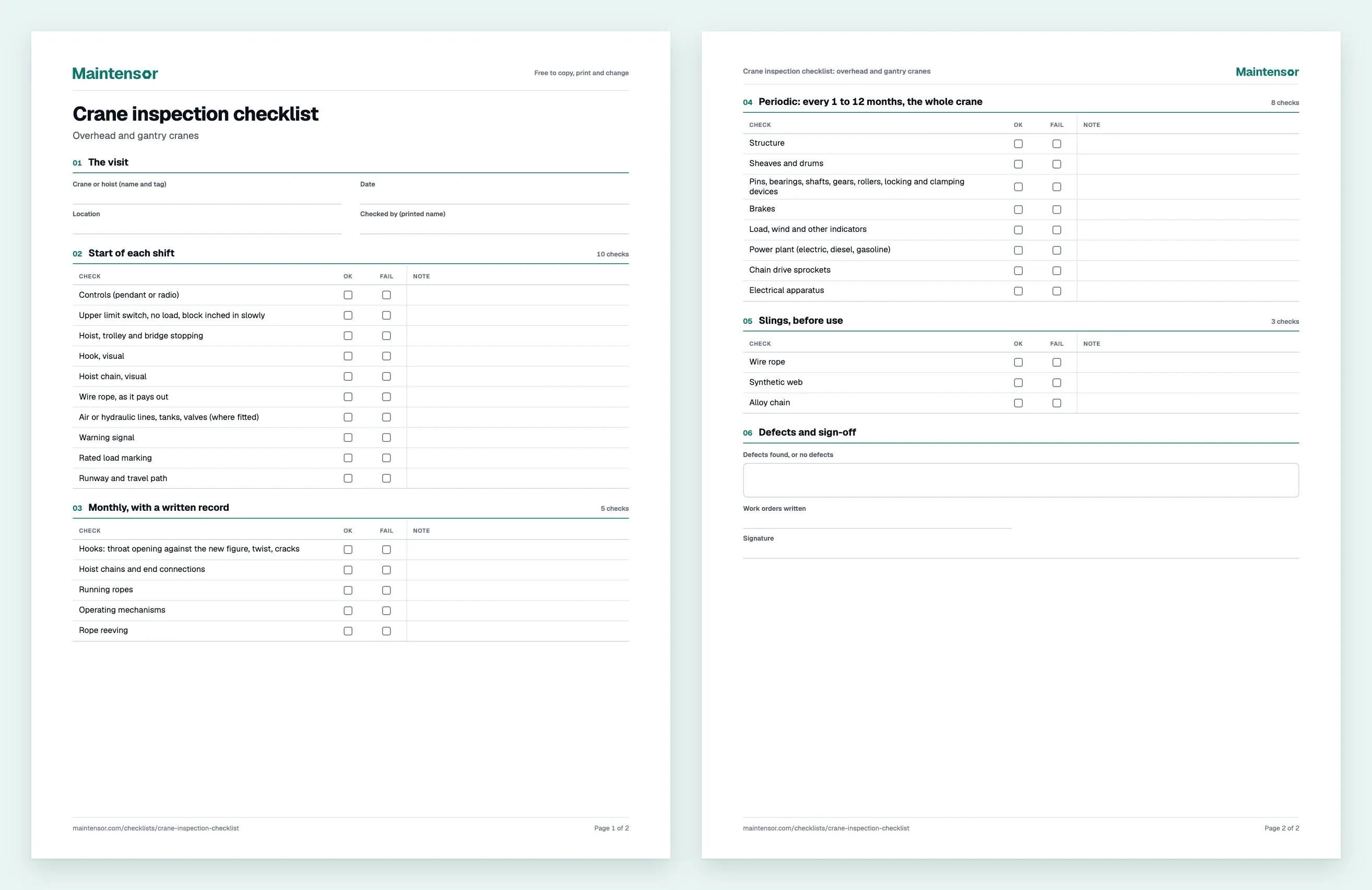
The checks, by inspection
The sheet holds the operator’s start-of-shift checks and the periodic inspection of the whole crane, which includes every frequent item. The monthly hook, chain and rope inspection has a record of its own, set out below. Your crane’s manual and your inspector come first.
Start of each shift10 checks
- Controls (pendant or radio)
- Upper limit switch, no load, block inched in slowly
- Hoist, trolley and bridge stopping
- Hook, visual
- Hoist chain, visual
- Wire rope, as it pays out
- Air or hydraulic lines, tanks, valves (where fitted)
- Warning signal
- Rated load marking
- Runway and travel path
Monthly, with a written record5 checks
- Hooks: throat opening against the new figure, twist, cracks
- Hoist chains and end connections
- Running ropes
- Operating mechanisms
- Rope reeving
Periodic: every 1 to 12 months, the whole crane8 checks
- Structure
- Sheaves and drums
- Pins, bearings, shafts, gears, rollers, locking and clamping devices
- Brakes
- Load, wind and other indicators
- Power plant (electric, diesel, gasoline)
- Chain drive sprockets
- Electrical apparatus
Slings, before use3 checks
- Wire rope
- Synthetic web
- Alloy chain
Slings are inspected too: 1910.184(d) has each sling and its fastenings inspected each day before use by a competent person the employer designates, and more often during use where conditions warrant. Damaged slings come out of service at once.
What counts as a fail, check by checkThe full tables, with the paragraph of the rule behind each, and the slings.
Paragraph numbers are those of 1910.179, and of 1910.184 for slings.
Start of each shift
| Check | What counts as a fail | Rule |
|---|---|---|
| Controls (pendant or radio) | A motion that sticks, drifts, runs the wrong way, or is labeled wrongly; labels unreadable | (j)(2)(i), daily; (l)(3)(iii)(d) |
| Upper limit switch, no load, block inched in slowly | Hook block does not stop before it reaches the trolley | (n)(4)(i), each operator’s shift |
| Hoist, trolley and bridge stopping | Hook or load drifts after release; bridge or trolley does not stop as usual | (j)(2)(i), daily |
| Hook, visual | Cracks, bending, an opening wider than usual, twist. Safety latch broken or missing (practice) | (j)(2)(iii), daily |
| Hoist chain, visual | Wear, twist, distorted links, stretch | (j)(2)(iv), daily |
| Wire rope, as it pays out | Kinks, crushing, birdcaging, broken wires, rope out of the drum grooves | Practice; criteria in (m)(1) |
| Air or hydraulic lines, tanks, valves (where fitted) | Leaks or deterioration | (j)(2)(ii), daily |
| Warning signal | Horn or bell silent | (n)(3)(xi) |
| Rated load marking | Not readable from the floor | (b)(5) |
| Runway and travel path | People or stock in the path, a runway stop missing, new noise or vibration | Practice |
When a load near the crane’s rating is lifted, (n)(3)(vii) has the operator test the brakes by raising it a few inches and applying them.
Monthly, with a written record
| Item | What to look for | The record the rule asks for |
|---|---|---|
| Hooks | Cracks; a throat opening more than 15% wider than normal; more than 10 degrees of twist from the plane of the unbent hook. A hook like that is discarded under (l)(3)(iii)(a) | Date, inspector’s signature, hook serial number or other identifier: (j)(2)(iii) |
| Hoist chains and end connections | Excessive wear, twist, distorted links, stretch beyond the maker’s figure | Date, signature, chain identifier: (j)(2)(iv) |
| Running ropes | Diameter below nominal; broken outside wires, how many and how bunched; worn outside wires; corroded or broken wires at end connections; corroded, cracked, bent, worn or wrongly fitted end connections; severe kinking, crushing, cutting or unstranding | Date, signature, rope identifier: (m)(1) |
| Operating mechanisms | Excessive wear of components | None in the rule: (j)(2)(vi) |
| Rope reeving | Not as the maker specifies | None in the rule: (j)(2)(vii) |
Periodic: every 1 to 12 months, the whole crane
The periodic inspection includes every frequent item, plus these from (j)(3):
| Area | What counts as a fail |
|---|---|
| Structure | Deformed, cracked or corroded members; loose bolts or rivets |
| Sheaves and drums | Cracked or worn |
| Pins, bearings, shafts, gears, rollers, locking and clamping devices | Worn, cracked or distorted |
| Brakes | Excessive wear on brake parts, linings, pawls and ratchets |
| Load, wind and other indicators | Significant inaccuracy over their full range |
| Power plant (electric, diesel, gasoline) | Not performing properly, or not meeting safety requirements |
| Chain drive sprockets | Excessive wear; drive chain stretch |
| Electrical apparatus | Pitting or deterioration of controller contactors, limit switches and pushbutton stations |
Slings, each day before use
| Sling | Remove from service when |
|---|---|
| Wire rope | 10 randomly distributed broken wires in one rope lay, or 5 in one strand in one lay; outside wires worn by a third of their diameter; kinking, crushing or birdcaging; heat damage; cracked, deformed or worn end attachments; a hook opened more than 15% or twisted more than 10 degrees; corrosion: (f)(5) |
| Synthetic web | Acid or caustic burns; melting or charring; snags, punctures, tears or cuts; broken or worn stitches; distorted fittings: (i)(9) |
| Alloy chain | Cracked or deformed master links, coupling links or other parts: (e)(9). Also a thorough inspection at least every 12 months, with a record of the month it was done: (e)(3) |
| Chain, web or fiber rope | Identification tag missing or unreadable: (e)(1), (i)(1), (h)(1) |
The monthly record: hooks, chains and ropes
Hooks, hoist chains and running ropes get a thorough inspection each month, with a record of the date, the inspector’s signature and an identifier for each item. What takes each out of service:
Measure each hook when it is new
Measure each hook’s throat opening when it is new and write the figure on its record. Without that baseline, nobody can say whether it has opened 15%.
The rule lists rope conditions without numbers; the crane maker’s manual and ASME B30.2 give the limits for removing a rope.
How often the whole crane is inspected
The rule sets the periodic interval by “activity, severity of service, and environment”.
ExampleThree cranes, three intervals
Made-up cranes, to show how the rule’s three factors play out.
| Crane | Use | Setting | Periodic interval chosen |
|---|---|---|---|
| 5 ton bridge crane over a maintenance bay | A few lifts a week | Clean, heated | 12 months |
| 10 ton crane in a steel warehouse | Most of every shift, often near its rating | Dusty, unheated | 3 months |
| 2 ton gantry in an outdoor yard | Daily | Rain, road salt, cold | 6 months |
Cranes that sit idle have their own rules in (j)(4), and idle rope in (m)(2):
Before you start
When a check fails
The crane stops. Paragraph (l)(3)(i) says unsafe conditions found by inspection are corrected before operation resumes, and only designated personnel adjust or repair. If the upper limit switch does not work, (n)(4)(i) says the appointed person is told at once.
The rule is the floor, not the whole job: ASME B30.2 is the US consensus standard for overhead and gantry cranes, and ASME B30.9 for slings. In Canada, provinces set their own rules, and CSA B167 covers the design, inspection, testing, maintenance and safe operation of overhead cranes, gantry cranes, monorails, hoists and jib cranes.
No checklist replaces operator training or a qualified inspector.
Crane inspections in Maintensor: shift, monthly and periodic records
Build three procedures from the tables above. The start-of-shift check is a row of Inspection checks (Pass, Flag, Fail), on a work order that repeats daily or weekly on the days the crane runs, assigned to its operators.
- The monthly inspection adds what the record needs: a Text step for the hook’s serial number and the chain or rope identifier, a Number step for the throat opening (with units and limits in its label: “Throat opening, inches, new 1.25”), a Photo step, a Text step for the inspector’s name, and a Signature step they draw.
- The periodic inspection is a yearly (or every 3 or 6 months) work order assigned to whoever books the crane inspector, with their report attached as a PDF.
- A failed check asks for a note and a photo, then offers a follow-up work order on the same crane and “Mark asset down”. A crane with two hoists can keep each hoist as an asset that is Part of the crane.

The completed work order holds the date, who completed it, every answer and the signature. Whether that is the “certification record” the rule means is for you and your inspector to decide: the app records what was done; it certifies nothing.
What it does not do: the Signature step stores the drawn signature and its time, not which user signed, which is why the name step is there. Each reading stays on its own work order, so comparing this month’s throat opening with last month’s means opening last month’s job.
Only Full users and Admins answer checklists, so each operator who does it in the app needs a user seat. The equipment maintenance log explains what a crane’s history should hold, and the manufacturing page shows how a plant runs its recurring work in the app.