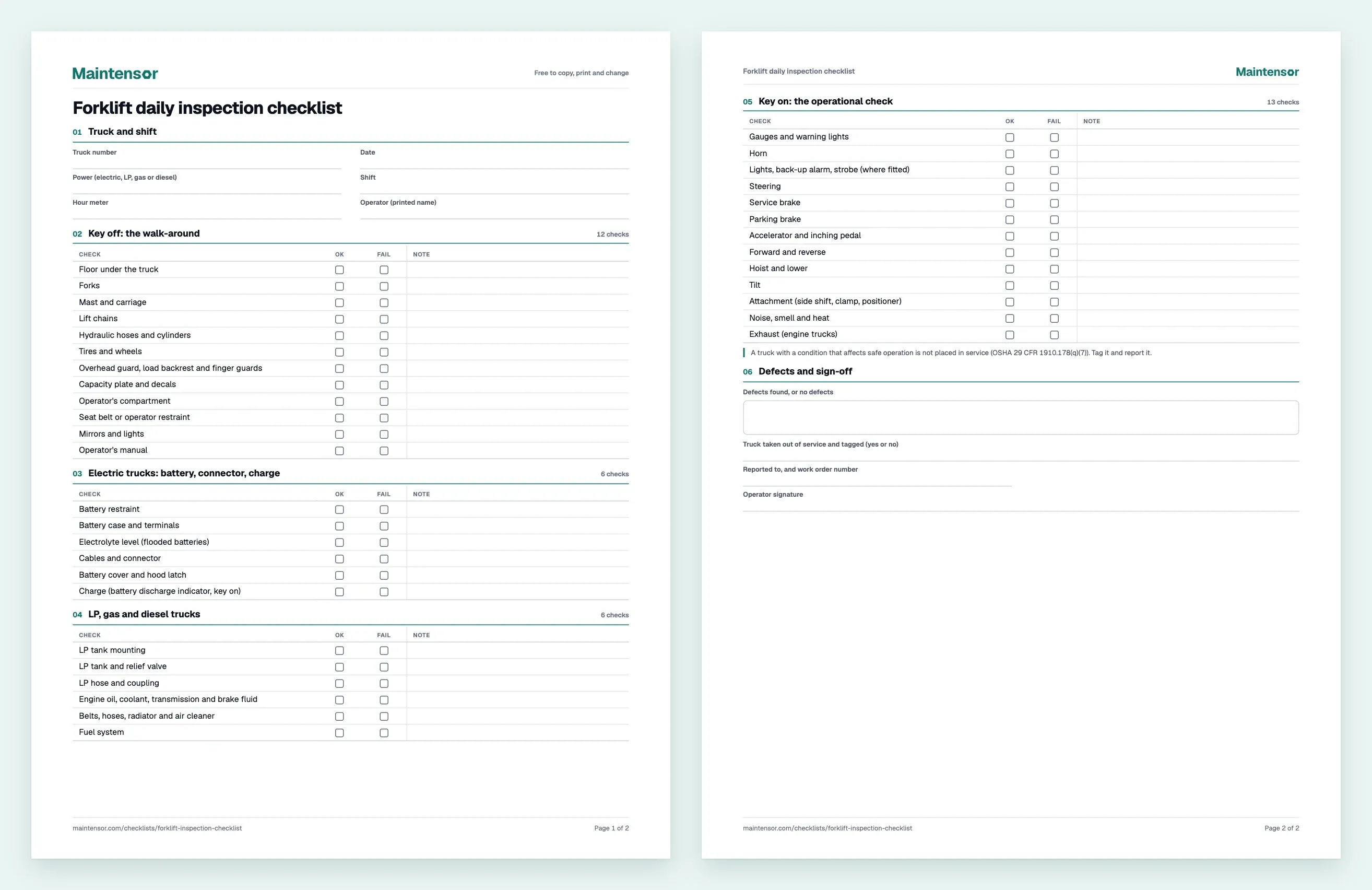
The checks, key off and key on
Two passes at the truck. The first is a walk-around with the key off, looking and touching; an electric truck adds its battery, and an engine truck its fuel system. The second is with the truck running, testing everything that moves, stops or warns.
Key off: the walk-around12 checks
- Floor under the truck
- Forks
- Mast and carriage
- Lift chains
- Hydraulic hoses and cylinders
- Tires and wheels
- Overhead guard, load backrest and finger guards
- Capacity plate and decals
- Operator's compartment
- Seat belt or operator restraint
- Mirrors and lights
- Operator's manual
Electric trucks: battery, connector, charge6 checks
- Battery restraint
- Battery case and terminals
- Electrolyte level (flooded batteries)
- Cables and connector
- Battery cover and hood latch
- Charge (battery discharge indicator, key on)
LP, gas and diesel trucks6 checks
- LP tank mounting
- LP tank and relief valve
- LP hose and coupling
- Engine oil, coolant, transmission and brake fluid
- Belts, hoses, radiator and air cleaner
- Fuel system
Key on: the operational check13 checks
- Gauges and warning lights
- Horn
- Lights, back-up alarm, strobe (where fitted)
- Steering
- Service brake
- Parking brake
- Accelerator and inching pedal
- Forward and reverse
- Hoist and lower
- Tilt
- Attachment (side shift, clamp, positioner)
- Noise, smell and heat
- Exhaust (engine trucks)
What counts as a fail, check by checkThe full tables, key off and key on, for electric and engine trucks.
Key off: the walk-around
| Check | What counts as a fail |
|---|---|
| Floor under the truck | A fresh puddle of oil, hydraulic fluid, coolant or electrolyte |
| Forks | Cracked, bent or uneven tips; heel worn thin; locking pin or retaining clip missing or loose |
| Mast and carriage | Cracked welds, bent rails, loose bolts, damaged rollers |
| Lift chains | Stiff, kinked or rusted links, a broken link or pin, one chain slacker than the other. Check tension with a stick, never a hand |
| Hydraulic hoses and cylinders | Wet fittings, cracked or rubbing hoses, a weeping cylinder seal |
| Tires and wheels | Cuts or chunks out of the tread, flat spots, low pressure on air-filled tires, loose or missing lug nuts |
| Overhead guard, load backrest and finger guards | Bent, cracked or missing |
| Capacity plate and decals | Missing, unreadable, or not matching the attachment on the truck |
| Operator’s compartment | Grease, debris or loose objects on the floor or pedals; seat loose or torn |
| Seat belt or operator restraint | Frayed, cut, will not latch or will not retract |
| Mirrors and lights | Missing, or cracked so the view or the light is lost |
| Operator’s manual | Not on the truck, where the maker puts one there |
Electric trucks: battery, connector, charge
| Check | What counts as a fail |
|---|---|
| Battery restraint | Battery not seated, or its restraint missing or loose |
| Battery case and terminals | Cracked case, electrolyte on top, corrosion built up on terminals |
| Electrolyte level (flooded batteries) | Below the mark the battery maker gives. Wear a face shield, rubber apron and rubber gloves |
| Cables and connector | Frayed or bare cable, cracked or scorched connector housing, loose terminals |
| Battery cover and hood latch | Will not close or latch |
| Charge (battery discharge indicator, key on) | Below the level your site sets for starting a shift |
LP, gas and diesel trucks
| Check | What counts as a fail |
|---|---|
| LP tank mounting | Tank not seated in its bracket, latch open, locating pin not engaged, tank sticking out past the truck’s profile |
| LP tank and relief valve | Dented, gouged or rusted tank; relief valve not pointing up |
| LP hose and coupling | Cracked hose, a leaking coupling, a hiss or a smell of gas. Wear a face shield, long sleeves and gauntlet gloves |
| Engine oil, coolant, transmission and brake fluid | Below the mark (coolant checked cold) |
| Belts, hoses, radiator and air cleaner | Cracked or loose belt, leaking hose, radiator packed with dust |
| Fuel system | Any leak. Under 1910.178(p)(4) no truck runs with a fuel leak until it is fixed |
Key on: the operational check
Do this in a clear area with headroom, with no load on the forks.
| Check | What counts as a fail |
|---|---|
| Gauges and warning lights | A warning light that stays on; hour meter not counting |
| Horn | Does not sound |
| Lights, back-up alarm, strobe (where fitted) | Out, weak or silent |
| Steering | Hard, jerky, or more free play than usual |
| Service brake | Truck does not stop smoothly and straight from walking speed |
| Parking brake | Does not hold the truck |
| Accelerator and inching pedal | Sticks, or does not return |
| Forward and reverse | Hesitates, jerks, or creeps with no pedal |
| Hoist and lower | Mast chatters or jerks, drifts down in neutral, or does not reach full height |
| Tilt | Does not reach full tilt both ways, or drifts |
| Attachment (side shift, clamp, positioner) | Does not move fully, leaks or drifts |
| Noise, smell and heat | New grinding or knocking, a burning smell, any part hotter than normal |
| Exhaust (engine trucks) | Sparks or flame from the exhaust |
The charging area, once a week
Battery charging rules sit in paragraph (g) of OSHA 1910.178, not in the daily examination, and they set no interval. A weekly walk of the charging area by the shift lead is a sensible one.
The charging area checksSix checks for the shift lead, each with the part of the rule behind it.
| Check | Rule behind it |
|---|---|
| Charging only in the area marked for it | (g)(1) |
| Means to flush and neutralize spilled electrolyte, fire protection, guards that keep trucks off the chargers, ventilation working | (g)(2) |
| Eyewash or drench within the work area where electrolyte can reach eyes or skin (the eyewash station checklist) | 1910.151(c) |
| Hoist or conveyor for changing batteries in working order | (g)(4) |
| No smoking signs posted, nothing that sparks or flames near the chargers | (g)(10) and (g)(11) |
| Battery covers open while charging, vent caps working, no tools on top of batteries | (g)(9) and (g)(12) |
The warehouse safety checklist folds these into a monthly walk of the whole building, and the dock leveler checklist covers where the trucks cross into trailers.
Paper at the truck, or the check in the app
ExampleSix trucks, two shifts
A made-up warehouse: 6 trucks, two shifts, 9 trained operators. That is 12 examinations a working day, about 60 a week, and both places for the check are honest choices.
| Paper at the truck | Checklist in the app | |
|---|---|---|
| Who answers it | Any operator, with a pen | Each operator, signed in as a user |
| A failed check | Tag the truck, find the supervisor | Note and photo, then a repair job and the truck marked down from the same screen |
| Proof it happened | A sheet in a binder | A completed work order with a name, a date and the answers |
| What it costs | Paper | A user seat for each operator who does the check |
A small site can keep paper at the truck and put only the defects into warehouse maintenance software. That works if someone reads the sheets every day.
The warning sign is sheets that come back with every box ticked for a month, as pencil whipping describes.
Before you start
When a check fails
A fail on anything that affects safe operation (brakes, steering, horn, lift chains, forks, a fuel leak) means the truck stays parked: forks down, controls in neutral, power off, brake set, key out, and a “Do Not Operate” tag on the wheel.
The operator tells the supervisor, who writes a work order for the repair. A fail on something minor, such as a scuffed decal, is written down and fixed soon, and the truck can run.
What takes a truck out of service
Under OSHA 29 CFR 1910.178(q)(7), a truck is examined before it is placed in service, and not placed in service if the examination shows any condition adversely affecting safety. OSHA said in a 2000 letter that the examination does not have to be documented.
What the rules sayThe paragraphs of 1910.178 that decide it, operator training, and Canada's lift truck standard.
Several lines of 1910.178 decide when a truck comes out of service. Paraphrased:
| Paragraph | What it says |
|---|---|
| (q)(7) | Trucks are examined before being placed in service, and not placed in service if the examination shows any condition adversely affecting safety. Defects are reported and corrected immediately |
| (q)(1) and (p)(1) | A truck not in safe operating condition, in need of repair, or defective is removed from service until restored. Repairs are made by authorized personnel |
| (q)(8) | A truck emitting hazardous sparks or flames from the exhaust is removed from service until the cause is fixed |
| (q)(9) | A truck with any part hotter than its normal operating temperature, creating a hazard, is removed from service |
| (q)(5) and (a)(4) | Replacement parts must be equivalent in safety to the originals; changes that affect capacity need the maker’s prior written approval |
| (a)(6) | Nameplates and markings stay in place and legible |
Paragraph (q)(7) sets the interval: “at least daily”, or after each shift where trucks run around the clock. OSHA said in a 2005 letter that a truck not used on a day needs no examination until it is ready to be placed in service.
Operators need training and an evaluation under paragraph (l), with an evaluation at least once every three years and refresher training after an accident, a near miss or unsafe driving. Read the rule yourself, and check your state plan if you are in one.
In Canada, each province sets its own rules for lift trucks; CSA B335, the national lift truck safety standard, covers inspection and operator training as part of a lift truck safety program.
The daily forklift check in Maintensor
Build the check once as a procedure: a Heading step for “Key off” and one for “Key on”, an Inspection check (Pass, Flag, Fail) for each line, a Yes / No / N/A step for anything fitted to only some trucks, a Number step for the hour meter, and a Signature step. There is no ready-made forklift checklist in the app.
- Duplicate it and swap the battery section for the LP one, so electric and engine trucks each get their own list.
- Keep the trucks as one asset with a unit for each truck. One job then makes a work order for every truck at once, set to repeat daily, or weekly on the days the trucks run. The next is created when the current one is completed, so a truck parked for a week has one open check, not five.
- A failed check asks for a note and a photo, then offers “Create follow-up work order”, which opens a repair job on that same truck, and “Mark asset down”, which marks that one truck Down until someone sets it back to Operational.

What it does not do: only Full users and Admins answer checklists, so every operator who does the check in the app needs a user seat. A Requester, free on every plan, can report a problem from the floor but cannot answer a checklist.
Work orders carry a date but no time of day, so a site that runs two or three shifts makes one repeating job per shift. The hour meter reading stays on that one work order; the app does not track hours or schedule the planned service from them, so the service runs on a calendar.
More on how a warehouse uses the app is on the warehousing page.