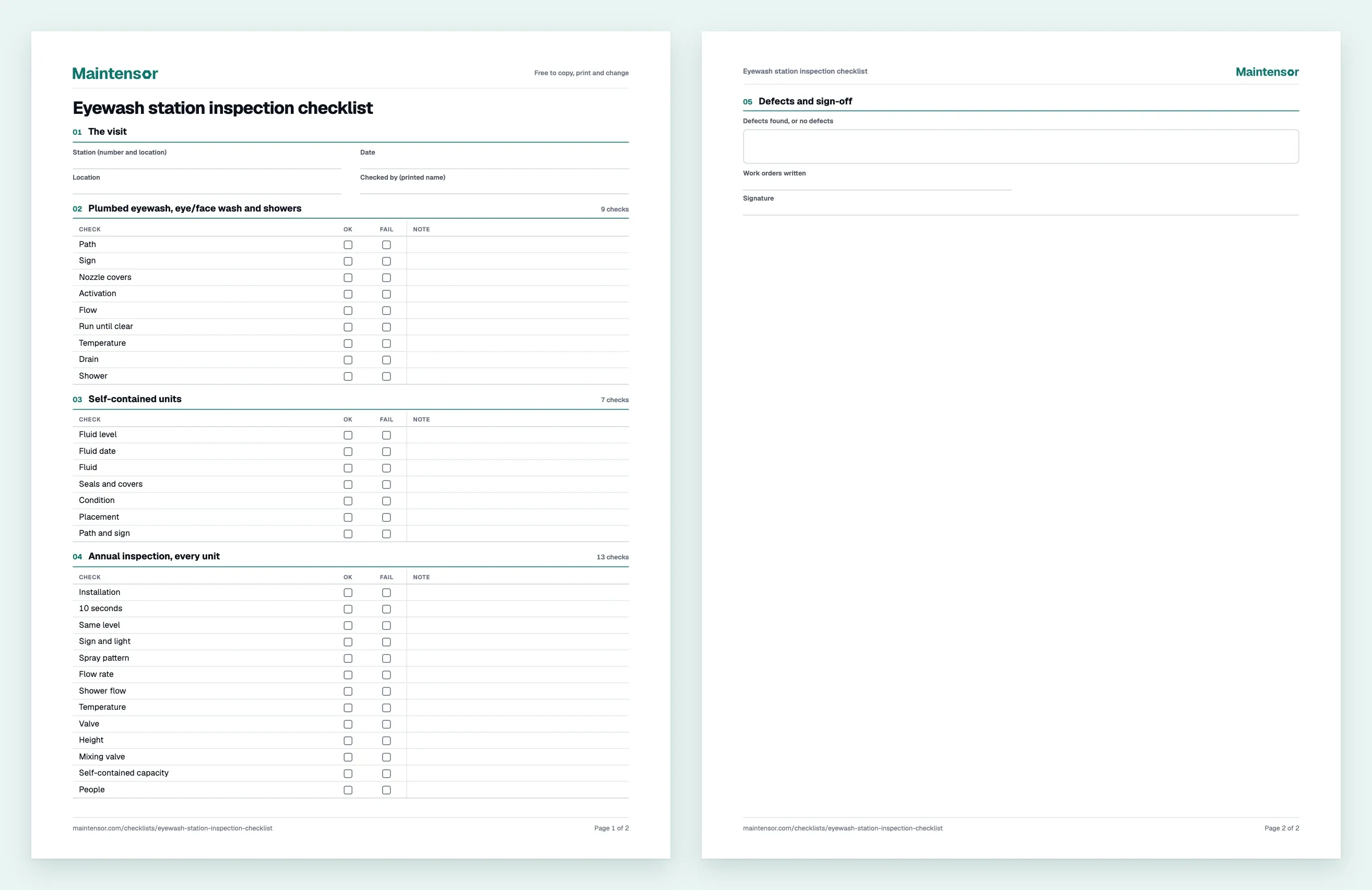
The checks, weekly and yearly
One sheet per station and visit: the weekly card for a plumbed unit or the one for a self-contained unit, and the annual card once a year. A failed check gets a work order. Adapt the list with the unit maker’s manual.
Plumbed eyewash, eye/face wash and showers9 checks
- Path
- Sign
- Nozzle covers
- Activation
- Flow
- Run until clear
- Temperature
- Drain
- Shower
Self-contained units7 checks
- Fluid level
- Fluid date
- Fluid
- Seals and covers
- Condition
- Placement
- Path and sign
Annual inspection, every unit13 checks
- Installation
- 10 seconds
- Same level
- Sign and light
- Spray pattern
- Flow rate
- Shower flow
- Temperature
- Valve
- Height
- Mixing valve
- Self-contained capacity
- People
What counts as a fail, check by checkThe full tables, and where each weekly check comes from.
The Source column of the weekly tables says where each check comes from: ANSI/ISEA Z358.1, the maker’s instructions, or common practice (“Practice”). The annual table says how to make each check instead.
Plumbed eyewash, eye/face wash and showers
| Check | Fail if | Source |
|---|---|---|
| Path | Anything stored in the way, or the unit hidden | Z358.1 location requirement |
| Sign | Missing, or not visible from where the hazard is | Z358.1 |
| Nozzle covers | Missing, or do not come off when the water starts | Z358.1 |
| Activation | Valve does not open with one push or pull, or does not stay open hands-free | Z358.1 |
| Flow | Weak, uneven between the two nozzles, or not a steady stream | Practice; the maker’s manual |
| Run until clear | Water still rusty, cloudy or smelly after flushing the unit and the pipe feeding it | Z358.1 weekly activation |
| Temperature | Hot or ice cold to the hand (then read it with a thermometer) | Practice |
| Drain | Water floods the floor or backs up | Practice |
| Shower | Pull rod out of reach, or no flow (use a shower tester where there is no floor drain) | Z358.1; practice |
The standard’s publisher says plumbed units are activated weekly “for a period long enough to verify operation” and to make sure flushing fluid is there, which also clears sediment and stale water from dead-end pipe. It is not a 15-minute test.
Self-contained units
| Check | Fail if | Source |
|---|---|---|
| Fluid level | Below the fill line or sight gauge mark | Maker’s instructions |
| Fluid date | Past the change date on the unit, cartridge or log | Maker’s instructions |
| Fluid | Cloudy, discolored, or anything growing in it | Maker’s instructions |
| Seals and covers | Cartridge seal broken; nozzle covers off | Maker’s instructions |
| Condition | Leaks or cracks in the tank or lines | Practice |
| Placement | In a spot that freezes or bakes, with no heater blanket or shade | Practice |
| Path and sign | As for plumbed units | Z358.1 |
The standard calls for a visual check of every self-contained unit, done to the maker’s instructions, to see whether its fluid needs changing or topping up.
Annual inspection, every unit
| Check | How | Fail if |
|---|---|---|
| Installation | Compare with the maker’s installation sheet | Loose, modified, or not as installed |
| 10 seconds | Walk from the hazard at a normal pace and time it | More than 10 seconds |
| Same level | Look at the route | Not on the same level as the hazard: stairs between them |
| Sign and light | Stand where the hazard is | No highly visible sign; area poorly lit |
| Spray pattern | The maker’s test gauge, or as the manual says | Flow does not cover the gauge’s area or both eyes |
| Flow rate | Run into a marked bucket for one minute | Under 0.4 gal (1.5 L) for an eyewash, 3.0 gal (11.4 L) for an eye/face wash |
| Shower flow | Shower tester into a container of known size, timed | Under 20 gal/min (75.7 L/min) |
| Temperature | Thermometer in the stream at the start and after several minutes | Outside 60 to 100 °F (16 to 38 °C) at either reading |
| Valve | Push it on and let go | Takes more than 1 second to open, or closes when let go |
| Height | Tape measure from the floor | Eyewash outside 33 to 53 in. (84 to 135 cm) above the floor, or under 6 in. (15 cm) from a wall or the nearest obstruction, as CCOHS gives the Z358.1 figures |
| Mixing valve | Check the service date | Maker’s service interval missed |
| Self-contained capacity | Read the label | Holds less than 15 minutes of flow (see the arithmetic below) |
| People | Ask two people in the area | They do not know where it is or how to hold their eyes open in it |
The figures to test against
The same for an eyewash, an eye/face wash and an emergency shower, except the flow. They come from the Z358.1 publisher’s selection, installation and use guide, OSHA’s eyewash InfoSheet and CCOHS.
ExampleThe arithmetic of a flow test
These numbers are made up to show the working.
- Eyewash, bucket test. One minute fills the bucket to 0.55 gal. That is above 0.4, so it passes. Over a full 15-minute flush it would deliver 0.55 x 15 = 8.25 gal (31 L): water the floor drain or a bucket has to take.
- Self-contained capacity. At the minimum 0.4 gal/min, 15 minutes needs 0.4 x 15 = 6 gal (22.7 L). A unit holding less than 6 gal cannot deliver the minimum for 15 minutes.
- Shower, timed container. A 5-gallon container fills in 12 seconds: 5 ÷ 12 x 60 = 25 gal/min, above 20, so it passes. A full 15-minute drench at the minimum is 20 x 15 = 300 gal (1,136 L), which is why showers without a floor drain are tested with a tester and a container rather than run to the floor.
ExampleA weekly log
| Week of | Unit | Location | Ran until clear | Stays on hands-free | Covers on | Path and sign | Initials | Notes |
|---|---|---|---|---|---|---|---|---|
| Oct 19 | EW-1 | Battery charging | Yes | Yes | Yes | OK | CR | |
| Oct 19 | EW-2 | Chemical store | Yes | Yes | One missing | OK | CR | Cover ordered |
| Oct 19 | SH-1 | Caustic wash bay | Yes | Yes | n/a | Pallet in path | CR | Moved during check |
EW-2. One nozzle cover was missing, a fail on the weekly check; a new cover was ordered.
SH-1. A pallet stood in the path to the shower. It was moved during the check, and the log still records it.
Before you start
When a check fails
An eyewash that will not flow, delivers hot or ice-cold water, or cannot be reached is out of service. Put a sign on it and write a work order at once.
If it cannot be fixed the same day, stop work with the corrosive in that area or bring in another unit that meets the standard; a squeeze bottle is not a replacement.
This list is a starting point to adapt with the unit maker’s manual, ANSI/ISEA Z358.1, your plumbing code and the rule where you are. It is information, not a substitute for a hazard assessment or for training the people who may need the eyewash.
Add it to an inspection calendar
Put these checks, and the rest of the building's, on a year plan with the usual minimums for the United States or Canada, then print it or add it to your calendar: open the inspection calendar with eyewash stations ticked.
What the rules ask
In the US, OSHA 29 CFR 1910.151(c) requires suitable facilities for quick drenching or flushing of the eyes and body wherever someone may be exposed to injurious corrosive materials. OSHA has not adopted ANSI Z358.1 and does not enforce it, but points employers to it as guidance on what suitable means.
What the rules sayOSHA's rule in full, the standard's edition, the states and plumbing codes, and Canada.
- OSHA. The facilities are within the work area, wherever someone’s eyes or body may be exposed. Battery charging areas need facilities for flushing and neutralizing spilled electrolyte (1910.178(g)(2)). OSHA has “often referred employers” to Z358.1 as guidance (OSHA interpretation, 2002).
- The standard. The current edition is ANSI/ISEA Z358.1-2014 (R2020). The publisher’s guide notes that some states require Z358.1 equipment, as do the model plumbing codes (International Plumbing Code section 411, Uniform Plumbing Code section 416).
- Canada. There is no national standard of its own; CCOHS uses Z358.1 as its guide and tells readers to check their province’s legislation.
The weekly eyewash round in Maintensor: one procedure, every station
In manufacturing plants the eyewashes are scattered across the floor, so the weekly run works best as one round: a procedure with a Heading for each station, on a work order repeating weekly on a chosen weekday. A round not done by its due date shows under Overdue on the work order list.
- Each station. A Checkbox for “ran until clear”, an Inspection check for “valve stays on, covers on, path and sign clear”, and a Photo step where a fault needs showing.
- The annual inspection. A second procedure on a work order repeating yearly: Number steps for the bucket reading and the two temperatures, each followed by an Inspection check, then a Signature step. A Number step has no unit or limit and flags nothing by itself, so write the limit into the step’s words.
- A Fail asks for a note and a photo before the next step, then offers a follow-up work order and, when the station is an asset on the work order, Mark asset down.

Only Admins and Full users answer checklists, so the area lead who runs the eyewashes needs a user seat. Maintensor has no flow or temperature sensors and no ready-made checklist library, and it records what was done; it certifies nothing.