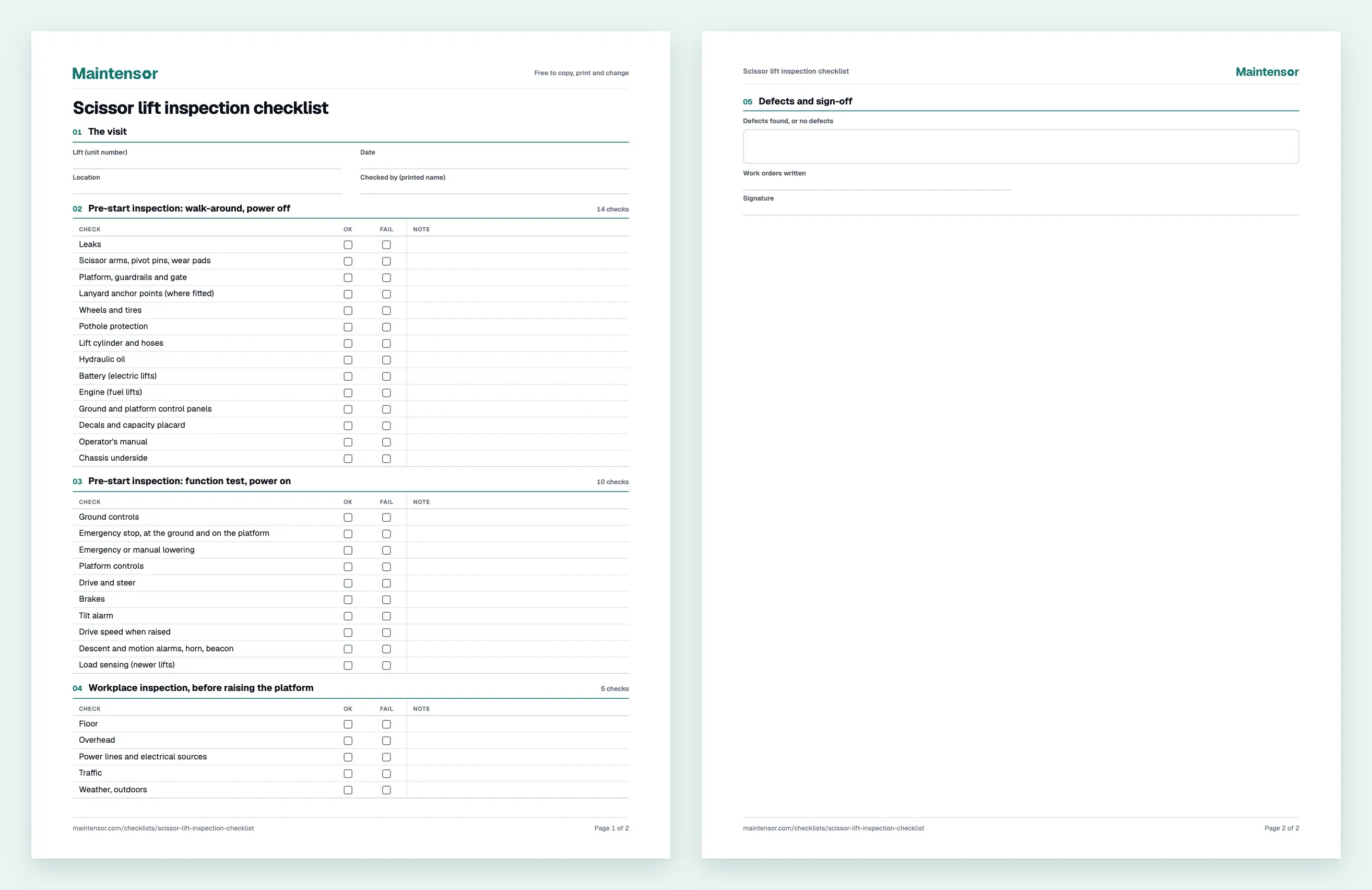
The operator’s checks, before use and before going up
The operator does the pre-start inspection before the lift is used each day, and again whenever a different operator takes it over. The workplace inspection comes before the platform goes up, and again when the job moves. Your lift’s manual comes first.
Pre-start inspection: walk-around, power off14 checks
- Leaks
- Scissor arms, pivot pins, wear pads
- Platform, guardrails and gate
- Lanyard anchor points (where fitted)
- Wheels and tires
- Pothole protection
- Lift cylinder and hoses
- Hydraulic oil
- Battery (electric lifts)
- Engine (fuel lifts)
- Ground and platform control panels
- Decals and capacity placard
- Operator's manual
- Chassis underside
Pre-start inspection: function test, power on10 checks
- Ground controls
- Emergency stop, at the ground and on the platform
- Emergency or manual lowering
- Platform controls
- Drive and steer
- Brakes
- Tilt alarm
- Drive speed when raised
- Descent and motion alarms, horn, beacon
- Load sensing (newer lifts)
Workplace inspection, before raising the platform5 checks
- Floor
- Overhead
- Power lines and electrical sources
- Traffic
- Weather, outdoors
What counts as a fail, check by checkThe full tables, and where the lists come from.
The lists follow the pattern of a maker’s pre-start inspection, such as section 2 of JLG’s ES scissor lift manual, with model-specific items left out. A boom lift takes the same layers plus its boom, turntable and jib checks.
Pre-start inspection: walk-around, power off
| Check | What counts as a fail |
|---|---|
| Leaks | Oil, hydraulic fluid or battery fluid on the machine or the floor under it |
| Scissor arms, pivot pins, wear pads | Dents, bends, cracked welds or cracked metal, a pin or retaining clip missing |
| Platform, guardrails and gate | A rail bent, loose, cracked or missing; gate does not close and latch; toeboard missing; extension deck does not lock |
| Lanyard anchor points (where fitted) | Bent, cracked or missing |
| Wheels and tires | Cuts or chunks out of the tread, loose or missing lug nuts |
| Pothole protection | Bars bent, missing, or not free to move |
| Lift cylinder and hoses | Wet fittings, rubbed or cracked hoses, a weeping seal |
| Hydraulic oil | Below the mark on the tank |
| Battery (electric lifts) | Loose or corroded terminals, cracked case, low electrolyte in flooded batteries |
| Engine (fuel lifts) | Low oil or coolant, any fuel leak |
| Ground and platform control panels | Placards missing or unreadable, switches or joystick not returning to neutral, control guards missing |
| Decals and capacity placard | Missing or unreadable |
| Operator’s manual | Not in the weather-resistant box on the machine |
| Chassis underside | Damage, debris, or loose and hanging wires |
Pre-start inspection: function test, power on
Test in a clear area with nothing overhead and no one on the platform for the ground control tests.
| Check | What counts as a fail |
|---|---|
| Ground controls | Raise or lower does not work smoothly, or a control does not return to off |
| Emergency stop, at the ground and on the platform | Any function still works with the button pressed |
| Emergency or manual lowering | Platform does not come down when the lowering control is used as the manual describes |
| Platform controls | Console not secured in its place; any function works without the enable switch held |
| Drive and steer | Jerks, drifts, or steers the wrong way |
| Brakes | Lift does not stop and hold when stopped on a slope within the manual’s rating, platform stowed |
| Tilt alarm | Light or alarm does not come on when tilted, tested the way the manual says |
| Drive speed when raised | Drives at high speed with the platform above the cutout height |
| Descent and motion alarms, horn, beacon | Silent or out |
| Load sensing (newer lifts) | An overload warning or a fault code with an empty platform |
Workplace inspection, before raising the platform
These come from OSHA’s hazard alert on scissor lifts, which says most of the deaths and injuries OSHA investigated came from not dealing with fall protection, stabilization and positioning.
| Check | What counts as a fail |
|---|---|
| Floor | Holes, drop-offs, dock edges, bumps, debris, or a slope beyond the lift’s rating |
| Overhead | Beams, sprinkler pipes, lights, racking or a door frame in the way up or along the drive path |
| Power lines and electrical sources | Closer than 10 feet (3 m), the distance in OSHA’s alert |
| Traffic | Forklifts or people passing with no cones, barrier or spotter |
| Weather, outdoors | Wind above the lift’s rating; OSHA’s alert notes outdoor lifts are generally limited to wind below 28 mph (45 km/h). An indoor-only lift taken outside is a fail |
Frequent and annual inspections, by a qualified person
The two operator inspections fit on the form. The frequent and annual ones need the maker’s service manual and inspection form, and someone trained on that make and model.
The frequent interval is the one in the maker’s table in JLG’s manual. The 13 month limit is ANSI A92.22’s, as JLG quotes it.
The annual covers everything in the frequent inspection plus the maker’s annual items, confirms the lift is registered with its maker, and addresses open safety bulletins. The lift does not go back into service until what it found is fixed, and the reports of both inspections belong in your files.
ExampleThree months or 150 hours, whichever comes first
“Whichever comes first” depends on how hard the lift works. Three made-up lifts:
| How it is used | Hours a week | Weeks to 150 hours | Comes first | Repeat to set |
|---|---|---|---|---|
| Light: 1 hour a day, 5 days | 5 | 30 | 3 months (about 13 weeks) | Every 3 months |
| Steady: 3 hours a day, 5 days | 15 | 10 | 150 hours | Every 9 weeks |
| Heavy: two shifts, 6 hours a day | 30 | 5 | 150 hours | Every 4 weeks |
The arithmetic is weeks to 150 hours = 150 ÷ hours a week. Set the repeat a little short of the result, and read the hour meter at each frequent inspection to check your guess. If a lift’s use changes, change its repeat.
Before you start
When a check fails
A fail on any safety item (guardrails, brakes, emergency stop, emergency lowering, tilt alarm, a hydraulic leak) means the lift stays stowed. Take the key, hang a “Do Not Operate” tag at the platform controls, tell the supervisor, and write a work order for a qualified mechanic.
What OSHA says
OSHA’s hazard alert on scissor lifts says many scissor lifts are covered by its scaffolding standard, and that scissor lifts must have guardrails (1926.451(g)). In general industry, 1910.27(a) sends scaffolds to the construction scaffold rules.
What the rules sayScaffold inspection and training, boom lifts, Canada's CSA standards.
- The scaffold rules. They call for an inspection for visible defects by a competent person before each work shift and after anything that could affect the structure (1926.451(f)(3)), set requirements for mobile scaffolds in 1926.452(w), and require training in 1926.454.
- Boom lifts. For boom-type aerial lifts, 1910.67(c)(2)(i) and 1926.453(b)(2)(i) require the lift controls to be tested each day before use.
- Canada. Provinces set their own rules; the CSA B354.7 and B354.8 standards cover inspection, maintenance, safe use and operator training for MEWPs.
Read the rule that applies to you; this page is a summary, not legal advice.
Lift inspections in Maintensor: pre-start, frequent and annual
Build the pre-start as a procedure: Heading steps for “Walk-around”, “Function test” and “Workplace”, an Inspection check (Pass, Flag, Fail) for each line above, and a Number step for the hour meter. The app has no ready-made lift checklist, so this page is the source you build from once.
- Attach it to a work order on the lift that repeats daily, or weekly on the days the lift works.
- Make a second repeating work order for the frequent inspection, using the interval from the example above (weekly every 9 weeks, or monthly every 3 months), and a third that repeats yearly for the annual, assigned to whoever brings in the qualified inspector. Their report goes on it as a PDF attachment.
- A failed check asks for a note and a photo before the next step, then offers a follow-up work order and “Mark asset down”, so the lift shows as Down until someone sets it back.

What it does not do: the hour meter reading is kept on that work order only, and the app schedules by calendar, never by hours, so the 150 hour side of the rule is yours to watch. Only Full users and Admins answer checklists, so an operator who does the pre-start in the app needs a user seat.
How the rest fits a warehouse is on the warehousing page, and the preventive maintenance schedule guide covers setting intervals in general.