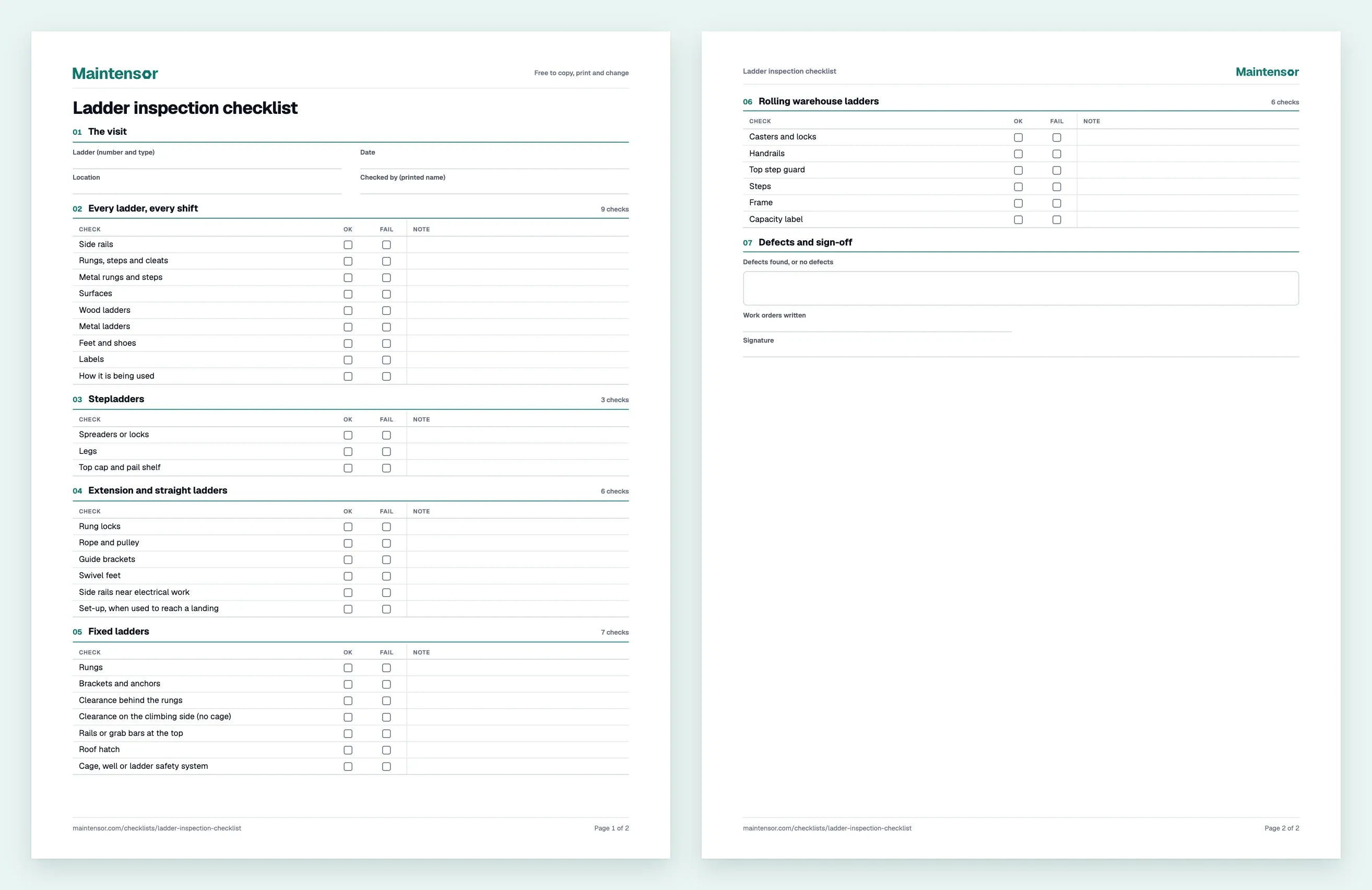
The checks, by type of ladder
One sheet per ladder: the person about to climb checks the first card and the card for their type of ladder, and the periodic walk uses the same cards. A ladder that fails is tagged out of service and gets a work order. Start from the maker’s labels on each ladder (duty rating and instructions) and adapt the list.
Every ladder, every shift9 checks
- Side rails
- Rungs, steps and cleats
- Metal rungs and steps
- Surfaces
- Wood ladders
- Metal ladders
- Feet and shoes
- Labels
- How it is being used
Stepladders3 checks
- Spreaders or locks
- Legs
- Top cap and pail shelf
Extension and straight ladders6 checks
- Rung locks
- Rope and pulley
- Guide brackets
- Swivel feet
- Side rails near electrical work
- Set-up, when used to reach a landing
Fixed ladders7 checks
- Rungs
- Brackets and anchors
- Clearance behind the rungs
- Clearance on the climbing side (no cage)
- Rails or grab bars at the top
- Roof hatch
- Cage, well or ladder safety system
Rolling warehouse ladders6 checks
- Casters and locks
- Handrails
- Top step guard
- Steps
- Frame
- Capacity label
What counts as a fail, check by checkThe full tables, and the rule behind each check.
The Rule column gives the paragraph of OSHA 29 CFR 1910.23 that a check comes from, unless it names another section. “Practice” means common practice, and “Maker” means the ladder maker’s labels and instructions.
Every ladder, every shift
| Check | What counts as a fail | Rule |
|---|---|---|
| Side rails | Bent, cracked, split, dented, buckled or burned | (b)(10) |
| Rungs, steps and cleats | Loose, bent, cracked or missing; not level, parallel and evenly spaced | (b)(1) |
| Metal rungs and steps | Slip-resistant surface worn smooth | (c)(1) |
| Surfaces | Burrs, sharp edges, splinters, sticking-out rivets; oil, grease or paint on the steps | (b)(7); practice for slick steps |
| Wood ladders | Painted or coated so cracks would be hidden | (b)(5) |
| Metal ladders | Corrosion | (b)(6) |
| Feet and shoes | Missing, worn through or loose | Practice |
| Labels | Duty rating or instruction labels missing or unreadable | Maker |
| How it is being used | As a plank, a brace or a shelf | (b)(8) |
Stepladders
| Check | What counts as a fail | Rule |
|---|---|---|
| Spreaders or locks | Missing, bent, or do not hold the front and back open | (c)(2) |
| Legs | Wobble, loose rivets, a leg shorter than the others | Practice |
| Top cap and pail shelf | Cracked, loose or missing | Practice |
Extension and straight ladders
| Check | What counts as a fail | Rule |
|---|---|---|
| Rung locks | Do not engage fully, or do not hold the fly section | Practice |
| Rope and pulley | Frayed rope, seized or cracked pulley | Practice |
| Guide brackets | Bent, loose or missing | Practice |
| Swivel feet | Missing, seized or worn through | Practice |
| Side rails near electrical work | Metal or other conductive rails where the ladder or its user could touch exposed energized parts; 1910.333(c)(7) calls for nonconductive rails there | (c)(7) of 1910.333 |
| Set-up, when used to reach a landing | Rails do not reach at least 3 feet (0.9 m) above the landing | (c)(11) |
Fixed ladders
| Check | What counts as a fail | Rule |
|---|---|---|
| Rungs | Loose, bent, worn, corroded or iced | (b)(1), (b)(6) |
| Brackets and anchors | Loose, cracked welds, pulling out of the wall | (d)(1) |
| Clearance behind the rungs | Stock, pipe or equipment closer than 7 inches (18 cm) behind them | (d)(2) |
| Clearance on the climbing side (no cage) | Pallets or racking within 30 inches (76 cm) of the rungs | (d)(13) |
| Rails or grab bars at the top | Bent, loose or missing, so there is nothing to hold at the landing | (d)(4), (d)(7) |
| Roof hatch | Does not open far enough or stay open | (d)(9) |
| Cage, well or ladder safety system | Bent cage hoops, a damaged carrier rail or sleeve, a harness or lanyard not inspected before the shift | 1910.28(b)(9), 1910.140(c)(18) |
A fixed ladder that rises more than 24 feet (7.3 m) needs fall protection. Ladders installed on or after November 19, 2018 need a ladder safety system or personal fall arrest; older ones may keep a cage or well until November 18, 2036, when every one of them needs a ladder safety system or personal fall arrest.
Rolling warehouse ladders
In OSHA’s terms these are mobile ladder stands, covered by 1910.23(e).
| Check | What counts as a fail | Rule |
|---|---|---|
| Casters and locks | The stand rolls when someone stands on it, or the lock or step-down brake does not hold | (e)(1)(vii), (e)(1)(viii) |
| Handrails | Missing or loose on a stand whose top step is 4 feet (1.2 m) or higher | (e)(1)(v) |
| Top step guard | Top step above 10 feet (3 m) not protected on three sides by a handrail | (e)(2)(ii) |
| Steps | Slip-resistant surface worn smooth or peeling | (e)(1)(ii) |
| Frame | Bent members, cracked welds, loose bolts | Practice |
| Capacity label | Missing or unreadable | Maker |
The out-of-service tag
A ladder with a structural or other defect is tagged at once, under 1910.23(b)(10). OSHA’s tag rule, 1910.145, asks for two things on the tag; the third is practice.
Before you start
When a check fails
Tag the ladder at once on a rail at eye level, write the date and your name on the tag, and carry it to a set quarantine spot so the next shift does not grab it. A fixed ladder cannot be carried away, so block it off. Then write a work order for the repair or the replacement.
A portable ladder that will not be repaired is cut up or crushed before it goes in the dumpster, so nobody pulls it back out.
The rule is 1910.23(b)(9): a ladder is inspected before its first use in each work shift, and more often as needed, for visible defects that could hurt someone. A ladder with a defect is removed from service until it is repaired or replaced.
What the rules sayFixed ladders, repairs, and the rules in Canada.
- Fixed ladders. A fixed ladder cannot be carried away, so 1910.22(d)(2) asks for the hazard to be guarded until the repair is made. A repair to its structure is done or supervised by a qualified person.
- Canada. Provinces set their own ladder rules, and CSA Z11 is the national standard for the design, testing and marking of portable ladders. Check the rule for your province and the maker’s instructions.
Ladder walks in Maintensor: 20 ladders as units on two assets
Leave the per-shift look out of the app: it takes seconds, it is done by everyone who climbs, and the rule does not ask for it to be recorded. Put the periodic walk in, where it earns its keep.
- Each ladder a unit. A made-up warehouse keeps its 14 portable ladders and 6 rolling ladders as two assets with units, L-01 to L-14 and R-01 to R-06. Two jobs make a work order for each of the 20 ladders, each with the inspection attached, repeating monthly, and the asset’s Units tab shows every ladder’s last check.
- A fail marks one ladder Down. The app asks for a note and a photo, then offers a follow-up work order and “Mark asset down”, which marks that one ladder Down until it is repaired or retired.
- Between walks. A shift lead with a Requester sign-in (free on every plan) can tag a damaged ladder and report it with Report a problem, as how requests from the floor work explains. A technician with a user seat writes the work order directly.

Answering the walk takes a Full user or Admin seat. Done as one work order on the building, with a step per ladder, the walk loses the per-ladder status: a work order with no asset on it offers the follow-up work order but not “Mark asset down”. The warehousing page shows how the app fits a warehouse.