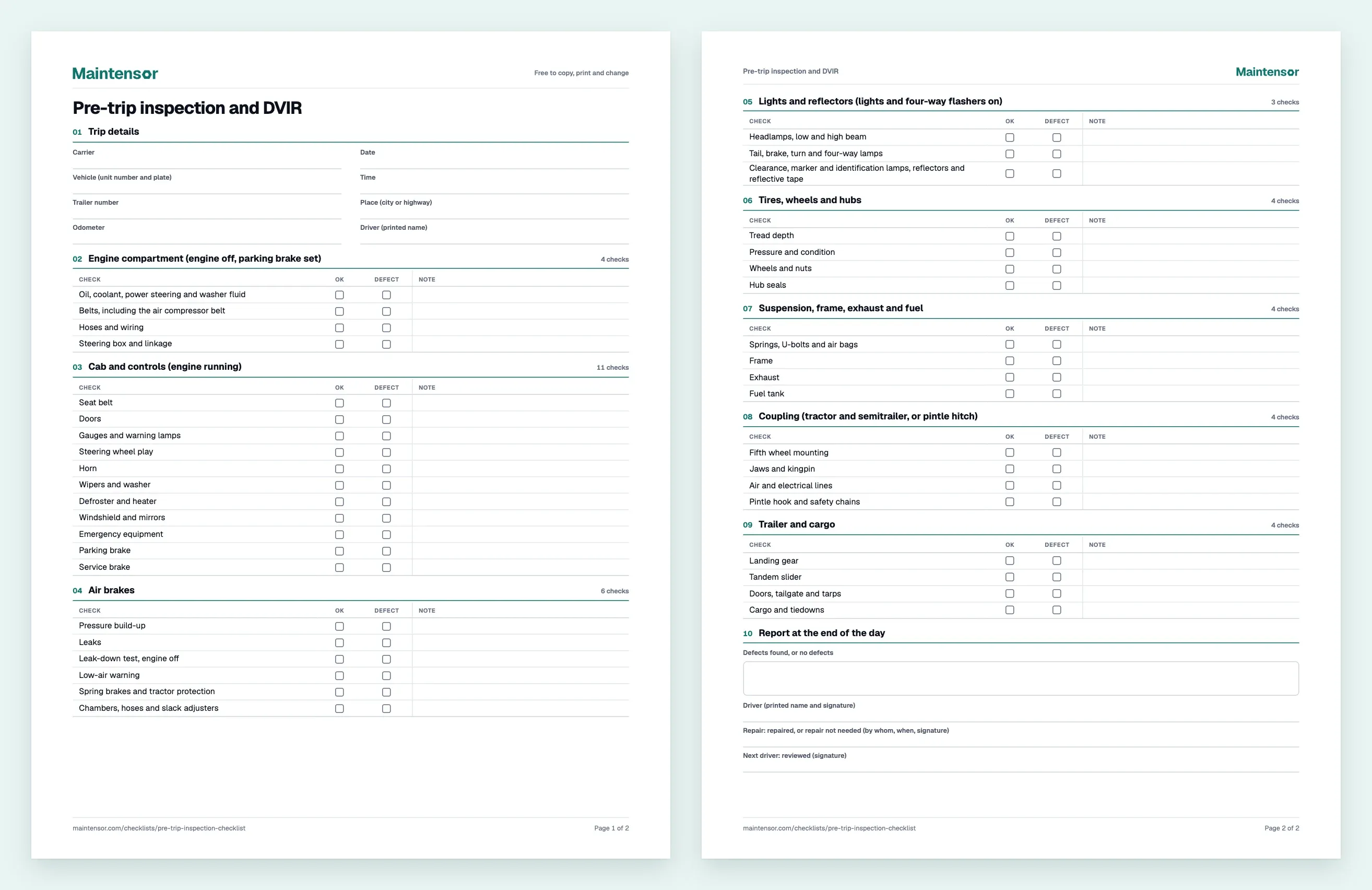
The checks, engine to trailer
Work in the sheet’s order. With the engine off: under the hood and a look for leaks. Then start the engine for the cab and the air system, then the lights, and last the walk-around: tires, wheels, coupling, trailer and load.
Engine compartment (engine off, parking brake set)4 checks
- Oil, coolant, power steering and washer fluid
- Belts, including the air compressor belt
- Hoses and wiring
- Steering box and linkage
Cab and controls (engine running)11 checks
- Seat belt
- Doors
- Gauges and warning lamps
- Steering wheel play
- Horn
- Wipers and washer
- Defroster and heater
- Windshield and mirrors
- Emergency equipment
- Parking brake
- Service brake
Air brakes6 checks
- Pressure build-up
- Leaks
- Leak-down test, engine off
- Low-air warning
- Spring brakes and tractor protection
- Chambers, hoses and slack adjusters
Lights and reflectors (lights and four-way flashers on)3 checks
- Headlamps, low and high beam
- Tail, brake, turn and four-way lamps
- Clearance, marker and identification lamps, reflectors and reflective tape
Tires, wheels and hubs4 checks
- Tread depth
- Pressure and condition
- Wheels and nuts
- Hub seals
Suspension, frame, exhaust and fuel4 checks
- Springs, U-bolts and air bags
- Frame
- Exhaust
- Fuel tank
Coupling (tractor and semitrailer, or pintle hitch)4 checks
- Fifth wheel mounting
- Jaws and kingpin
- Air and electrical lines
- Pintle hook and safety chains
Trailer and cargo4 checks
- Landing gear
- Tandem slider
- Doors, tailgate and tarps
- Cargo and tiedowns
What counts as a defect, check by checkThe full tables, with the defects Canada counts as major.
The Major column marks the items Canada’s NSC Standard 13 calls major defects, with which no one may drive. A blank there does not make a defect safe to drive with: a loose steering part still parks the truck.
Engine compartment (engine off, parking brake set)
| Check | What counts as a defect | Major |
|---|---|---|
| Oil, coolant, power steering and washer fluid | Below the mark, or a fresh drip under the engine | |
| Belts, including the air compressor belt | Cracked, frayed, glazed or loose | |
| Hoses and wiring | Hose cracked, bulging or leaking; wire chafed or loose | |
| Steering box and linkage | Missing nut, bolt or cotter pin; leaking box; a crack or welded repair |
Cab and controls (engine running)
| Check | What counts as a defect | Major |
|---|---|---|
| Seat belt | Missing, loose, or will not latch | Major |
| Doors | A cab or sleeper door will not close securely | Major |
| Gauges and warning lamps | Oil pressure, temperature or charging out of range; a warning lamp stays on; the ABS lamp does not light at start-up and then go out | |
| Steering wheel play | More than normal. Appendix A to Part 396 sets limits by wheel size: on a 20 inch wheel, 2½ inches manual or 5¼ inches power | Past the limit |
| Horn | Does not sound | |
| Wipers and washer | Blade torn or missing; fails to clear the driver’s view | In rain or snow |
| Defroster and heater | Defroster does not clear the windshield | Major |
| Windshield and mirrors | Crack or damage in the driver’s view; a mirror missing, broken, loose or badly aimed | |
| Emergency equipment | Fire extinguisher missing, not charged or not mounted; warning devices short: three reflective triangles, or the fusees the rule allows instead (393.95) | |
| Parking brake | The vehicle moves when gently pulled against it in low gear | Major |
| Service brake | Pedal fades or sinks under steady pressure, or the vehicle pulls to one side in a low-speed stop | Pedal fade |
Air brakes
| Check | What counts as a defect | Major |
|---|---|---|
| Pressure build-up | Builds slowly, or the governor cuts out outside the range in your driver’s manual | |
| Leaks | Any air leak you can hear, brakes released or applied | |
| Leak-down test, engine off | Pressure falls faster than the limit in your driver’s manual | Major |
| Low-air warning | No warning as pressure is fanned down. Appendix A fails a warning that does not work at 55 psi and below (or half the governor cut-out pressure, if lower) | Major |
| Spring brakes and tractor protection | Spring brakes do not apply as pressure falls; trailer brakes do not apply when the trailer supply is cut (393.43) | Major |
| Chambers, hoses and slack adjusters | Broken or missing part; hose chafed, kinked or leaking; pushrod stroke past its limit in 393.47 | Past the limit |
On hydraulic brakes, check instead that fluid is at the mark (less than a quarter full is major), the pedal holds firm and the power assist works.
Lights and reflectors (lights and four-way flashers on)
| Check | What counts as a defect | Major |
|---|---|---|
| Headlamps, low and high beam | Out, or cracked lens | Both low beams out |
| Tail, brake, turn and four-way lamps | Out, or cracked lens | Both rear tail lamps, both rear brake lamps, or a rear turn signal out |
| Clearance, marker and identification lamps, reflectors and reflective tape | Out, missing, or covered by dirt or load (393.9) |
Tires, wheels and hubs
| Check | What counts as a defect | Major |
|---|---|---|
| Tread depth | Less than 4/32 inch (3.2 mm) on a front tire of a truck or tractor, or 2/32 inch (1.6 mm) on any other (393.75) | Major |
| Pressure and condition | Flat, or a leak you can hear; cut to the cords; bulge or separation; marked not for highway use; touching another tire | Flat, cords showing, marked not for highway use, or touching |
| Wheels and nuts | Loose, missing or broken nut; rust streaks from a nut (a sign it is loose: check it); cracked wheel or rim | Loose, missing or broken nut, or a cracked wheel or rim |
| Hub seals | Oil below the sight glass mark, or oil on the wheel |
Suspension, frame, exhaust and fuel
| Check | What counts as a defect | Major |
|---|---|---|
| Springs, U-bolts and air bags | Broken or shifted leaf; loose U-bolt; air bag leaking or flat | Loose U-bolt, flat air bag, broken main leaf or a shifted part |
| Frame | Cracked, sagging or shifted member | Major |
| Exhaust | Leak under or ahead of the cab | Fumes in the cab |
| Fuel tank | Cap missing; tank loose; fuel dripping | Loose tank or dripping fuel |
Coupling (tractor and semitrailer, or pintle hitch)
| Check | What counts as a defect | Major |
|---|---|---|
| Fifth wheel mounting | Loose or missing bolts; cracked plate or bracket; the fifth wheel shifts on its mounting | Cracked plate or bracket, or shifts on its mounting |
| Jaws and kingpin | Jaws not closed around the kingpin; release handle not locked; a gap between the fifth wheel and the trailer | Major |
| Air and electrical lines | Glad hand leaking or seal torn; line chafing, kinked or dragging | |
| Pintle hook and safety chains | Latch not locked; chains missing or not attached (393.70) | Major |
Trailer and cargo
| Check | What counts as a defect | Major |
|---|---|---|
| Landing gear | Not fully raised, or crank handle loose | |
| Tandem slider | Locking pins not fully engaged | |
| Doors, tailgate and tarps | Not latched or secured | |
| Cargo and tiedowns | Load can shift or fall; strap cut or frayed, chain link worn (393.104) | Major |
The trailer inspection checklist covers the trailer in full, with its yearly checks.
The report at the end of the day
One page per vehicle per day. The US rule asks for the vehicle, the defects and the signatures; Canada’s also asks for the carrier, the time and place and the odometer, and a report even when there are no defects. A fleet that runs in both countries uses every line.
File the signed reports with each vehicle’s maintenance log, so a defect and its repair can be found together later.
Write the defect so a mechanic can find it
“Brakes bad” sends a mechanic hunting. “Right rear trailer brake chamber leaking air when applied” does not. Ticking every box without looking has a name, pencil whipping, and it is the usual way a daily check stops working.
Before you start
When a check fails
If the defect affects safe operation, the vehicle does not leave: tag the key, tell the shop and write the defect on the report. Smaller defects go on the report for the shop to fix.
What the rules require
In the US, the driver must be satisfied before driving that the vehicle’s brakes, steering, lights, tires, coupling and emergency equipment are in good working order, and writes a report at the end of the day only when a defect was found or reported. In Canada, NSC Standard 13 asks for an inspection and a written report every 24 hours.
What the rules sayThe US rules before, during and after the trip, who they cover, and Canada's NSC Standard 13.
United States
- Before driving. The driver must be satisfied that the service brakes (with trailer brake connections), parking brake, steering, lights and reflectors, tires, horn, wipers, mirrors, coupling devices, wheels and rims and emergency equipment are in good working order (392.7), and that the emergency equipment is in place (392.8).
- The last report. If the last report listed defects, the driver reviews it and signs it, to acknowledge the review and that the repairs have been certified (396.13).
- On the road. Cargo and its tiedowns are checked within the first 50 miles, then again at each change of duty status, every 3 hours or every 150 miles, whichever comes first (392.9).
- At the end of the day. The driver writes and signs a driver vehicle inspection report for each vehicle driven, covering the same items and listing any defect that would affect safety or cause a breakdown (396.11).
- With no defects. No report is needed when no defect was found or reported: property carriers were relieved of it in December 2014, passenger carriers in 2020.
- Repairs and records. The carrier repairs each listed defect that affects safety, signs that it was repaired or that repair is unnecessary, and keeps the reports three months. A rule in force since March 23, 2026 made explicit what was already allowed: the report may be made and kept electronically, under 49 CFR 390.32.
- Who it covers. Commercial motor vehicles in interstate commerce, mainly those rated at 10,001 pounds or more. Section 396.11 does not apply to a carrier with one vehicle, driveaway-towaway operations or private non-business passenger carriers. States set rules for trucks that stay in the state.
Canada
NSC Standard 13 covers trucks, tractors and trailers over 4,500 kg registered weight, and each province puts it into its own rules:
- Inspect to Schedule 1 every 24 hours, from a copy of the schedule the carrier provides.
- Write a report each time, recording “no defects” when there are none. It names the vehicle’s plate or unit number, the carrier, the date, time and place, and the odometer reading if there is one, with the printed name and signature of the person who inspected, and of the driver if different.
- The driver carries the schedule and the report, and shows them to an inspector on demand.
- Minor defects are reported to the carrier before the next inspection. Major defects are reported at once, and no one may drive with one.
- The driver hands the report in within 20 days; the carrier keeps it with the repair certification for at least six months.
These are summaries for information. Read the rule that applies to you.
A pre-trip procedure in Maintensor: odometer, name and signature
Build the checklist once as a procedure: a Heading step for each area, an Inspection check for each line (Pass, Flag or Fail), a Number step for the odometer, a Text step for the driver’s printed name, and a Signature step at the end. There is no built-in DVIR or pre-trip form, so this page is the template.
- The name step is needed because a Signature step stores the drawn signature and the time, not which user signed.
- Attach the procedure to a work order on each truck that repeats Weekly on the days it runs, or Daily. The fleet page shows a pre-trip check in use.
- On a Fail, the driver cannot go on until there is a note and a photo, and is then offered a follow-up work order for the shop and Mark asset down, which sets the truck’s status to Down.

What it does not do: only Full users and Admins answer checklists, so a driver who does the inspection in the app needs a Full user seat. A driver with the free Requester role can report a defect, picking the truck, but cannot answer a checklist. The app runs in a phone’s browser and needs a network connection.
The app does not print or export the report, so a Canadian driver who must show the report on demand may still carry it on paper. Whether a record kept in the app meets 396.11, 390.32 or your province’s rules is yours to check: Maintensor records what was done and certifies nothing.