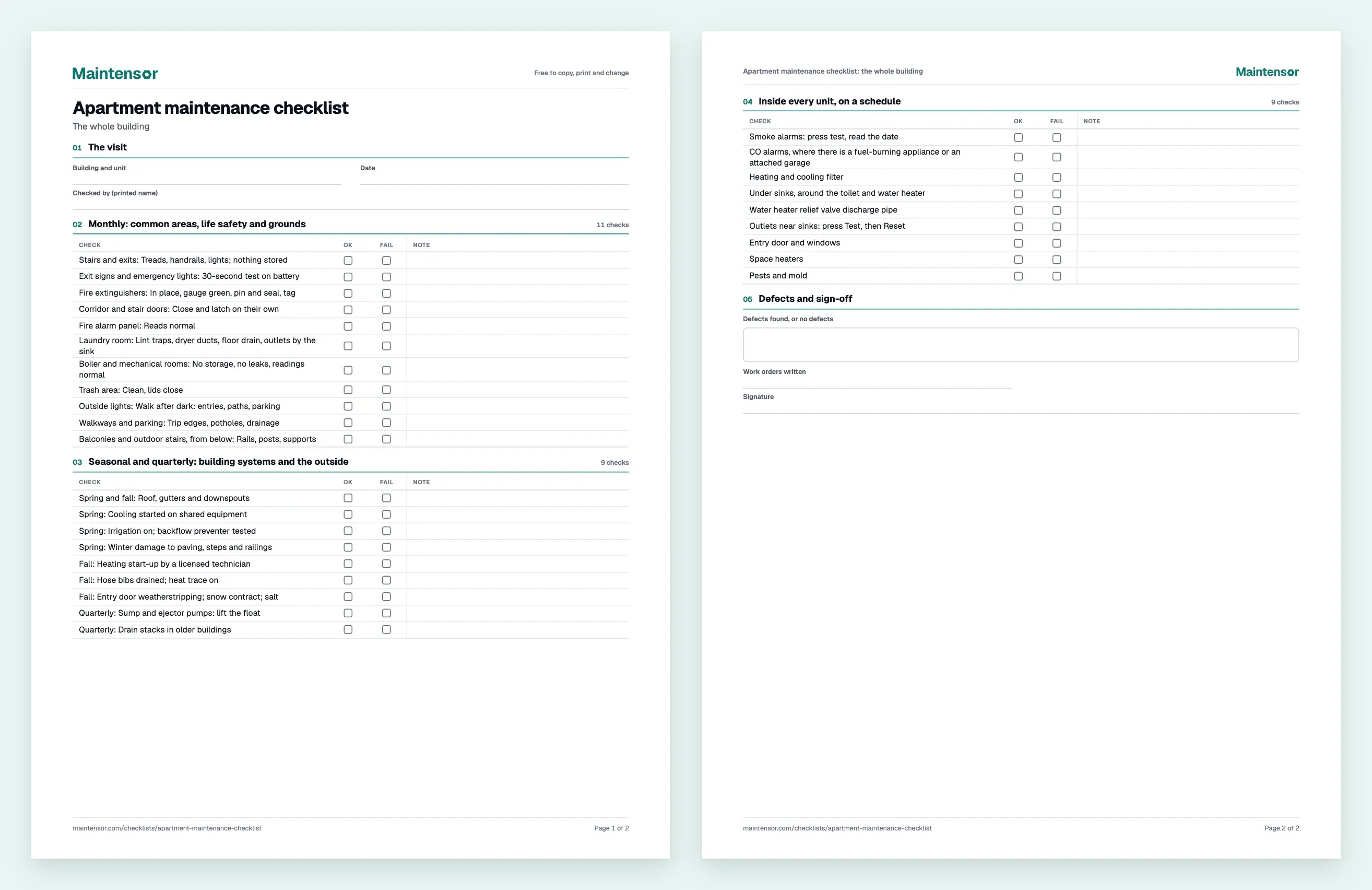
The checks, by round
One sheet per walk or unit visit, for an occupied building. Anything that fails becomes a work order with a due date before the walk ends. Adapt the list with your makers’ manuals and local codes, and where they ask for more, they win.
Monthly: common areas, life safety and grounds11 checks
- Stairs and exits: Treads, handrails, lights; nothing stored
- Exit signs and emergency lights: 30-second test on battery
- Fire extinguishers: In place, gauge green, pin and seal, tag
- Corridor and stair doors: Close and latch on their own
- Fire alarm panel: Reads normal
- Laundry room: Lint traps, dryer ducts, floor drain, outlets by the sink
- Boiler and mechanical rooms: No storage, no leaks, readings normal
- Trash area: Clean, lids close
- Outside lights: Walk after dark: entries, paths, parking
- Walkways and parking: Trip edges, potholes, drainage
- Balconies and outdoor stairs, from below: Rails, posts, supports
Seasonal and quarterly: building systems and the outside9 checks
- Spring and fall: Roof, gutters and downspouts
- Spring: Cooling started on shared equipment
- Spring: Irrigation on; backflow preventer tested
- Spring: Winter damage to paving, steps and railings
- Fall: Heating start-up by a licensed technician
- Fall: Hose bibs drained; heat trace on
- Fall: Entry door weatherstripping; snow contract; salt
- Quarterly: Sump and ejector pumps: lift the float
- Quarterly: Drain stacks in older buildings
Inside every unit, on a schedule9 checks
- Smoke alarms: press test, read the date
- CO alarms, where there is a fuel-burning appliance or an attached garage
- Heating and cooling filter
- Under sinks, around the toilet and water heater
- Water heater relief valve discharge pipe
- Outlets near sinks: press Test, then Reset
- Entry door and windows
- Space heaters
- Pests and mold
What counts as a fail, check by checkThe full tables, the yearly tests, and where each interval comes from.
“Rule” names the regulation or code. NFPA codes apply where your state, province or city has adopted them, in the edition it adopted. “Maker” means the equipment’s manual decides. “Practice” means common practice, to adjust.
Monthly: common areas, life safety and grounds
| Area | Check | Fail if | Basis |
|---|---|---|---|
| Stairs and exits | Treads, handrails, lights; nothing stored | Loose rail, broken tread, light out, anything in the way | Practice |
| Exit signs and emergency lights | 30-second test on battery | Dark, or dims before 30 seconds | Rule: NFPA 101, 7.9.3 |
| Fire extinguishers | In place, gauge green, pin and seal, tag | Missing, used, damaged | Rule: NFPA 10; see the extinguisher checklist |
| Corridor and stair doors | Close and latch on their own | Wedged open, or will not latch | Rule: your fire code |
| Fire alarm panel | Reads normal | A trouble light | Practice |
| Laundry room | Lint traps, dryer ducts, floor drain, outlets by the sink | Lint behind dryers, crushed duct, no GFCI | Maker; NSPIRE for the GFCI |
| Boiler and mechanical rooms | No storage, no leaks, readings normal | Storage near burners, water on the floor | Maker; the boiler checklist |
| Trash area | Clean, lids close | Overflowing, signs of rodents | Practice |
| Outside lights | Walk after dark: entries, paths, parking | Any light out | Practice |
| Walkways and parking | Trip edges, potholes, drainage | Lifted slab, pothole, standing water | Practice; the parking lot checklist |
| Balconies and outdoor stairs, from below | Rails, posts, supports | Loose rail, rot, rust stains at bolts | Practice |
Seasonal and quarterly: building systems and the outside
| When | Check | Fail if | Basis |
|---|---|---|---|
| Spring and fall | Roof, gutters and downspouts | Damage, a blocked drain or gutter | NRCA; the roof inspection checklist |
| Spring | Cooling started on shared equipment | Warm air, iced lines | Maker |
| Spring | Irrigation on; backflow preventer tested | Failed test | Rule: your water utility |
| Spring | Winter damage to paving, steps and railings | Heaved slab, loose rail | Practice |
| Fall | Heating start-up by a licensed technician | Cracked heat exchanger or blocked flue: shut it down | Maker |
| Fall | Hose bibs drained; heat trace on | A pipe open to the cold | Practice |
| Fall | Entry door weatherstripping; snow contract; salt | Daylight under a closed door; no contract | Practice |
| Quarterly | Sump and ejector pumps: lift the float | Pump or alarm does not start | Practice |
| Quarterly | Drain stacks in older buildings | Slow drains in several units on one stack | Practice: call the plumber |
Yearly: contractor tests, and what an apartment property adds
The yearly tests that fire and elevator codes set (fire alarm, sprinklers, fire doors, the 90-minute emergency light test, extinguisher maintenance, elevator and boiler inspections) are the same as in any building; the facility maintenance checklist lists them with their codes. An apartment property adds:
| Check | Who | Basis |
|---|---|---|
| Every smoke and CO alarm in every unit tested, its date read | Crew, or residents where the law says so | Rule where one exists (below) |
| Laundry dryer exhaust ducts cleaned to the outside | Crew or a duct cleaner | Maker |
| Balconies, decks and outdoor stairs inspected closely | Crew, or a qualified professional where the law asks | Rule in some states (below) |
| Pest control: contract and findings reviewed | Manager and vendor | Practice |
| Sewer lines camera-checked in older buildings | Plumber | Practice |
Inside every unit, on a schedule
The fuller check, once or twice a year; the visits in between can be the filter and a look under the sinks.
| Check | Fail if | Basis |
|---|---|---|
| Smoke alarms: press test, read the date | No sound, missing, over 10 years old | Rule where it applies; USFA advice |
| CO alarms, where there is a fuel-burning appliance or an attached garage | No sound, or past end of life | Rule where it applies |
| Heating and cooling filter | Loaded, or past its date | Maker |
| Under sinks, around the toilet and water heater | Drips, stains, a soft floor, water in the pan | Practice |
| Water heater relief valve discharge pipe | Missing or capped | Maker |
| Outlets near sinks: press Test, then Reset | Power does not cut, or will not reset | Maker |
| Entry door and windows | Lock broken; a door that must self-close does not | Local code |
| Space heaters | Any unvented heater that burns gas, oil or kerosene | Rule for HUD housing; practice everywhere |
| Pests and mold | Droppings, live insects, mold that comes back | Practice |
Unit visits: four a year instead of seven
Residents report a dripping faucet. They seldom report a slow leak under the sink, an alarm with its battery taken out, or a filter nobody has changed in a year.
A short visit every 3 months for the filter, with a fuller check once or twice a year, is common practice. Give notice the way your lease and local law require; the property maintenance guide has the entry rules in two places as examples.
Example48 apartments, one technician, fewer entries
A made-up property: 48 apartments in two three-story buildings, each with a boiler and a laundry room, sharing one parking lot. Susan Clarke manages it and Jason Miller is the technician. Every number is invented to show the arithmetic.
| Separate visits | Combined visits | |
|---|---|---|
| Filter changes a year | 4 | 4, one each visit |
| Unit inspections | 2 | in 2 of the 4 |
| Alarm tests | 1 | in 1 of the 4 |
| Entries per home a year | 7 | 4 |
| Entries for 48 homes | 336 | 192 |
| At 15 minutes each for notice, knocking and walking | 84 hours | 48 hours |
Separate visits. If the filter change, the unit inspection and the alarm test are each their own visit, every home is entered 7 times a year.
Combined. Each quarterly filter visit carries something extra: two of them include the inspection, one includes the alarm test. That saves 36 hours a year, almost a full 40-hour week of Jason’s time, and each resident is disturbed four times instead of seven.
Where a rule fixes the date of the alarm test, put that visit in the quarter the rule needs. Ask the resident what else needs fixing, and write it down: small fixes done on a scheduled visit are requests that never have to be made.
The short version for one small building
A building of 4 to 20 units with one person looking after it can run on four rounds.
A dated line for each round in one shared spreadsheet is enough at this size, as long as one person keeps it current.
Before you start
When a check fails
If it is unsafe, act the same day: tag the dryer, close the stair, put up a working alarm, shut off the heater. Everything else becomes a work order with a due date before the walk ends.
This apartment maintenance checklist is a starting point to adapt with your makers’ manuals and local codes, not legal advice or a substitute for a licensed contractor.
What the rules say
HUD-assisted housing is held to HUD’s NSPIRE standards, which cover the inside, the outside and the units. Who installs and tests smoke and carbon monoxide alarms depends on where the building is, and NSPIRE does not override state and local housing codes.
NSPIRE, alarm laws and local codesHUD's NSPIRE standards, smoke and CO alarm rules, California's balcony law, and local codes.
- HUD-assisted housing. HUD’s NSPIRE standards, at 24 CFR 5.703, split a property into three areas: inside (common areas and building systems), outside (the site, the grounds and the building’s exterior, roof included), and units. For voucher units the standards cover the unit, the way out of it to the public way, and the common features and systems that serve it.
- What NSPIRE asks for. Among the requirements: at least one working smoke detector on each level of the property, and in each unit on each level, inside each bedroom and within 21 feet of any bedroom door; GFCI protection for outlets within 6 feet of a water source; a guardrail wherever a walking surface drops 30 inches or more; and no unvented space heaters that burn gas, oil or kerosene. Carbon monoxide detection must meet the standard HUD sets by notice. HUD’s NSPIRE standards page lists each standard, from carbon monoxide alarms to clothes dryer exhaust ventilation.
- Smoke and carbon monoxide alarms. Who installs and who tests depends on where the building is. New York City requires owners to provide and install at least one approved smoke and carbon monoxide detector in each apartment and makes tenants responsible for maintaining them, testing and batteries included. Texas and Ontario put a test at the start of each tenancy on the landlord, as the make ready checklist sets out. The U.S. Fire Administration advises testing smoke alarms monthly and replacing them every 10 years.
- Balconies. On buildings with three or more units, California requires a sample of the balconies, decks, stairways and walkways that are more than 6 feet above the ground and rely on wood for support to be inspected by a qualified professional every 6 years (SB 721, now Health and Safety Code section 17973). Other states and cities have rules of their own.
- Local codes. Section 5.703(f) itself says NSPIRE does not override state and local housing codes, and names fire, mechanical, plumbing, carbon monoxide, property maintenance and residential codes. Your city may enforce a property maintenance code of its own, and your state or province’s landlord and tenant law sets repair duties; in Canada, the provincial fire code and residential tenancy act.
This is information, not legal advice: ask your city’s code office and your fire marshal what applies to your buildings.
Apartment rounds in Maintensor: buildings, units and residents
Each building is a location and each apartment a location inside it; the boilers, water heaters and laundry dryers are assets. There is no library of ready-made checklists, so build each round once as a procedure.
- The unit visit. One work order per building works well: a Checklist step listing every apartment number (it takes up to 100), ticked as each is done, a Text step for the ones not entered and why, and an Inspection check (Pass, Flag or Fail) for the alarms.
- A failed check. A Fail asks for a note and a photo before moving on and offers a follow-up work order. It is made on the building, with the note in its description; change its location to the apartment so the repair shows there.
- Repeats. Monthly on a weekday, every 3 months, every year. The next work order is created when the current one is completed; repeats run by the calendar only, so a check after a storm or a complaint is a work order you create by hand.

Residents can be requesters, free on every plan: you invite each one by email, and they report a problem and follow it on My requests. A request has no photo and there is no public form.
What it does not do: Maintensor keeps to maintenance, with no leases, rent or payments. Only Admins and Full users answer checklists, so the technician needs a user seat. The Free plan holds 3 procedures and 5 recurring work orders; more is on Pro. How a building fits together is on the facility maintenance software page.