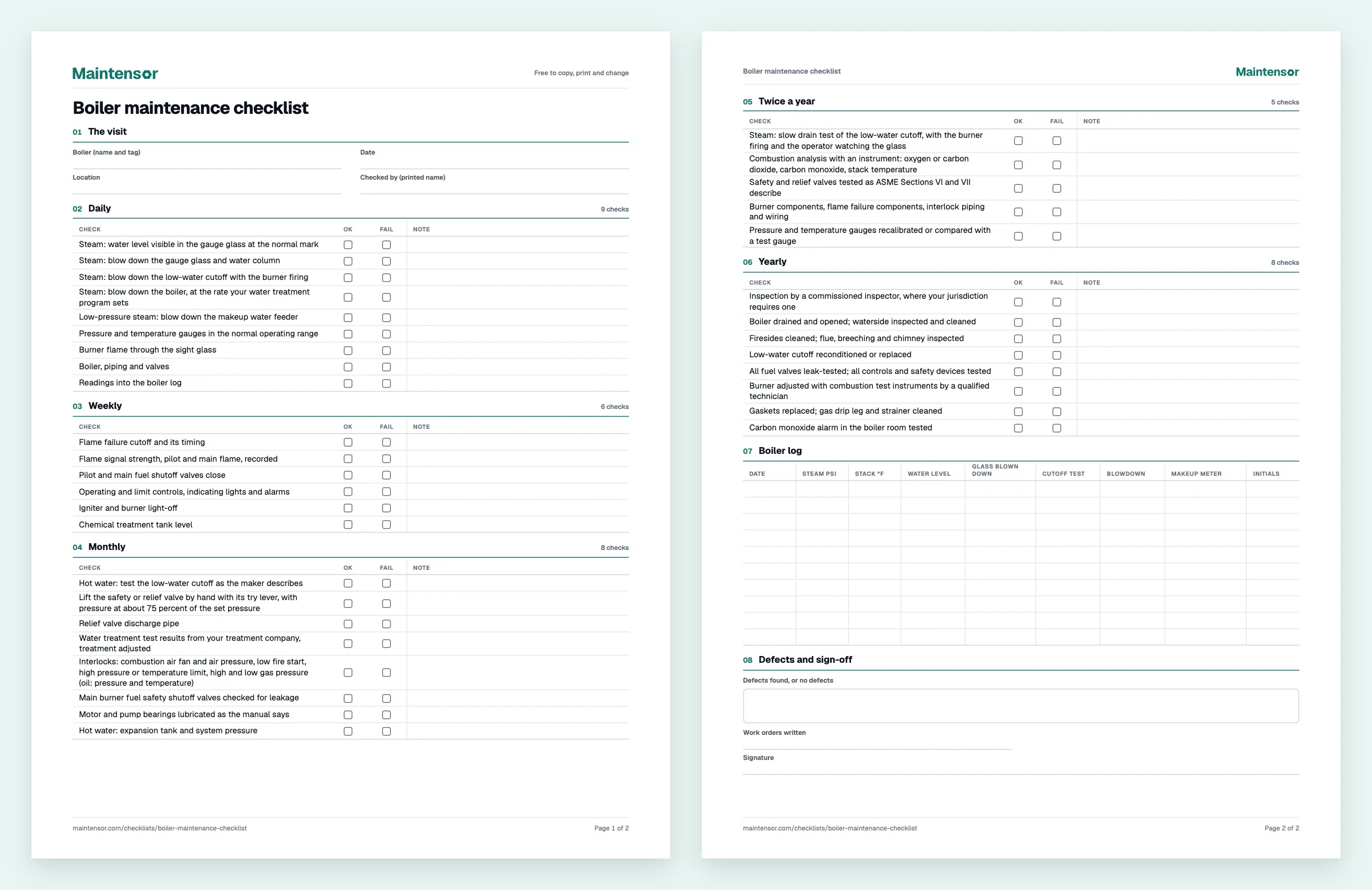
The checks, by visit
One sheet per boiler and visit, for low-pressure steam and hot water boilers fired by gas or oil. Anything that fails gets a work order the same day, with the reading in it, and where the boiler or burner manual asks for more, the manual wins.
Daily9 checks
- Steam: water level visible in the gauge glass at the normal mark
- Steam: blow down the gauge glass and water column
- Steam: blow down the low-water cutoff with the burner firing
- Steam: blow down the boiler, at the rate your water treatment program sets
- Low-pressure steam: blow down the makeup water feeder
- Pressure and temperature gauges in the normal operating range
- Burner flame through the sight glass
- Boiler, piping and valves
- Readings into the boiler log
Weekly6 checks
- Flame failure cutoff and its timing
- Flame signal strength, pilot and main flame, recorded
- Pilot and main fuel shutoff valves close
- Operating and limit controls, indicating lights and alarms
- Igniter and burner light-off
- Chemical treatment tank level
Monthly8 checks
- Hot water: test the low-water cutoff as the maker describes
- Lift the safety or relief valve by hand with its try lever, with pressure at about 75 percent of the set pressure
- Relief valve discharge pipe
- Water treatment test results from your treatment company, treatment adjusted
- Interlocks: combustion air fan and air pressure, low fire start, high pressure or temperature limit, high and low gas pressure (oil: pressure and temperature)
- Main burner fuel safety shutoff valves checked for leakage
- Motor and pump bearings lubricated as the manual says
- Hot water: expansion tank and system pressure
Twice a year5 checks
- Steam: slow drain test of the low-water cutoff, with the burner firing and the operator watching the glass
- Combustion analysis with an instrument: oxygen or carbon dioxide, carbon monoxide, stack temperature
- Safety and relief valves tested as ASME Sections VI and VII describe
- Burner components, flame failure components, interlock piping and wiring
- Pressure and temperature gauges recalibrated or compared with a test gauge
Yearly8 checks
- Inspection by a commissioned inspector, where your jurisdiction requires one
- Boiler drained and opened; waterside inspected and cleaned
- Firesides cleaned; flue, breeching and chimney inspected
- Low-water cutoff reconditioned or replaced
- All fuel valves leak-tested; all controls and safety devices tested
- Burner adjusted with combustion test instruments by a qualified technician
- Gaskets replaced; gas drip leg and strainer cleaned
- Carbon monoxide alarm in the boiler room tested
What counts as a fail, check by checkThe full tables, and where each check comes from.
“NB” is the National Board of Boiler and Pressure Vessel Inspectors’ suggested maintenance log, and “BC” is Technical Safety BC’s bulletin for low-pressure steam boilers. Both are recommendations; your jurisdiction and the maker can ask for more. “Minnesota guide” is the state’s boiler safety guide.
Daily
| Check | Fail if | Basis |
|---|---|---|
| Steam: water level visible in the gauge glass at the normal mark | Level out of sight low: shut the burner off at once and find out why. Do not add water to a hot boiler: let it cool first | Minnesota guide |
| Steam: blow down the gauge glass and water column | Water slow to come back into the glass, which means blocked connections | NB |
| Steam: blow down the low-water cutoff with the burner firing | Burner keeps firing after the float chamber drains | NB (daily); Minnesota guide (at least weekly) |
| Steam: blow down the boiler, at the rate your water treatment program sets | Blowdown valve sticks or will not close tight afterward | NB; Minnesota guide |
| Low-pressure steam: blow down the makeup water feeder | Feeder does not refill, or keeps feeding | NB |
| Pressure and temperature gauges in the normal operating range | Near the relief valve setting, or a needle that never moves | Practice |
| Burner flame through the sight glass | Smoky, unsteady, lifting off the burner or hitting the walls | NB; BC |
| Boiler, piping and valves | Any leak, new noise or vibration | NB |
| Readings into the log (see below) | A reading left blank | BC |
Weekly
| Check | Fail if | Basis |
|---|---|---|
| Flame failure cutoff and its timing | Fuel keeps flowing after the flame is lost, or shuts off late | NB |
| Flame signal strength, pilot and main flame, recorded | Signal falling from week to week, or below the burner maker’s minimum | NB |
| Pilot and main fuel shutoff valves close | Flame lingers after the valves are told to close | NB |
| Operating and limit controls, indicating lights and alarms | A control that does not cycle the burner, a dead lamp or alarm | BC |
| Igniter and burner light-off | Delayed or rough light-off | NB |
| Chemical treatment tank level | Below the level your treatment program sets | NB |
Monthly
| Check | Fail if | Basis |
|---|---|---|
| Hot water: test the low-water cutoff as the maker describes | Burner keeps firing | NB |
| Lift the safety or relief valve by hand with its try lever, with pressure at about 75 percent of the set pressure | No discharge, does not reseat, keeps leaking after | NB; Minnesota guide |
| Relief valve discharge pipe | Plugged, capped, smaller than the valve outlet, or ending where it could scald someone | Practice |
| Water treatment test results from your treatment company, treatment adjusted | Results out of range two months running | NB |
| Interlocks: combustion air fan and air pressure, low fire start, high pressure or temperature limit, high and low gas pressure (oil: pressure and temperature) | Burner fires with an interlock open | NB |
| Main burner fuel safety shutoff valves checked for leakage | Any leak past the closed valve | NB |
| Motor and pump bearings lubricated as the manual says | Noise, heat or a dry fitting | NB |
| Hot water: expansion tank and system pressure | Pressure swings widely between cold and hot, or the relief valve weeps as the boiler heats | Practice |
Twice a year
| Check | Fail if | Basis |
|---|---|---|
| Steam: slow drain test of the low-water cutoff, with the burner firing and the operator watching the glass | Burner still firing when the water is out of sight low | NB; BC |
| Combustion analysis with an instrument: oxygen or carbon dioxide, carbon monoxide, stack temperature | Carbon monoxide above the burner maker’s limit, oxygen outside its range, stack temperature up from the last test at the same firing rate | BC |
| Safety and relief valves tested as ASME Sections VI and VII describe | Fails to lift at its set pressure, or leaks | NB; BC |
| Burner components, flame failure components, interlock piping and wiring | Worn, burnt, loose or bypassed parts | NB; BC |
| Pressure and temperature gauges recalibrated or compared with a test gauge | Off by more than the gauge maker’s accuracy | NB |
Yearly
| Check | Fail if | Basis |
|---|---|---|
| Inspection by a commissioned inspector, where your jurisdiction requires one | No current certificate, or open findings | NB; your jurisdiction |
| Boiler drained and opened; waterside inspected and cleaned | Scale, sludge or pitting found | NB; BC |
| Firesides cleaned; flue, breeching and chimney inspected | Soot, blocked passages, rust-through, loose joints | NB; BC |
| Low-water cutoff reconditioned or replaced | Worn float, sticking linkage, scale in the chamber | NB |
| All fuel valves leak-tested; all controls and safety devices tested | Any leak, any device that fails | NB; BC |
| Burner adjusted with combustion test instruments by a qualified technician | Cannot be brought into the maker’s range | NB; BC |
| Gaskets replaced; gas drip leg and strainer cleaned | Leaks at handholes or manholes after refilling | NB |
| Carbon monoxide alarm in the boiler room tested | No alarm, or it fails its test | Practice |
A boiler log
Keep a separate sheet for each boiler, one line per reading. A tick says the round was done; the readings, line after line, show what is changing.
ExampleA small steam boiler, four days in January
Made-up lines, for a small low-pressure steam boiler. Two things in these four days deserve a work order.
| Date | Steam pressure (psi) | Stack temp (°F) | Water level | Gauge glass blown down | Cutoff test: burner stopped | Boiler blowdown | Makeup meter (gal) | Initials |
|---|---|---|---|---|---|---|---|---|
| Jan 6 | 8 | 410 | Normal | Yes | Yes | Yes | 21,460 | JM |
| Jan 7 | 8 | 412 | Normal | Yes | Yes | Yes | 21,472 | JM |
| Jan 8 | 9 | 415 | Normal | Yes | Yes | Yes | 21,511 | AD |
| Jan 9 | 8 | 421 | Normal | Yes | Yes | Yes | 21,553 | AD |
Makeup water. It went from 12 gallons a day to about 40 (151 L). A steam boiler that needs that much fresh water is losing it somewhere, through a leaking trap, a failed return line or a weeping valve, and fresh water brings in oxygen and minerals.
Stack temperature. It crept up 11°F at the same pressure. The National Board’s article on boiler logs explains that a steady rise at the same load points to dirty firesides or scale on the water side.
The same article warns about logs filled with identical readings for a whole month, which is pencil whipping with a boiler attached. For a wider view of logs, the equipment maintenance log covers what to record for any machine.
Before you start
When a check fails
A low-water cutoff that does not stop the burner is the most serious fail on this page. Shut the boiler off and do not fire it again until the cutoff is fixed and retested. The same goes for a relief valve that will not open, a flame that will not prove, or carbon monoxide in the boiler room.
Anything less urgent gets a work order the same day, with the reading in it.
This list is a starting point, not a substitute for training or for the boiler and burner manuals. The National Board’s own log says it plainly: “In all cases the equipment manufacturer’s recommendations should be followed.”
Add it to an inspection calendar
Put these checks, and the rest of the building's, on a year plan with the usual minimums for the United States or Canada, then print it or add it to your calendar: open the inspection calendar with boiler ticked.
What the codes say
ASME CSD-1 sets the controls and safety devices for automatically fired boilers, and Section VI of the ASME Boiler and Pressure Vessel Code gives recommended rules for the care and operation of heating boilers. Which boilers need inspection, how often and by whom is set by each state and province.
Each code, and where to look it upASME CSD-1, ASME Sections VI and VII, and the boiler laws by state and province.
- ASME CSD-1 sets the controls and safety devices for automatically fired boilers with a fuel input under 12,500,000 Btu per hour, as the Department of Energy’s Building America Solution Center summarizes its scope. Many jurisdictions adopt it; the National Board keeps a table of which edition each requires.
- ASME Boiler and Pressure Vessel Code, Section VI gives recommended rules for the care and operation of heating boilers, and Section VII for power boilers. The National Board’s log points to both for safety valve testing.
- Inspection and certificates. US states and Canadian provinces each have boiler laws that say which boilers need inspection, how often, and by whom. The National Board’s synopsis of boiler and pressure vessel laws lists them jurisdiction by jurisdiction. Your insurer may inspect as well.
This is information, not legal advice. No checklist or record keeps a boiler compliant: the inspector and the law where it stands decide that.
Boiler rounds in Maintensor: daily readings to the yearly service
Give each boiler its own asset, and build one procedure per interval: daily, weekly, monthly, twice a year and yearly. For the yearly inspection, attach the inspector’s report and the new certificate as files.
- In the daily round, each reading becomes a Number step named with its unit (“Stack temperature, °F”), and each blowdown and cutoff test an Inspection check. Mark the cutoff test as required.
- Attach each round to a repeating work order: daily, weekly on a chosen day, and monthly every 6 months for the twice-a-year checks. The next one is created when the current one is completed, so a missed round sits in the Overdue group until someone does it.
- A cutoff test answered Fail needs a note and a photo before going on, then offers a follow-up work order and marking the boiler down. A round completed with the required test left open is finished “with exceptions”, and the open step goes into the work order’s history.

What it does not do: there is no logbook view. Each day’s readings sit on that day’s work order, so a trend like the stack temperature above means opening completed work orders one by one; some sites keep a paper log sheet beside the boiler for exactly that.
The operator who does the daily round needs a Full user seat, because only Admins and Full users answer checklists. Five procedures are more than the Free plan’s 3, so a full boiler program needs Pro.
The facility maintenance software page shows a whole building’s setup, and the HVAC maintenance checklist covers the air side.