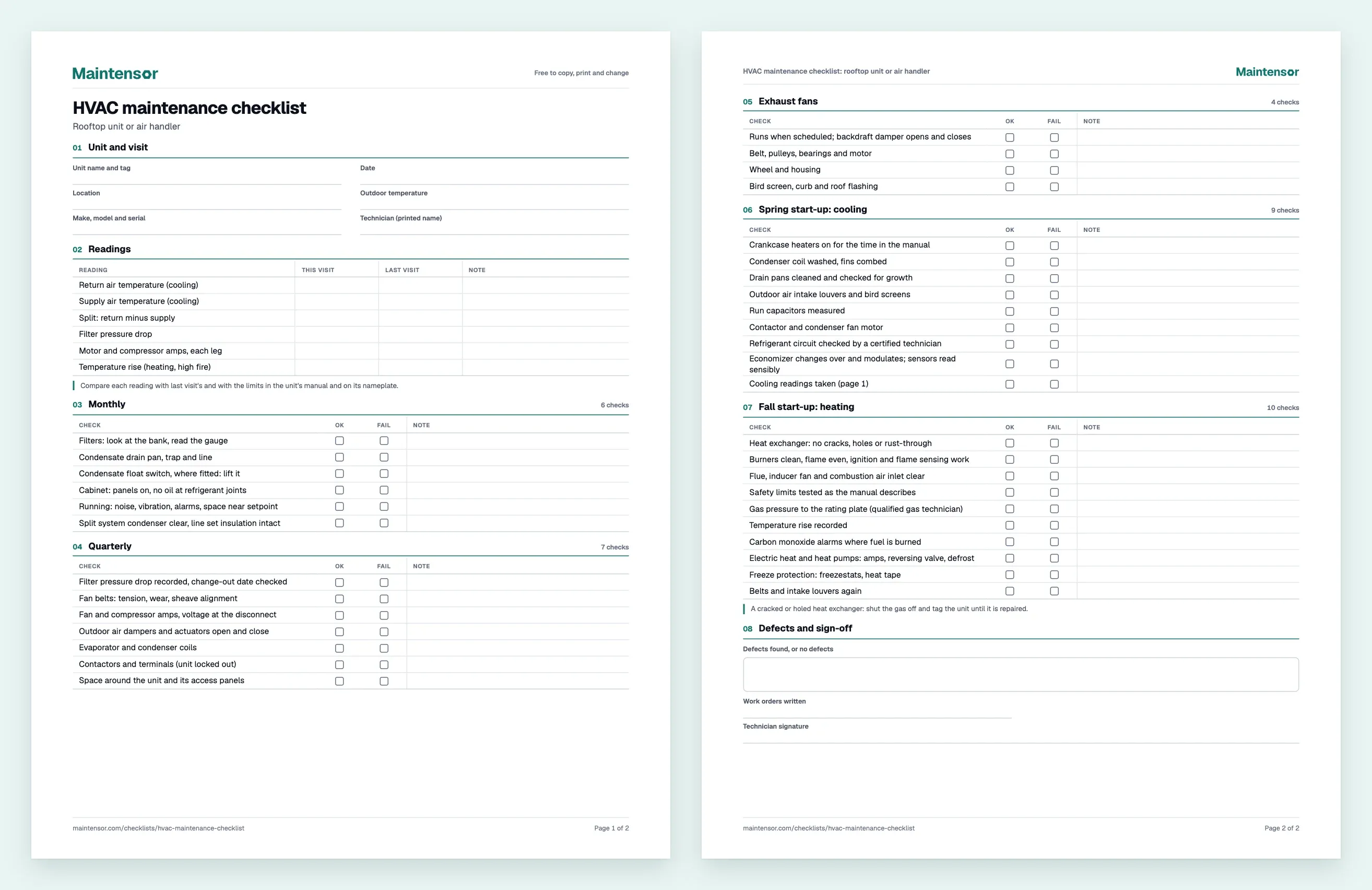
The checks, by visit
One sheet per unit and visit. Tick each check on the visit it belongs to; anything that fails gets a work order the same day, with the reading in it. Add each unit’s own tasks from its manual, and where the two disagree, the manual wins.
Monthly6 checks
- Filters: look at the bank, read the gauge
- Condensate drain pan, trap and line
- Condensate float switch, where fitted: lift it
- Cabinet: panels on, no oil at refrigerant joints
- Running: noise, vibration, alarms, space near setpoint
- Split system condenser clear, line set insulation intact
Quarterly7 checks
- Filter pressure drop recorded, change-out date checked
- Fan belts: tension, wear, sheave alignment
- Fan and compressor amps, voltage at the disconnect
- Outdoor air dampers and actuators open and close
- Evaporator and condenser coils
- Contactors and terminals (unit locked out)
- Space around the unit and its access panels
Exhaust fans4 checks
- Runs when scheduled; backdraft damper opens and closes
- Belt, pulleys, bearings and motor
- Wheel and housing
- Bird screen, curb and roof flashing
Spring start-up: cooling9 checks
- Crankcase heaters on for the time in the manual
- Condenser coil washed, fins combed
- Drain pans cleaned and checked for growth
- Outdoor air intake louvers and bird screens
- Run capacitors measured
- Contactor and condenser fan motor
- Refrigerant circuit checked by a certified technician
- Economizer changes over and modulates; sensors read sensibly
- Cooling readings taken (page 1)
Fall start-up: heating10 checks
- Heat exchanger: no cracks, holes or rust-through
- Burners clean, flame even, ignition and flame sensing work
- Flue, inducer fan and combustion air inlet clear
- Safety limits tested as the manual describes
- Gas pressure to the rating plate (qualified gas technician)
- Temperature rise recorded
- Carbon monoxide alarms where fuel is burned
- Electric heat and heat pumps: amps, reversing valve, defrost
- Freeze protection: freezestats, heat tape
- Belts and intake louvers again
What counts as a fail, check by checkThe full tables, and where each interval comes from.
“62.1” marks a minimum frequency from ASHRAE Standard 62.1’s maintenance table, explained under the standards below. “Maker” means the unit’s manual decides. “Practice” means common practice, to adjust.
Monthly
For every rooftop unit, air handler and split system.
| Check | Fail if | Basis |
|---|---|---|
| Filters: look at the bank, read the gauge where there is one | At or past the change-out figure, collapsed or wet media, gaps around the frames | Maker; 62.1 sets quarterly as the minimum |
| Condensate drain pan, trap and line | Standing water, slime, a dry or blocked trap, water on the cabinet floor | Practice |
| Condensate float switch, where fitted: lift it | The unit keeps running with the float raised | Practice |
| Cabinet: panels on and fastened, no oil at refrigerant joints | A missing panel, water inside, an oily film at a joint (a sign of a leak) | Practice |
| Running: noise, vibration, controller alarms, space near setpoint | A new squeal or rattle, an alarm, a zone out of range | Practice |
| Split system condensers: clear of leaves and stored items, line set insulation intact | Blocked airflow, less clearance than the manual asks, torn or missing insulation | Maker |
Quarterly
| Check | Fail if | Basis |
|---|---|---|
| Filter pressure drop recorded, and the replacement date checked | Above the change-out figure, or past its date | 62.1 |
| Fan belts: tension, wear, sheave alignment | Cracked, glazed or frayed belt; deflection outside the manual’s figure; sheaves out of line | Maker; 62.1 sets twice a year |
| Fan and compressor amps on each leg, voltage at the disconnect | Over nameplate, or outside the voltage range | Maker |
| Outdoor air dampers and actuators: command them open and closed | Stuck, partly open when commanded closed, linkage slipping on its shaft | Practice; 62.1 sets yearly |
| Evaporator and condenser coils | Dirt visible across the face, matted or flattened fins, oil staining | Practice; 62.1 sets yearly |
| Contactors and terminals, with the unit locked out | Pitted or burnt contacts, discolored wire insulation, loose terminals | 62.1 sets yearly |
| Space around the unit and its access panels | Anything stored in it, a blocked path to the unit | 62.1 |
Exhaust fans
Roof and wall exhaust fans, on the quarterly round.
| Check | Fail if | Basis |
|---|---|---|
| Fan runs when scheduled; backdraft damper opens and closes | Not running, or the damper stuck either way | Practice |
| Belt, pulleys, bearings and motor | Worn or loose belt, noisy or hot bearings, grease leaking | Maker |
| Wheel and housing | Built-up grease or dirt on the blades, wobble | 62.1 sets yearly for fan blades |
| Bird screen, curb and roof flashing | Torn screen, nest, loose curb, gaps in the flashing | Practice |
Spring start-up: cooling
| Check | Fail if | Basis |
|---|---|---|
| Crankcase heaters on for the time the manual gives before the compressor starts | Heater cold, or no time given before start | Maker |
| Condenser coil washed, fins combed | Coil still blocked after cleaning | Maker |
| Drain pans cleaned and checked for growth | Slime or growth left, or water carried past the pan | 62.1 (yearly) |
| Outdoor air intake louvers and bird screens | Debris, nests or damage that blocks the intake | 62.1 (twice a year) |
| Run capacitors measured | Outside the tolerance printed on the capacitor, bulging or leaking | Maker |
| Contactor and condenser fan motor | Pitted contacts; fan amps over nameplate; a cracked blade | Maker |
| Refrigerant circuit checked by a certified technician | Outside the maker’s charging chart, or a leak found | Maker; EPA Section 608 |
| Economizer changes over and modulates; outdoor and return air sensors read sensibly | Stuck dampers, a sensor far off a hand thermometer | 62.1 (yearly for the controls) |
| Cooling readings from the table above | Any fail limit | Maker |
Fall start-up: heating
| Check | Fail if | Basis |
|---|---|---|
| Heat exchanger inspected for cracks, holes and rust-through | Any crack or hole: shut the gas off and tag the unit | Maker |
| Burners clean, flame even, ignition and flame sensing work | Lazy, lifting or yellow flame; delayed ignition; failed flame proving | Maker |
| Flue, inducer fan and combustion air inlet clear | Blocked, rusted through or disconnected | Maker |
| Safety limits (high limit, rollout switch, pressure switch) tested as the manual describes | Burner keeps firing when a limit opens | Maker |
| Gas pressure set to the rating plate, by a qualified gas technician | Outside the plate | Maker |
| Temperature rise recorded | Outside the range on the rating plate | Maker |
| Carbon monoxide alarms in rooms with fuel-burning equipment | No alarm, or it fails its test | Practice |
| Electric heat and heat pumps: amps on each stage, reversing valve and defrost | A stage drawing nothing or over nameplate; no change to heating; no defrost | Maker |
| Freeze protection: freezestats on water coils, heat tape on rooftop drain lines | A freezestat that does not trip, cold heat tape | Practice |
| Belts and intake louvers again | As in spring | 62.1 (twice a year) |
The readings, with a filled-in example
A tick says someone looked; a reading says what they found, and the next one says whether it is changing. Take these at every quarterly service and both start-ups, with the outdoor temperature.
ExampleOne rooftop unit, May to August
Made-up readings. The filter’s change-out figure is 0.8 inches of water column (about 200 Pa); the compressor’s nameplate says 18.6 rated-load amps.
| Visit | Outdoor | Split | Filter drop | Compressor amps |
|---|---|---|---|---|
| May | 82°F | 19°F | 0.35 in. | 15.2 |
| June | 84°F | 19°F | 0.48 in. | 15.4 |
| July | 83°F | 24°F | 0.92 in. | 15.0 |
| August | 84°F | 13°F | 0.30 in. | 13.1 |
July. The filters were past their change-out figure and the split jumped: less air crossed the coil, so it came off colder, and a starved coil can ice up. New filters went in that day.
August. The split fell and the compressor drew less current, which points to a low charge. The certified technician found a leak at a brazed joint. A column of ticks would have shown four good months.
Before you start
When a check fails
If it is unsafe (a cracked heat exchanger, a burnt wire, a motor that smells hot), shut the unit down and tag it. Otherwise write a work order the same day, on paper or in facility maintenance software, with the failed reading in it.
Your own technician can do the monthly checks and most of the quarterly service. Filters and coils need more than this on a dusty roof or beside a kitchen exhaust. This list is a starting point, not a substitute for training or the maker’s manual.
What the standards sayASHRAE 180 and 62.1, EPA refrigerant rules, Canada's halocarbon rules.
- ANSI/ASHRAE/ACCA Standard 180 sets minimum inspection and maintenance tasks for commercial building HVAC, in tables by type of equipment. It binds you only where a contract, code or owner adopts it. ASHRAE sells Standard 180.
- ASHRAE Standard 62.1, the ventilation standard, has a maintenance table its committee based on Standard 180. The lines marked 62.1 above come from that table as published in Addendum e to the 2013 edition, free from ASHRAE. The 2022 edition numbers it Table 8-1, and its Addendum h replaced it in 2025 with a table of inspection tasks, so the edition your jurisdiction adopted is the one that counts.
- Refrigerant. EPA requires Section 608 certification for anyone who maintains, services, repairs or disposes of equipment that could release refrigerant. Since January 1, 2026, EPA’s leak repair rule for HFC appliances covers systems holding 15 pounds or more, with a 10 percent leak rate threshold for comfort cooling, but leaves out the residential and light commercial air conditioning subsector; your technician can say which of your systems it covers. In Canada, the Federal Halocarbon Regulations, 2022 cover federal systems and those on federal or Indigenous lands, and the provinces regulate the rest.
None of this is legal advice, and no checklist makes a building compliant.
HVAC visits in Maintensor: one procedure per visit
Set each unit up as an asset with its nameplate, and build one procedure per visit: monthly, quarterly, spring and fall. There is no ready-made library, so you type the checks in once.
- Make each line an Inspection check, answered Pass, Flag or Fail, and each reading a Number step. A Number step has no units or limits, so put them in its name: “Compressor amps L1 (nameplate RLA 18.6)”.
- Attach the monthly procedure to a work order on the unit that repeats monthly, with yearly repeats for the start-ups. When one is completed, the next is created with a blank checklist.
- A Fail answer asks for a note and a photo, then offers a follow-up work order and Mark asset down, which sets the unit to Down.

What it does not do: a reading lives only on the work order it was taken on, with no chart of readings, so comparing July with June means opening June’s completed work order. Work comes due by the calendar, never by run hours, and only Admins and Full users answer checklists. The facility maintenance software page shows the whole building’s setup.