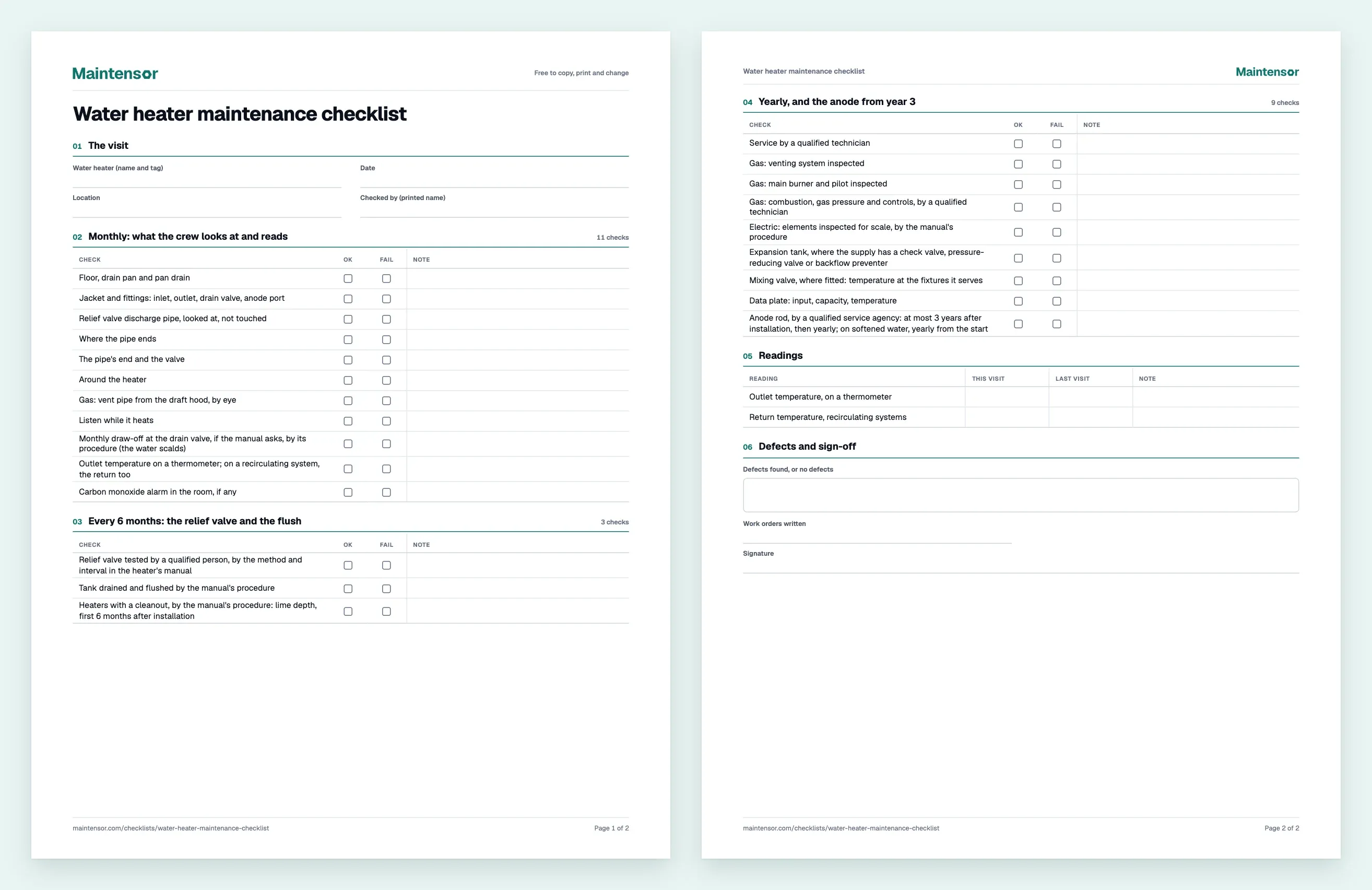
The checks, by visit
One sheet per heater and visit: the crew’s monthly round, the relief valve and flush every 6 months or as the maker’s manual says, and a technician’s yearly service, with the anode from year 3. A fail becomes a work order before the round ends, unless it means stopping (below).
Monthly: what the crew looks at and reads11 checks
- Floor, drain pan and pan drain
- Jacket and fittings: inlet, outlet, drain valve, anode port
- Relief valve discharge pipe, looked at, not touched
- Where the pipe ends
- The pipe's end and the valve
- Around the heater
- Gas: vent pipe from the draft hood, by eye
- Listen while it heats
- Monthly draw-off at the drain valve, if the manual asks, by its procedure (the water scalds)
- Outlet temperature on a thermometer; on a recirculating system, the return too
- Carbon monoxide alarm in the room, if any
Every 6 months: the relief valve and the flush3 checks
- Relief valve tested by a qualified person, by the method and interval in the heater's manual
- Tank drained and flushed by the manual's procedure
- Heaters with a cleanout, by the manual's procedure: lime depth, first 6 months after installation
Yearly, and the anode from year 39 checks
- Service by a qualified technician
- Gas: venting system inspected
- Gas: main burner and pilot inspected
- Gas: combustion, gas pressure and controls, by a qualified technician
- Electric: elements inspected for scale, by the manual's procedure
- Expansion tank, where the supply has a check valve, pressure-reducing valve or backflow preventer
- Mixing valve, where fitted: temperature at the fixtures it serves
- Data plate: input, capacity, temperature
- Anode rod, by a qualified service agency: at most 3 years after installation, then yearly; on softened water, yearly from the start
What counts as a fail, check by checkThe full tables, and the manual or code behind each check.
“Gas manual” is a maker’s published commercial gas water heater manual; “Electric manual” a commercial electric water heater manual. Your heater’s manual wins where it differs. “Code” is International Plumbing Code section 504.6 (below); “Practice” is common practice.
Monthly: what the crew looks at and reads
| Check | Fail if | Basis |
|---|---|---|
| Floor, drain pan and pan drain | Water in the pan or on the floor; drain blocked | Practice |
| Jacket and fittings: inlet, outlet, drain valve, anode port | Rust streaks, a drip, wet insulation, white crust | Gas manual |
| Relief valve discharge pipe, looked at, not touched | Missing, capped, plugged, smaller than the valve outlet, threaded at the end, a valve or tee in it | Code |
| Where the pipe ends | Over 6 inches (152 mm) above the floor or drain, or where discharge could hit someone | Code |
| The pipe’s end and the valve | A drip, wet end or mineral crust (it has discharged); valve painted over or corroded | Code; Gas manual; practice |
| Around the heater | Storage against it; flammable liquids or sprays nearby; air openings blocked | Gas manual |
| Gas: vent pipe from the draft hood, by eye | Loose, sagging or rusted through; soot or scorch marks; water at the draft hood | Practice (Gas manual: yearly) |
| Listen while it heats | Rumbling or popping (gas); sizzling or hissing (electric: scale on the elements) | Practice; Electric manual |
| Monthly draw-off at the drain valve, if the manual asks, by its procedure (the water scalds) | Water stays gritty or rusty; valve drips once closed | Gas manual |
| Outlet temperature on a thermometer; on a recirculating system, the return too | Outside your procedure’s range; circulating water below 120°F (49°C) | CDC; your water management program |
| Carbon monoxide alarm in the room, if any | Missing, fails its test, past its date | Practice |
Monthly is practice; a busy kitchen or laundry heater may earn weekly looks.
Every 6 months: the relief valve and the flush
| Check | Fail if | Basis |
|---|---|---|
| Relief valve tested by a qualified person, by the method and interval in the heater’s manual | Does not work as the manual describes, or keeps releasing water: replaced with a properly rated valve | Gas manual: every 6 months; Electric manual: at least yearly |
| Tank drained and flushed by the manual’s procedure | Water will not run clear; heavy sediment; drain valve leaks when closed | Gas manual: every 6 months; Electric manual: periodically |
| Heaters with a cleanout, by the manual’s procedure: lime depth, first 6 months after installation | More build-up than planned: set the schedule by how long 1 inch (25 mm) takes | Gas manual |
The manual’s flush procedure usually covers turning off the power or gas, letting the water cool, a hose to a drain that can take hot water, and refilling before the power or gas goes back on. Drain water can scald.
Yearly, and the anode from year 3
A technician services the heater yearly; the anode joins from year 3, or at once on softened water.
| Check | Fail if | Basis |
|---|---|---|
| Service by a qualified technician | Any finding left open | Electric manual: at least yearly |
| Gas: venting system inspected | Obstruction, damage or soot: off until cleaned or replaced | Gas manual: at least yearly |
| Gas: main burner and pilot inspected | Any soot: gas off until repaired | Gas manual: at least yearly |
| Gas: combustion, gas pressure and controls, by a qualified technician | Outside the maker’s range | Practice; your gas code |
| Electric: elements inspected for scale, by the manual’s procedure | Scale on the elements, sediment near them | Electric manual: periodically |
| Expansion tank, where the supply has a check valve, pressure-reducing valve or backflow preventer | No tank; tank leaking; relief valve weeps as the heater heats | Gas manual requires one; yearly is practice |
| Mixing valve, where fitted: temperature at the fixtures it serves | Above the limit your code or program sets | Practice; valve maker |
| Data plate: input, capacity, temperature | Over a boiler law limit (below), no current certificate | State or provincial law |
| Anode rod, by a qualified service agency: at most 3 years after installation, then yearly; on softened water, yearly from the start | Depleted, such as most of the rod under 3/8 inch (10 mm) across, or bare wire along a third of its length: replaced | Gas and Electric manuals |
Setpoint, scalding and Legionella: each number’s source
| Water temperature | What the source says | Source |
|---|---|---|
| 77 to 113°F (25 to 45°C) | The range where Legionella grows best | CDC |
| 120°F (49°C) | Circulating hot water should stay above it (CDC). CPSC’s setting for residential heaters, though 5 minutes at it can still cause third-degree burns | CDC; CPSC |
| 130°F (54°C) | Burns in 30 seconds | CPSC |
| 140°F (60°C) | Store hot water above it (CDC). Burns in 6 seconds (CPSC) | CDC; CPSC |
| 150°F (66°C) | Third-degree burns in 2 seconds | CPSC |
Legionella control and scald safety pull opposite ways, so buildings store water hot and deliver it tempered. CDC says to follow local and state anti-scald rules and to mix hot and cold at or near the point of use; the gas manual says to fit mixing valves where codes require them.
Your number comes from the building’s water management program, if any (CDC’s toolkit, based on ASHRAE Standard 188, explains control limits), your plumbing code and the maker.
Read a thermometer, not the dial
The gas manual warns that short, repeated heating cycles can push the tap up to 20°F (11°C) above the setting, and in another section up to 30°F (17°C).
Worked example: three heaters, one budget line
ExampleThe Lakehouse Hotel's three tank heaters
The Lakehouse Hotel, made up, has three tank heaters. Frank Morris runs maintenance; Alex Turner walks the round.
| WH-1, guest wing | WH-2, kitchen | WH-3, laundry | |
|---|---|---|---|
| Kind, size, age | Gas, 100 gal, 12 years | Gas, 75 gal, 6 years | Electric, 80 gal, 4 years |
| Monthly rounds with a Fail | 0 of 12 | 4 of 12: pan damp twice, rust at the cold inlet, wet discharge pipe end | 1 of 12: sizzling while heating |
| The two flushes | Clear within minutes | A bucket of grit, then cloudy water | A little fine sediment |
| Anode | Replaced 2 years ago | Never inspected | Never inspected |
| Outlet readings, setpoint 140°F (60°C) | 138 to 141°F | 129 to 152°F | 136 to 140°F |
WH-2 first. Age says replace WH-1 first. The log says WH-2. A damp pan can be a fitting, condensation or the relief valve, and the gas manual says not to replace a heater until every source of water has been checked.
So a technician checks WH-2’s anode, relief valve, expansion tank and temperature swings; a wet discharge pipe end means pressure, temperature or the valve. Its heavy sediment fits the manual’s note that hotter water and heavier use drop more lime, so its flush moves to every 3 months.
Frank puts a replacement in next year’s maintenance budget, to spend if the tank itself is leaking.
WH-3 and WH-1. WH-3’s anode is past its manual’s 3-year limit, and the sizzling goes to the yearly service. WH-1, the oldest, stays: a clean log, a newer anode.
Tankless water heaters: what changes
Before you start
When to stop, and when a check fails
A gas smell ends the round: follow the gas smell instructions in the heater’s manual (light nothing, touch no electrical switch, call the gas supplier from somewhere else).
A capped relief valve outlet, soot at the burner or draft hood, or a loose vent pipe means the heater is turned off as its manual describes and a technician comes the same day. Anything else becomes a work order before the round ends.
Adapt this water heater maintenance checklist with each manual and your local code; it is a starting point, not a substitute for training or a qualified person.
The plumbing code, boiler laws and gas codes
International Plumbing Code section 504.6 (P2804.6.1 in the residential code) sets what the relief valve’s pipe must do. A large heater may fall under your state’s boiler law, and venting, combustion air and gas piping fall under the gas code your state or province adopts.
This is information, not legal advice: the code official and the local law decide.
Each code, and what it asksThe relief valve's discharge pipe, the boiler law limits for large heaters, and the gas codes.
The discharge pipe. ICC’s article on water heater safety lists the items behind the monthly checks above, and a few more: no direct connection to a drain, an air gap in the heater’s room, one relief device per pipe, no traps or sags, and an end that occupants can see. ICC adds that any discharge from a healthy system points to a pressure problem, a heater problem or a failing valve. Some places use the Uniform Plumbing Code; provinces have their own.
Large heaters and boiler law. Pennsylvania’s boiler division exempts water heaters only while none of these is exceeded: 200,000 Btu per hour input (about 59 kW), 210°F (99°C), 120 gallons (454 L); larger ones need inspection. Other states set their own terms; the National Board’s synopsis of boiler laws lists each state’s and province’s.
Gas. US states adopt NFPA 54, the National Fuel Gas Code, or the International Fuel Gas Code; provinces adopt CSA B149.1 (British Columbia in section 30 of its Gas Safety Regulation). These cover venting, combustion air and gas piping; your state or province decides who may do gas work.
Water heater checks in Maintensor: one asset per heater
Give each heater its own asset at its location, with maker, model and serial number in its Nameplate. There is no library of ready-made checklists, so build three procedures once from the tables: monthly, every 6 months and yearly.
- The steps. Each look is an Inspection check step (Pass, Flag or Fail). The outlet temperature is a Number step, with no unit or limits: name it with its unit (“Outlet temperature, °F”) and put your range in an Instruction step. A Photo step for the pan and the pipe’s end keeps the round honest.
- The repeats. Attach each procedure to a work order on the heater that repeats monthly, every 6 months (Monthly, every 6) or yearly; for the anode, a yearly work order first due in year 3. The next work order is created when the current one is completed.
- A failed check. A Fail asks for a note and a photo before moving on, then offers Create follow-up work order and Mark asset down. Attach the technician’s report as a file.
Two limits. A typed temperature stays on that work order’s checklist, not on the heater or in Reporting, so a year of readings means opening old work orders one by one. And only Admins and Full users answer checklists, so whoever walks the round needs a user seat.
Three heaters with three rounds each make nine recurring work orders, more than the Free plan’s five: that takes Pro. See facility maintenance software for how a building’s assets fit together, and the facility maintenance checklist for the rest of the building.