Key points
- Every answer needs evidence beside it: a reading, a photo, a worn part or a record.
- When a why has two believable answers, follow both until the evidence rules one out.
- Stop at a cause you can act on: usually a missing check, step or part, not a person.
- The last answer is usually a check nobody does. Write it as a preventive task that repeats.
- It comes from Toyota, where Taiichi Ohno traced a blown fuse back to a missing strainer.
How the 5 whys works
Start with the problem, stated as a fact. Ask why it happened. Check the answer. Then ask why of that answer, and keep going until you reach a cause you can fix that would stop the problem coming back.
A worksheet with a row for each why, its answer and how it was checked is free to download, on one Letter page.
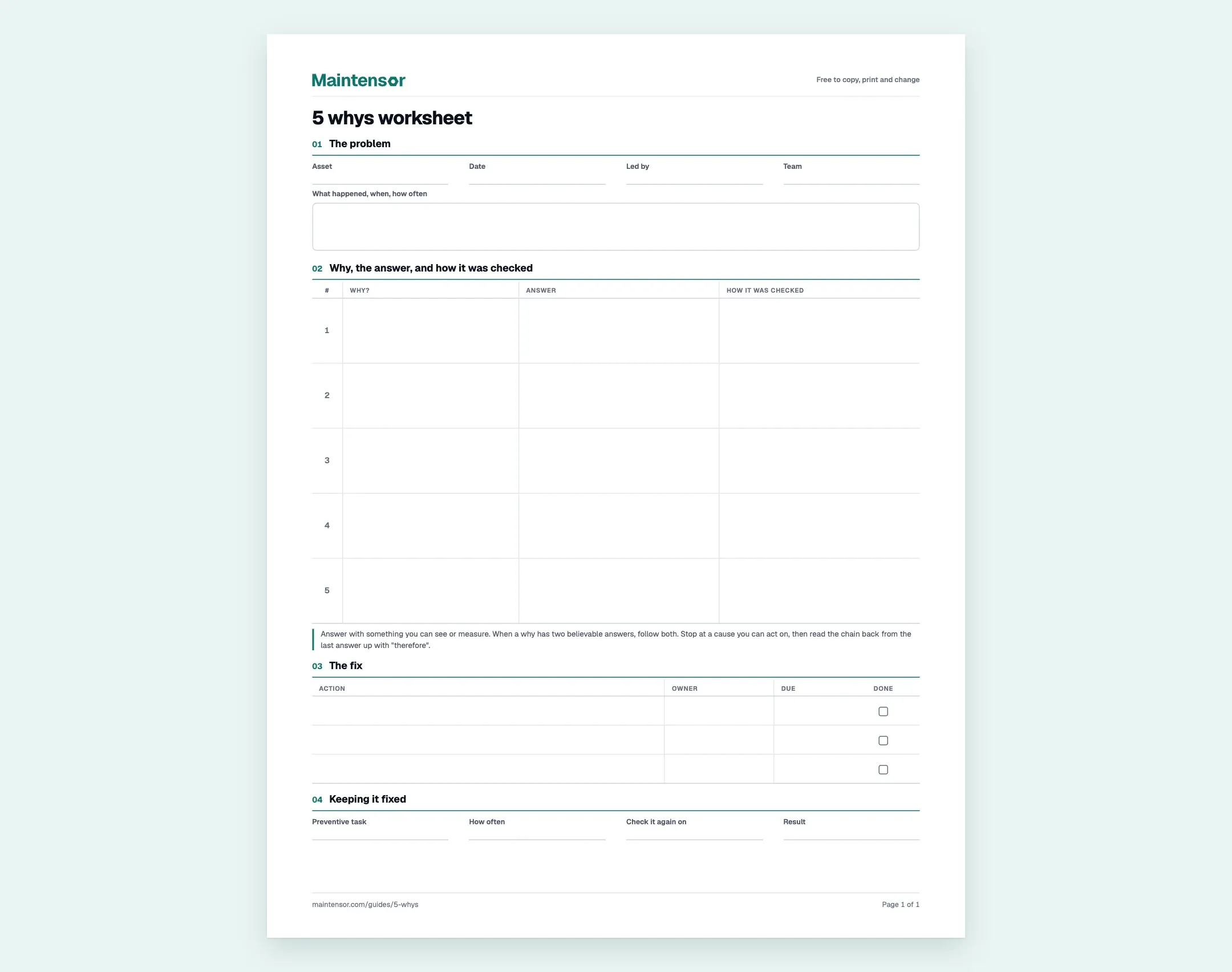
The method needs no software and no training course, which makes it the easiest one for a small crew to pick up. It is also easy to do badly: a chain of plausible guesses looks exactly like a chain of checked facts once it is written down. It works when every answer is checked at the machine, so the examples below put the evidence beside every answer.
5 whys example 1: a motor that keeps tripping
A made-up food plant; every name and number is invented. Pump P-2’s motor tripped 3 times in 2 weeks, each time in the afternoon. Dan Kowalski, the plant’s electrician, worked through it with the supervisor, Laura Bennett.
| Why? | Answer | Evidence |
|---|---|---|
| Why did P-2 stop? | The overload relay in its starter tripped | The relay’s trip flag was set; after a reset the motor ran |
| Why did the overload trip? | The current was unbalanced: two legs high, one low | Clamp meter readings of 18, 18 and 11 amps against a 15 amp nameplate rating |
| Why was it unbalanced? | A loose, overheated connection on one phase at the starter | Insulation browned at one terminal; with the starter locked out, its screw turned by hand |
| Why was it loose? | Not checked since the starter was replaced three years ago, in a cabinet that heats up in the afternoon sun | The replacement work order; the cabinet is hot by mid-afternoon, when the trips came |
| Why did nobody find it? | Nothing in the preventive maintenance looks inside electrical panels | P-2’s procedure covers its seal and bearings only |
Action: re-terminate the connection now, and add a yearly check of the panels: an infrared scan under load (see infrared thermography) and a check of connection tightness in the shutdown.
Live panels are for a qualified electrician
Readings inside a live panel are work for a qualified electrician. OSHA’s rule on electrical work practices, 29 CFR 1910.333, allows only qualified persons to work on parts that have not been de-energized. Check the rule that applies to you, and in Canada your province’s.
How to run a 5 whys on a breakdown
- Write the problem as a fact. “P-2 tripped 3 times in 2 weeks, each time in the afternoon” beats “P-2 keeps tripping”.
- Go to the equipment, with the technician who did the repairs and, if there is one, the operator. Answers worked out in an office are guesses.
- Ask why, and answer with something you can see or measure. A reading, a photo, a worn part, a record. A hunch is a question to check, not a step in the chain.
- When a why has two believable answers, follow both. Check each until the evidence rules one out.
- Stop at a cause you can act on: usually a missing check, a missing step or a missing part, not a person.
- Read it back with “therefore”. From the last answer up, as in example 2 below: “no step to refit the clamp, therefore the clamp was left off, therefore the hose flexes…” If a “therefore” does not follow, there is a gap.
- Write the action, an owner and a date, and set a date to check that the problem has not come back.
Work it out in the browser: root cause worksheet.
5 whys example 2: a hydraulic fitting that keeps leaking
A made-up warehouse. The fitting where the hose meets the cardboard baler’s main cylinder weeps oil. It has been tightened 3 times in 6 weeks. Kevin Brooks, the technician, ran the 5 whys.
The chain for the leaking baler fittingFive whys with their evidence, from a cut O-ring to a clamp left off in the spring
| Why? | Answer | Evidence |
|---|---|---|
| Why does it leak? | The O-ring in the face-seal fitting is cut | Baler locked out, pressure relieved, fitting opened: the O-ring was nicked and flattened on one side |
| Why was the O-ring cut? | The fitting kept working loose and was overtightened each time to stop the weep | Three “tightened fitting” work orders |
| Why did it work loose? | The hose flexes at every stroke and pulls on the fitting | Rub marks on the hose cover and on the frame |
| Why does it flex? | The clamp that holds the hose to the frame is missing | Two empty bolt holes; the maker’s parts diagram shows a clamp there |
| Why is the clamp missing? | It was not refitted when the hose was replaced in the spring; the job was done from memory | The April work order: no step about clamps |
Action: a new O-ring, the fitting tightened to the maker’s torque, and the clamp refitted. Then a written hose replacement procedure whose last step is “refit every clamp and guard”, and a weekly check on the baler. The hydraulic system maintenance checklist covers the routine checks.
Never look for a hydraulic leak with your hand
Ohio State University’s fact sheet Safe Use of Hydraulic Systems says to search for leaks with a piece of cardboard or paper, and to relieve pressure before disconnecting a line. It also says to get medical attention promptly if fluid is injected into the skin.
5 whys example 3: a walk-in cooler that warmed up overnight
A made-up hotel kitchen. At 6 a.m. the walk-in cooler read 46 °F (7.8 °C). Brian Cho, the hotel’s engineer, worked it with the refrigeration contractor.
What the FDA Food Code sets
The FDA Food Code, a model that state and local health departments adopt, sets cold holding for food that needs temperature control at 41 °F (5 °C) or below (section 3-501.16).
What to discard is the chef’s decision under the local health rules (in Canada, the province’s). Maintenance owns why the box warmed up.
This chain splits at the second why, which is where a single chain would have gone wrong.
The chain for the warm coolerThe branch ruled out, the branch confirmed, and the evidence for each
| Why? | Answer | Evidence |
|---|---|---|
| Why was the box warm? | The evaporator coil was iced solid, so the fans could not move air through it | Ice across the coil face, fans running |
| Why did it ice? Branch A | The defrost was not working | Ruled out: the contractor watched the next scheduled defrost start, and the heaters drew current |
| Why did it ice? Branch B | Warm, humid kitchen air was getting in | Ice heaviest nearest the door; the door gasket torn at the bottom hinge corner; the door, let go 2 inches (5 cm) open, stopped short of latching |
| Why did the door not close? | The self-closing hinge cam is worn, and the door had been propped open with a crate during deliveries for months | The worn cam; the receiving clerk confirmed the crate |
| Why was it not caught? | The monthly cooler checklist checks the temperature and the condenser coil, not whether the door closes and seals | The checklist |
Four whys, not five, and two causes, not one. Action: replace the gasket and the hinge cam, agree that deliveries go in with the door held by a person, and add a monthly door check (below). The walk-in cooler maintenance checklist has the rest of a cooler’s routine.
Where the 5 whys goes wrong, and how to fix it
- One chain. The cooler “iced because defrost failed”, and the door is never looked at. Follow every believable answer until evidence rules it out.
- Guessing. Each answer sounds right, and nobody checked any of them. An answer needs evidence beside it.
- Stopping at a person. “Kevin overtightened it”. Ask why the job made that likely: no torque value, no clamp, no written steps.
- Stopping at the part. “O-ring cut”, replace the O-ring, the leak is back in a month. Keep asking until the answer is a check, a step or a design change.
- Going too far. “Why was the budget cut?” Stop at the deepest cause your crew can act on.
- The room decides. The loudest person’s theory wins. Go to the machine.
When the problem involves a system with backups (two boilers, two pumps, a standby generator), one chain cannot show that two things had to fail at once. A fault tree can. The wider process is in root cause analysis.
Where it came from
The 5 whys comes from Toyota. Taiichi Ohno described it in his book on the Toyota Production System, and one of his examples traces a blown fuse back to a missing strainer. Replacing the fuse, or even the lubrication pump, would have brought the failure back. Fitting a strainer stops it.
Ohno's chain, why by whyFrom the blown fuse to the missing strainer, as the Lean Enterprise Institute gives it
Ohno's machine that kept stopping
The Lean Enterprise Institute’s summary gives the chain:
- The machine stopped because a fuse blew on an overload.
- The overload came from a bearing that was not lubricated well enough.
- The lubrication pump was not pumping enough.
- Its shaft was worn.
- It was worn because no strainer was fitted, so metal scraps got in.
Turning the last answer into a preventive task
The last answer is usually a check nobody does. Write it as a task that repeats, with a step whose failure is obvious:
| Example | Preventive task | How often | The check, as written |
|---|---|---|---|
| Tripping motor | Infrared scan of the panels under load, by a qualified electrician | Yearly | “Panel MCC-1 scanned, image attached. Fail: any connection noticeably hotter than its neighbors” |
| Leaking fitting | Baler hose walk-around | Weekly | “All hoses clamped, none rubbing, no wet fittings. Fail: any weep” |
| Warm cooler | Cooler door and gasket check | Monthly | “Let go of the door 2 inches open: it closes and latches by itself. Fail if not” |
Only the check repeats
A one-time repair (the re-terminated connection, the clamp, the gasket) is a single work order. Set the check’s interval from how fast the problem developed and from the maker’s manual, and shorten it if the check keeps failing.
Writing it down in Maintensor
In Maintensor’s work order management software, the simplest home for the chain is a note on the repair’s work order: the History tab keeps it with the person’s name and the time, and photos go on as attachments.
If the problem was found on an inspection, the failed check already holds the first piece of evidence: a Fail asks for a note and a photo before the next step, though the job can still be closed without them. The follow-up work order it offers names the step it came from, so the repair points back to the evidence.

The last answer becomes a work order that repeats, with a procedure attached that holds the new check as an Inspection check step.
What it does not do
There is no 5 whys form and no cause field on a work order. The schedule runs on the calendar only: nothing comes due from run hours or a reading.