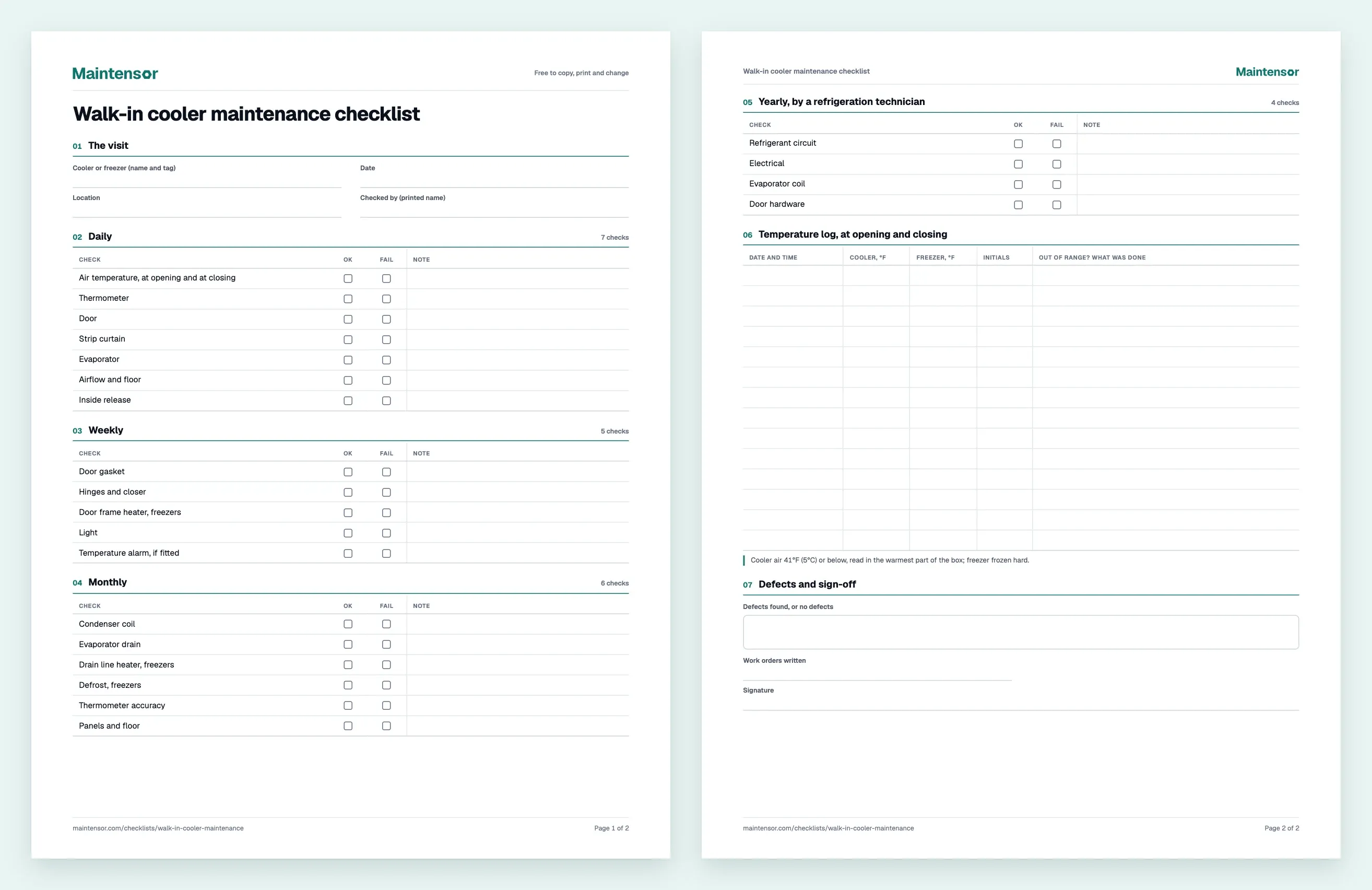
The checks, daily to yearly
Kitchen staff read the temperatures at opening and closing and check the door each day. Maintenance does the weekly and monthly items, and a refrigeration technician the yearly ones. Add the tasks in your walk-in and condensing unit makers’ manuals.
Daily7 checks
- Air temperature, at opening and at closing
- Thermometer
- Door
- Strip curtain
- Evaporator
- Airflow and floor
- Inside release
Weekly5 checks
- Door gasket
- Hinges and closer
- Door frame heater, freezers
- Light
- Temperature alarm, if fitted
Monthly6 checks
- Condenser coil
- Evaporator drain
- Drain line heater, freezers
- Defrost, freezers
- Thermometer accuracy
- Panels and floor
Yearly, by a refrigeration technician4 checks
- Refrigerant circuit
- Electrical
- Evaporator coil
- Door hardware
What counts as a fail, check by checkThe full tables, and where each interval comes from.
Where the last column of a table names a rule, the rule sets what passes; none of these rules sets how often you check, so the intervals are common practice or the maker’s.
Daily
| Check | Pass | Fail if | Interval from |
|---|---|---|---|
| Air temperature, at opening and at closing | 41°F (5°C) or below in the cooler; freezer frozen hard | Above 41°F: act as above | Food Code 3-501.16 |
| Thermometer | In place in the warmest spot, readable | Missing, broken or reading oddly | Food Code 4-204.112 |
| Door | Closer pulls it firmly shut from an inch open; it seals with no gap | Door stays ajar or springs back | 10 CFR 431.306, Food Code 4-501.11 |
| Strip curtain | Every strip hanging and overlapping | Strips torn, missing or tied back | 10 CFR 431.306 |
| Evaporator | Fans running; coil clear or lightly frosted | Fans stopped, coil iced into a block | The maker |
| Airflow and floor | Nothing stacked against the evaporator; food off the floor; floor dry | Blocked fans, food on the floor, water on the floor | Food Code 3-305.11 |
| Inside release | Opens the door from inside | Stiff or missing | Common practice |
Weekly
| Check | Pass | Fail if | Interval from |
|---|---|---|---|
| Door gasket | Whole, soft, and grips a strip of paper all round | Torn, flat, or the paper slides out | Food Code 4-501.11(B) |
| Hinges and closer | Tight; door does not sag or drag | Loose hinge screws, door rubbing the floor | Food Code 4-501.11(B) |
| Door frame heater, freezers | Frame dry and free of frost; door opens without sticking | Frost or ice on the frame, door freezing shut | The maker |
| Light | Works; bulb shielded or shatter-resistant | Out, or bare glass bulb over open food | Food Code 6-202.11 |
| Temperature alarm, if fitted | Sounds or sends its alert when tested | No alarm | The alarm maker |
Monthly
| Check | Pass | Fail if | Interval from |
|---|---|---|---|
| Condenser coil | Brushed or vacuumed clean; fan blades clean; nothing stored against it | Matted with dust, lint or grease | Common practice, or the maker’s figure |
| Evaporator drain | Pan clean; water runs out freely | Water in the pan, slime, ice in the line | The maker |
| Drain line heater, freezers | Drain line warm and clear | Ice in the drain line | The maker |
| Defrost, freezers | Coil clears in each defrost; timer set as the maker says | Ice left after defrost | The maker |
| Thermometer accuracy | Within 3°F (1.5°C) of a calibrated probe thermometer | Further off: adjust or replace | Food Code 4-203.12, 4-502.11(C) |
| Panels and floor | No gaps at seams; no ice or sweating on the outside | Ice or condensation on outside panels, soft floor | Common practice |
Yearly, by a refrigeration technician
| Check | Pass | Fail if | Interval from |
|---|---|---|---|
| Refrigerant circuit | Pressures and temperatures recorded and normal; no leaks | Low charge, leak found | Technician, EPA Section 608 |
| Electrical | Connections tight; compressor and fan amps recorded | Burnt contacts, high amps | Technician |
| Evaporator coil | Cleaned | Dirty or damaged fins | Technician |
| Door hardware | Closer, hinges and handle sound for another year | Worn closer or hinge | Common practice |
The temperature log, with a filled-in example
A log on the door, filled in at opening and closing, shows a drift before it becomes a failure. These are the limits it is read against.
ExampleThree days of a cooler and a freezer
These rows are made up, for a cooler and a freezer read by two cooks.
| Date and time | Cooler, °F | Freezer, °F | Initials | Out of range? What was done |
|---|---|---|---|---|
| Mon, 6:00 a.m. | 37 | -2 | LB | No |
| Mon, 10:00 p.m. | 38 | 0 | MS | No |
| Tue, 6:00 a.m. | 44 | -1 | LB | Yes. Door found ajar, strip curtain tied back. Food probed at 40°F. Door shut, curtain down; 39°F at 7:00 a.m. |
| Tue, 10:00 p.m. | 39 | 3 | MS | Freezer warm: coil iced. Work order for the defrost |
| Wed, 6:00 a.m. | 38 | -1 | LB | No. Technician replaced the defrost timer |
Tuesday morning. One high reading with a known cause is a door problem: the door was ajar and the curtain tied back.
The slow kind. Readings that creep up a degree a week are a coil, gasket or refrigerant problem, and they show only if someone writes the numbers down. An equipment maintenance log holds the repairs behind them.
Before you start
When a check fails
A reading above 41°F (5°C) gets action, not a note: check the door and the evaporator, probe the food itself, and follow your food safety plan and health department’s rules for food that was out of temperature.
A box that does not recover within the hour is a call to the refrigeration technician. A door that does not close and seal gets fixed the same day.
What the Food Code asks of a walk-in
The FDA Food Code holds time and temperature control for safety food at 41°F (5°C) or less (3-501.16(A)(2)). A federal efficiency rule requires walk-ins made since January 1, 2009 to have automatic door closers, and strip doors or another way to keep warm air out.
The rest of the rulesFreezers, thermometers, doors and seals, storage, and the federal door rule.
States adopt the Food Code, often an earlier edition; these sections read the same in 2022 and 2026.
- Frozen food. Frozen food is kept frozen (3-501.11). FDA’s consumer advice on storing food safely uses 0°F (-18°C) for freezers.
- Thermometers. The sensor reads the air (or a simulated product) in the warmest part of the unit, and cold holding equipment has a permanently fitted, easy-to-read thermometer (4-204.112). Air thermometers are accurate to within 3°F (1.5°C) and kept that way (4-203.12, 4-502.11(C)).
- Doors and seals. Doors, seals, hinges and fasteners are kept intact, tight and adjusted to the maker’s specification (4-501.11(B)).
- Storage. Food is stored at least 6 inches (15 cm) off the floor, with exceptions for some packaged goods (3-305.11).
- The federal door rule. 10 CFR 431.306 requires walk-ins made since January 1, 2009 to have automatic door closers that pull a door shut from within an inch of closed (for doors up to 3 feet 9 inches wide and 7 feet tall), and strip doors, spring-hinged doors or another way to limit warm air getting in while the door is open. Keeping those working is maintenance’s job.
The walk-in in Maintensor: two readings a day and a 41°F check
The walk-in is an asset, and its condensing unit can be a second asset recorded as part of it. The daily check becomes a work order that repeats every day; the monthly coil cleaning repeats monthly, and the technician’s yearly visit is a yearly work order with a File step for the service report.
- The daily procedure: Number steps for the opening and closing temperatures, Inspection checks for the door, gasket, strip curtain and evaporator, and a Signature.
- The 41°F check. A Number step has no limits, so add an Inspection check, “Cooler at 41°F or below”. Failing it asks for a note and a photo, then offers a follow-up work order and Mark asset down, which records the cooler’s downtime.
- Who answers. Only Full users and Admins answer checklists, so cooks who read the temperatures in the app need a Full user seat, or they report problems as Requesters.

What it does not do: Maintensor is not a temperature monitor. It has no sensors and no alarms, and a reading stays on that day’s work order Checklist, with no chart across days and no export, so keep the paper log on the door if your food safety plan or health department asks for one.
A dead cooler on a Saturday is emergency maintenance: the app holds the record, the phone gets the technician. The food and beverage page describes how a food plant keeps its cold rooms in the app.