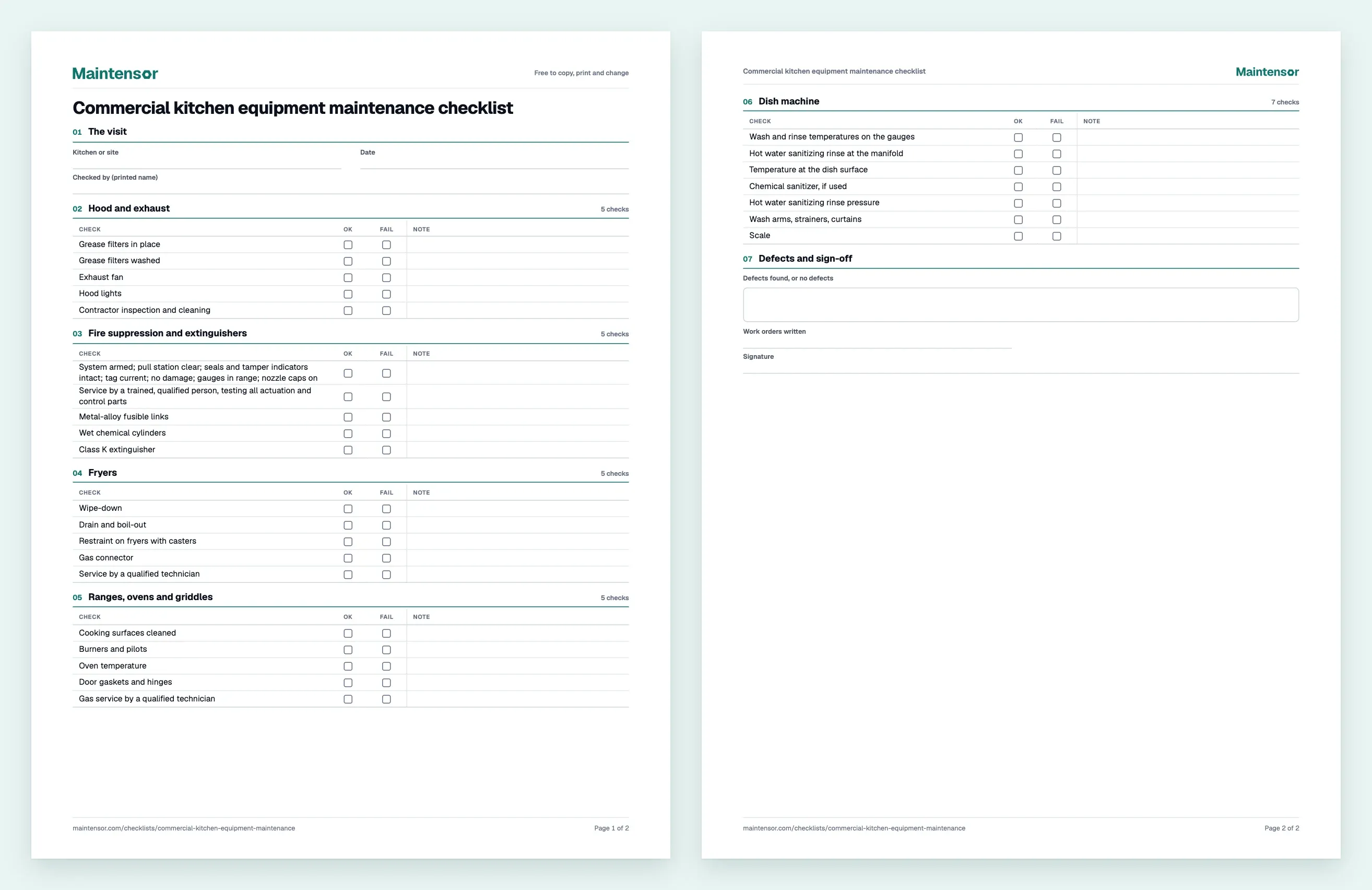
The checks, machine by machine
Each check has its own interval, from every shift to once in 12 years; the full tables say which. A failed check gets a work order. Cut the machines you do not have and add your makers’ tasks: every model differs, and the manual wins.
Hood and exhaust5 checks
- Grease filters in place
- Grease filters washed
- Exhaust fan
- Hood lights
- Contractor inspection and cleaning
Fire suppression and extinguishers5 checks
- System armed; pull station clear; seals and tamper indicators intact; tag current; no damage; gauges in range; nozzle caps on
- Service by a trained, qualified person, testing all actuation and control parts
- Metal-alloy fusible links
- Wet chemical cylinders
- Class K extinguisher
Fryers5 checks
- Wipe-down
- Drain and boil-out
- Restraint on fryers with casters
- Gas connector
- Service by a qualified technician
Ranges, ovens and griddles5 checks
- Cooking surfaces cleaned
- Burners and pilots
- Oven temperature
- Door gaskets and hinges
- Gas service by a qualified technician
Dish machine7 checks
- Wash and rinse temperatures on the gauges
- Hot water sanitizing rinse at the manifold
- Temperature at the dish surface
- Chemical sanitizer, if used
- Hot water sanitizing rinse pressure
- Wash arms, strainers, curtains
- Scale
What counts as a fail, check by checkThe full tables, machine by machine, with how often and where that comes from.
The last column of each table says how often, and whether that comes from a code, the maker or common practice.
Hood and exhaust
| Check | Pass | Fail if | Interval from |
|---|---|---|---|
| Grease filters in place | Every slot filled, baffles the right way | Missing filter, gap at the end | Daily, common practice |
| Grease filters washed | No grease dripping or pooling in the gutter | Grease dripping from the hood | Weekly, or as the hood maker says |
| Exhaust fan | Belt sound, grease box at the roof fan not full | Grease on the roof, slipping belt | Monthly, common practice |
| Hood lights | Work, covers on | Out or uncovered | Monthly, common practice |
| Contractor inspection and cleaning | Report and sticker current | Past the date for your class | NFPA 96 |
Fire suppression and extinguishers
The Minnesota Department of Health’s guide to kitchen cooking equipment sets out what the older editions its rules adopt require (NFPA 96 of 2011 and NFPA 17A of 2009); check the editions your fire marshal enforces.
| Check | Pass | Fail if | Interval from |
|---|---|---|---|
| System armed; pull station clear; seals and tamper indicators intact; tag current; no damage; gauges in range; nozzle caps on | All true | Any one not true: call the contractor | Monthly, by the owner (NFPA 17A) |
| Service by a trained, qualified person, testing all actuation and control parts | Report and tag dated within 6 months | Overdue | Every 6 months (NFPA 96) |
| Metal-alloy fusible links | Replaced at the service | Not replaced | At least every 6 months (NFPA 96) |
| Wet chemical cylinders | Hydrostatic test date current | Overdue | Every 12 years (NFPA 17A) |
| Class K extinguisher | Within 30 feet of travel from the fryers and other cooking-oil hazards; monthly check done | Missing, blocked or too far | NFPA 10, as OSHA’s placement guidance summarizes it |
Monthly extinguisher checks are covered in the fire extinguisher inspection checklist.
Fryers
From Pitco’s installation and operation manual for its SG gas fryers; other makers’ manuals differ in detail. A fryer with a built-in filter adds the oil filtering its own manual sets.
| Check | Pass | Fail if | Interval from |
|---|---|---|---|
| Wipe-down | Done at close; no oil on the outside | Built-up oil on the cabinet | Daily, maker |
| Drain and boil-out | Tank, tubes and walls clean after a boil-out | Carbon on the tubes | Weekly, maker |
| Restraint on fryers with casters | Restraining device connected whenever the fryer is on gas | Restraint unhooked | Every shift, maker |
| Gas connector | Not kinked or crushed; quick-disconnect seated | Kinked, crushed or leaking | Weekly, common practice |
| Service by a qualified technician | Performance and operation inspected; report on file | Overdue | Yearly, maker’s recommendation |
Ranges, ovens and griddles
| Check | Pass | Fail if | Interval from |
|---|---|---|---|
| Cooking surfaces cleaned | Clean at the end of each day | Encrusted grease | At least every 24 hours (Food Code 4-602.12) |
| Burners and pilots | Light at once, even flame on every port | Late ignition, ragged or yellow flame | Daily, common practice |
| Oven temperature | An oven thermometer agrees with the dial | Far off: recalibrate | Monthly, common practice |
| Door gaskets and hinges | Door closes and seals | Gap, torn gasket, dropped door | Monthly, common practice; Food Code 4-501.11(B) |
| Gas service by a qualified technician | Report current | Overdue | Yearly, common practice, or the maker |
Dish machine
These figures are from the FDA Food Code, as your state adopted it.
| Check | Pass | Fail if | Interval from |
|---|---|---|---|
| Wash and rinse temperatures on the gauges | Match the machine’s data plate | Below the data plate | Each shift; data plate per Food Code 4-204.113 |
| Hot water sanitizing rinse at the manifold | 180°F (82°C) or more, or 165°F (74°C) for a stationary rack, single temperature machine; not above 194°F (90°C) | Outside those | Food Code 4-501.112 |
| Temperature at the dish surface | Irreversible temperature indicator (a heat strip or thermometer) shows the plate got hot enough | Indicator not reached | Daily; indicator required by Food Code 4-302.13(B) |
| Chemical sanitizer, if used | Test kit reads the label’s concentration | Low or no sanitizer | Each shift; Food Code 4-501.116 |
| Hot water sanitizing rinse pressure | Within the data plate range, between 5 and 30 psi | Outside it | Food Code 4-501.113 |
| Wash arms, strainers, curtains | Clean, nozzles clear | Blocked nozzles | Daily, maker |
| Scale | No scale in the tank or on the heating element | Scale: delime | As the maker says for your water |
How often the hood is inspected, by cooking volume
NFPA 96 sets a schedule for inspecting the whole exhaust system (hood, grease filters, fan and duct) for grease, by how much and what you cook. Which class your kitchen falls in is for your hood contractor and fire marshal to settle, not a guess.
This is the table as the 2017 edition has it (Table 11.4), from the Village of New Paltz building department’s summary; later editions renumber it. Where the inspection finds grease deposits, a trained, qualified company cleans the contaminated parts.
Refrigeration, ice and the grease trap
Reach-in coolers need the same door gasket and condenser care as a walk-in, on a smaller scale. The walk-in cooler checklist covers temperatures, gaskets, coils and the temperature log, and the ice machine checklist covers cleaning on the maker’s interval.
How often the grease trap or interceptor is pumped is set by your sewer utility, not the Food Code. Keep the hauler’s receipt each time.
Before you start
When a check fails
Gas smell: shut the gas off at the appliance or the main if it is safe to, get people out and call the gas utility.
A suppression system with a missing seal, an out-of-date tag or a blocked pull station: call your fire protection contractor that day and ask your fire marshal what you may cook in the meantime.
Anything else gets a work order, and equipment that is unsafe to use is tagged out until it is fixed.
This list is a starting point and not a substitute for the contractors your code requires.
What the codes say
NFPA 96 sets the hood inspections and the 6-monthly suppression service, NFPA 17A the owner’s monthly suppression check, and the FDA Food Code the dish machine figures. Your fire marshal enforces the editions your jurisdiction adopted, and the Food Code applies as your state adopted it.
What the rules sayHood cleaning and dampers under NFPA 96, grease interceptors, and Canada.
- The cleaning certificate. After a cleaning, a certificate with the company, the person and the date stays on the premises.
- Dampers and wash systems. Hoods with mechanical or fire-actuated dampers or built-in wash systems are inspected and tested every 6 months or at the maker’s interval. See NFPA 96 for the standard itself.
- The grease trap and the Food Code. The Food Code asks only that a grease trap, where one is used, be easy to reach for cleaning (5-402.12).
- How often it is pumped. EPA’s fact sheet on grease from food service establishments says the right frequency depends on how much grease the kitchen produces and the practices it follows to keep grease out of the drains.
- One ordinance. A North Las Vegas sewer ordinance on EPA’s site requires gravity grease interceptors to be serviced at least every 90 days, or sooner when floating grease and settled solids pass 25% of capacity, and a record of each pumping.
- Canada. Provincial fire codes and gas regulations apply.
Kitchen equipment in Maintensor: who does what, as repeating jobs
In Maintensor, each machine is an asset under the kitchen location: the hood, each fryer, the range, the dish machine. Split the work by who does it and how often, and make each split a work order that repeats.
- The repeats. The cooks’ daily line check, the weekly hood filters and fryer boil-out, the monthly suppression and extinguisher check, and the contractor visits every 3 or 6 months, each ending in a File step for the contractor’s report.
- A failed Inspection check asks for a note and a photo, then offers a follow-up work order and Mark asset down, so the record of a fryer with a broken high-limit shows it Down. That is a record, not a lockout: tag the fryer itself, since a Down asset can still be given new work.
- Cooks. Only Full users and Admins answer checklists, so cooks who do the daily check in the app need a seat; otherwise they report problems as Requesters, free on every plan.

What it does not do: Maintensor records what was done and found. It does not replace the hood sticker, the suppression tag or the contractor’s certificate, and it has no export. The hospitality page shows the app on a demo hotel, and the hotel maintenance guide fits the kitchen into the engineering week.