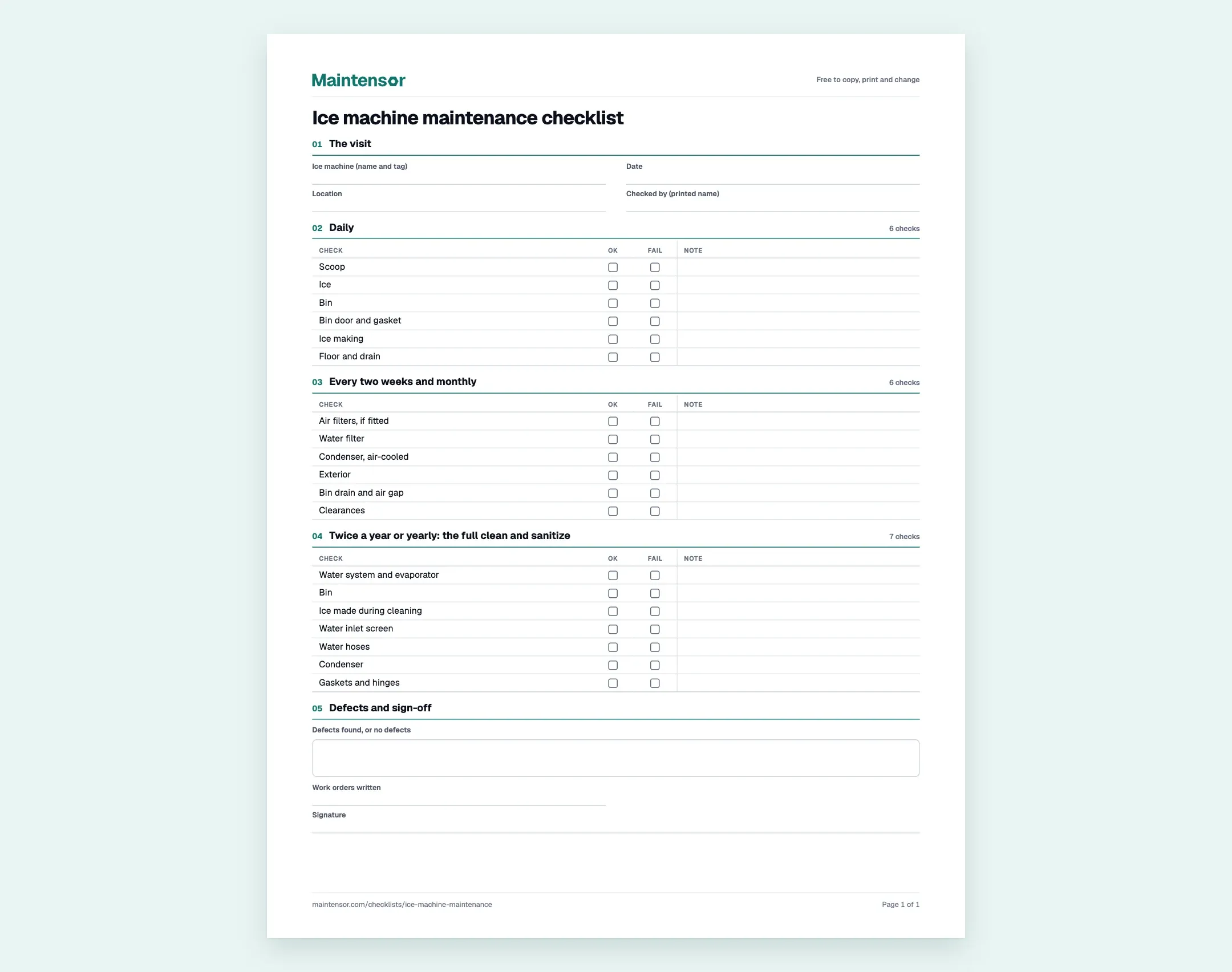
The checks, by visit
One sheet per machine and visit. Kitchen or bar staff tick the daily card; engineering, or a service agent, does the monthly checks and the full clean. A failed check gets a work order, and your model’s manual sets the steps.
Daily6 checks
- Scoop
- Ice
- Bin
- Bin door and gasket
- Ice making
- Floor and drain
Every two weeks and monthly6 checks
- Air filters, if fitted
- Water filter
- Condenser, air-cooled
- Exterior
- Bin drain and air gap
- Clearances
Twice a year or yearly: the full clean and sanitize7 checks
- Water system and evaporator
- Bin
- Ice made during cleaning
- Water inlet screen
- Water hoses
- Condenser
- Gaskets and hinges
What counts as a fail, check by checkThe full tables, and where each interval comes from.
The last column of each table says where each check comes from. The makers’ manuals set most of the intervals; where the column names only the Food Code, the code sets what passes and the interval is common practice.
Daily
| Check | Pass | Fail if | Interval from |
|---|---|---|---|
| Scoop | Washed, rinsed and kept in a clean holder outside the ice | Left in the ice, or in a dirty holder | Food Code 3-304.12; Hoshizaki’s schedule cleans the scoop daily |
| Ice | Clear, no odor, no specks or slime | Specks, film, odor or off taste: stop serving it | Food Code 4-602.11 |
| Bin | Nothing stored in the ice: no bottles, no fruit, no glasses | Anything else in the bin | Food Code 3-303.11 (ice that chilled bottles or food is not served) |
| Bin door and gasket | Closes fully; gasket whole | Gap, torn gasket | Food Code 4-501.11(B) |
| Ice making | Machine harvesting; stops when the bin is full | Not harvesting, or bin overflowing | Common practice |
| Floor and drain | Dry under the machine; bin drain flowing | Puddle, slow drain | Common practice |
Every two weeks and monthly
| Check | Pass | Fail if | Interval from |
|---|---|---|---|
| Air filters, if fitted | Inspected every two weeks, washed when dirty | Matted with dust or grease | Hoshizaki KM manual (every two weeks) |
| Water filter | Pressure at the gauge in range; cartridge in date | Pressure drop past the maker’s figure, or past its date: change it | Hoshizaki KM manual (monthly check), filter maker |
| Condenser, air-cooled | Fins clean, nothing blocking the airflow | Dust, lint or grease on the fins: brush or vacuum | Common practice near a fryer or in a dusty room; Hoshizaki’s figure is a yearly inspection |
| Exterior | Wiped down; no rust or chlorine stains | Rust spots, damaged panels | Hoshizaki KM manual (monthly) |
| Bin drain and air gap | Water runs freely; air gap above the floor drain intact | Drain hose pushed into the floor drain | Food Code 5-402.11 |
| Clearances | Air space around the machine as the manual requires | Boxes stacked against the vents | The maker |
Twice a year or yearly: the full clean and sanitize
| Check | Pass | Fail if | Interval from |
|---|---|---|---|
| Water system and evaporator | Cleaned and descaled with the maker’s cleaner, then sanitized | Scale or slime left on surfaces | Manitowoc Indigo: at least every 6 months. Hoshizaki KM: yearly as a guideline |
| Bin | Emptied, cleaned and sanitized, liner and door included | Film or growth left in corners | Same as above |
| Ice made during cleaning | All of it thrown away | Any served | Manitowoc Indigo manual |
| Water inlet screen | Cleaned | Blocked | Hoshizaki KM manual (yearly) |
| Water hoses | Not cracked, kinked or slimed | Cracked or slimed: replace | Hoshizaki KM manual (yearly) |
| Condenser | Cleaned, and the fan turns freely | Packed fins, noisy fan | Hoshizaki KM manual (yearly inspection) |
| Gaskets and hinges | Seal all round; door closes on its own weight where designed to | Torn gasket, sagging door | Food Code 4-501.11(B) |
The two makers’ intervals come from Manitowoc’s Indigo series manual, which says to clean and sanitize at least once every six months, and from Hoshizaki’s service manual for its larger KM models, whose schedule lists the yearly clean as a guideline. It adds that water quality, the room and local sanitation rules may call for more.
When to clean more often
Shorten the interval when the machine tells you to: slime between cleanings, scale on the evaporator soon after a clean, ice that comes out cloudy or slow. A machine near a fryer or in a dusty storeroom may need its condenser and air filters done sooner than the manual’s figure.
Manitowoc’s manual says a machine that needs more frequent cleaning should have its water tested by a qualified service company, for treatment.
ExampleSpreading the full cleans across the year
Say a made-up hotel has six machines, five on guest floors and one in the kitchen, all cleaned twice a year. That is 12 cleans, or one a month.
One machine a month is a morning of work; six machines in the same week is a lost week. How to build a preventive maintenance schedule covers spreading the load.
Before you start
When a check fails
If you find slime, mold, specks or an odor in the ice or the bin, stop serving that ice, empty the bin and clean and sanitize before the machine is used again. A leak, a blocked drain or a machine that stops harvesting gets a work order the same day.
Ice is food: what the Food Code says
Under the FDA Food Code, the definition of food includes ice (1-201.10(B)). Ice bins and the enclosed parts of ice makers are cleaned at the frequency the maker specifies, or, without one, often enough to prevent soil or mold building up (4-602.11(E)(4)).
The rest of the Food CodeDrinking water, coolant ice, scoops, drains, doors and seals.
The code is a model that states and localities adopt, often an earlier edition than the newest. The sections below read the same in the 2026 and 2022 editions.
- Drinking water only. Ice used as food or as a cooling medium must be made from drinking water (3-202.16).
- Coolant ice is not served. Ice that chilled cans, bottles or the outside of food may not then be used as food (3-303.11).
- Scoops. Utensils such as ice scoops are stored in a clean, protected location between uses (3-304.12(E)).
- Drains. Liquid waste drain lines may not pass through an ice machine or ice bin (4-204.17), and a drain from equipment that holds food may not connect directly to the sewer (5-402.11), which is why the bin drain ends above the floor drain with an air gap.
- Doors and seals. Doors, seals and hinges are kept intact, tight and adjusted to the maker’s specification (4-501.11(B)).
Ice machines in Maintensor: nameplates, filter stock and the clean
Each machine is an asset with its maker, model and serial number on the nameplate, which is what you need when ordering a filter. The monthly check and the clean and sanitize become two work orders that repeat: monthly, and monthly every 6 months (or yearly) for the full clean.
- The water filter can be a part with a reorder level. Put it on the work order for the change, such as a follow-up from the monthly check, and the stock comes off when that job is completed.
- The clean as a procedure: an Instruction step for switching off and isolating the machine, a Checkbox for “all ice made during cleaning thrown away”, Inspection checks for the bin, evaporator and drain, a Photo of the clean bin, and a Signature. A failed check asks for a note and a photo and offers a follow-up work order and Mark asset down.
- Guest-floor machines are reported by housekeeping as requests, with the machine picked as the equipment. The hospitality page shows a leaking ice machine in a demo hotel’s request queue.

What it does not do: Maintensor has no sensors and no meters, so it will not know the machine stopped harvesting, or that a filter has passed its gallons. A part on a repeating work order is carried to the next one and comes off stock at every completion, changed or not: keep the filter off the monthly one.