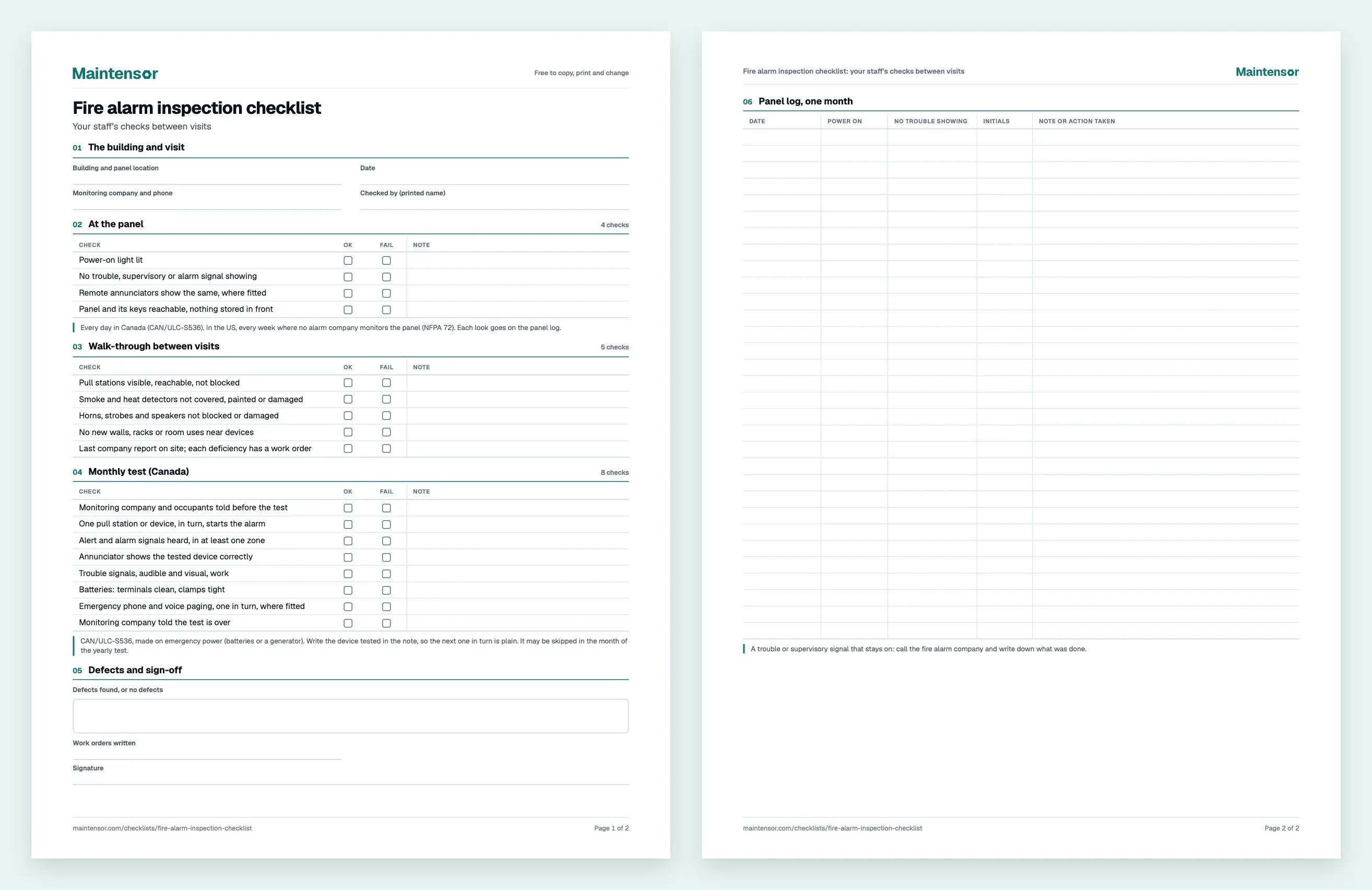
The checks your staff make
One sheet per round. These are the checks between the fire alarm company’s visits: the look at the panel, a walk past the devices, and the monthly test where the code asks for one. A failed check gets a call to the company and a work order.
At the panel4 checks
- Power-on light lit
- No trouble, supervisory or alarm signal showing
- Remote annunciators show the same, where fitted
- Panel and its keys reachable, nothing stored in front
Walk-through between visits5 checks
- Pull stations visible, reachable, not blocked
- Smoke and heat detectors not covered, painted or damaged
- Horns, strobes and speakers not blocked or damaged
- No new walls, racks or room uses near devices
- Last company report on site; each deficiency has a work order
Monthly test (Canada)8 checks
- Monitoring company and occupants told before the test
- One pull station or device, in turn, starts the alarm
- Alert and alarm signals heard, in at least one zone
- Annunciator shows the tested device correctly
- Trouble signals, audible and visual, work
- Batteries: terminals clean, clamps tight
- Emergency phone and voice paging, one in turn, where fitted
- Monitoring company told the test is over
What counts as a fail, check by checkThe full tables, and where each check comes from.
The Source column names the standard behind each check, or “Practice” where it is common practice and no rule. S536 is CAN/ULC-S536, the Canadian standard; NFPA 72 is the American one.
At the panel
| Check | Fail if | Source |
|---|---|---|
| Power-on light lit | Not lit | S536 (daily); NFPA 72 Table 14.3.1 (weekly, unmonitored panels) |
| No trouble, supervisory or alarm signal showing | Any trouble or supervisory light or sound, or an alarm not cleared | S536 (daily); NFPA 72 Table 14.3.1 (weekly, unmonitored panels) |
| Remote annunciators show the same, where fitted | A remote annunciator shows trouble, or does not match the panel | S536 (daily) |
| Panel and its keys reachable, nothing stored in front | Stock or furniture in the way; nobody on shift knows where the key is | NFC 6.3.1.2(2) (components accessible); Weyburn Fire Department (keys at hand) |
Walk-through between visits
What the company’s yearly visual inspection looks for, watched for by your own crew in the months between. Extinguishers have their own monthly round.
| Check | Fail if | Source |
|---|---|---|
| Pull stations visible, reachable, not blocked | Hidden behind stock or a door, or the cover broken | Practice; NFPA 72 Table 14.3.1 |
| Smoke and heat detectors not covered, painted or damaged | A dust cover left after work, paint on a detector, a detector hanging loose | Practice; NFPA 72 Table 14.3.1 |
| Horns, strobes and speakers not blocked or damaged | A new partition or sign in front of one, a cracked strobe | Practice; NFPA 72 Table 14.3.1 |
| No new walls, racks or room uses near devices | A room split in two, racking up to the ceiling, an office turned into storage: tell the fire alarm company | NFPA 72 Table 14.3.1 (building changes, occupancy changes) |
| Last company report on site; each deficiency has a work order | No report on file, or a deficiency with nothing done | NFPA 72 14.6; NFC Division C 2.2.1.2 |
Monthly test (Canada)
Made with the system on its emergency power supply, its batteries or a generator, as the standard asks. Halifax Fire’s copy of it suggests making the test with the generator’s monthly run.
| Check | Fail if | Source |
|---|---|---|
| Monitoring company and occupants told before the test | Nobody told: the test may bring the fire department | NFC 6.1.1.3 (a way to notify people of tests) |
| One pull station or device, in turn, starts the alarm | The device does not start an alarm | S536 |
| Alert and alarm signals heard, in at least one zone | A signal not heard where it should be | S536 |
| Annunciator shows the tested device correctly | The wrong device or zone shown, or none | S536 |
| Trouble signals, audible and visual, work | The trouble light or buzzer does not work | S536 |
| Batteries: terminals clean, clamps tight | Corrosion, loose clamps; on batteries with liquid electrolyte, a level or reading outside the maker’s figures | S536 |
| Emergency phone and voice paging, one in turn, where fitted | No two-way talk, no sign of it at the panel, or a page not heard in its zone | S536 |
| Monitoring company told the test is over | Not told: a real alarm may be taken for a test | Practice |
How often, in the United States and Canada
The usual minimums. Your fire marshal, insurer, state or province may ask for more.
| Check | By | United States | Canada |
|---|---|---|---|
| Look at the panel: power on, no trouble | Your staff | Weekly, where no alarm company monitors it | Daily |
| Test one device in turn, the signals and the batteries | Your staff | No national minimum | Monthly |
| Inspection and test of the system | Fire alarm company | Every 6 months | Yearly |
The US figures are from NFPA 72, Tables 14.3.1 and 14.4.3.2 (2022 edition). The Canadian ones are from CAN/ULC-S536:2019, which the National Fire Code of Canada 2020 calls on in 6.3.1.2.
ExampleA year of monthly tests: eight pull stations
A made-up two-story office in Manitoba, with eight pull stations. Megan Doyle tests one each month in turn, so each is pulled once in eight monthly tests.
| Month | Device | Alarm and signals | Annunciator | Batteries | Note |
|---|---|---|---|---|---|
| January | PS-1, main entrance | OK | OK | OK | |
| February | PS-2, east stair | OK | Fail | OK | Showed as zone 3, not zone 2. Work order to the company |
| March | PS-3, west stair | OK | OK | OK | |
| April | none | The technician’s yearly test this month | |||
| May | PS-4, shipping door | OK | OK | Fail | A corroded terminal. Cleaned by the company that week |
February. A device that reports the wrong zone sends the fire department to the wrong part of the building. The annunciator check exists to catch it.
April. Halifax Fire’s copy of the standard lets the monthly test be skipped in the month of the yearly one. PS-4 waits until May.
What the fire alarm company does
The company’s work is theirs to plan; your job is to know when it is due and what came of it.
Fire doors on hold-open devices should close when the alarm sounds; the fire door inspection checklist has that check.
The sprinkler system’s own valves and gauges have a monthly round of their own on the sprinkler inspection checklist.
Before you start
When a check fails
A trouble signal that stays on, a device that does not start the alarm, a horn nobody hears: call the fire alarm company, and write a work order so the fix is tracked.
If the system or part of it is out of service, NFPA 72 asks that the owner be told (10.21), and the NFC asks for other measures that keep the building protected meanwhile (6.1.1.4). Ask your fire department what it expects, such as a fire watch.
This list is a starting point to adapt with the panel maker’s manual, the code your jurisdiction adopts and your fire alarm company. It is information, not training, and it does not replace the company’s inspection and test.
Add it to an inspection calendar
Put these checks, and the rest of the building's, on a year plan with the usual minimums for the United States or Canada, then print it or add it to your calendar: open the inspection calendar with fire alarm system ticked.
What the rules say
In the United States, NFPA 72 sets the intervals through the fire code your state or city adopts, in the edition it adopts. In Canada, the National Fire Code calls on CAN/ULC-S536, through the code your province or territory adopts.
What the rules sayThe sections, the records to keep, and what was read.
- United States. NFPA 72 (2022), Table 14.3.1 for the visual inspections and Table 14.4.3.2 for the tests, as NFPA prints them in its public input report for the 2025 edition. The 2025 edition is current; your jurisdiction may have adopted an earlier one.
- The US record. NFPA 72 (14.6.2.1) keeps test records until the next test and for 1 year after it.
- Canada. NFC 2020, 6.3.1.2 calls on CAN/ULC-S536, which its publisher sells. The daily and monthly checks here are from Halifax Fire’s copy of its daily and monthly section and the Weyburn Fire Department’s summary.
- The Canadian record. The NFC (Division C, 2.2.1.2) asks for records kept at the building for the authority having jurisdiction: at least the current and the previous ones, none destroyed within two years.
- Your province. Each province and territory adopts its own edition of the NFC, and some, Ontario for one, publish their own fire code.
None of this is legal advice, and no checklist makes a fire alarm system compliant.
Fire alarm rounds in Maintensor: the panel as an asset
Set the fire alarm panel up as an asset in its room, and build one procedure for each round. There is no ready-made library, so you type the checks in once.
- The rounds. An Inspection check for each line, answered Pass, Flag or Fail, and a Text step for the device tested this month. In Canada the look at the panel is a work order that repeats daily; the monthly test repeats monthly.
- A Fail asks for a note and a photo before the next step, then offers a follow-up work order, and Mark asset down to show the panel as Down.
- The company’s visit. A work order that repeats every 6 months (yearly in Canada), with the company’s report attached. Turn each deficiency on it into a follow-up work order, so it does not wait for the next visit.

What it does not do: Maintensor has no link to the panel or the monitoring company, so it knows only what someone records. Only Admins and Full users answer checklists, so whoever makes the rounds needs a user seat. It records what was checked; it certifies nothing. The facility maintenance software page shows the rest of a building’s setup.