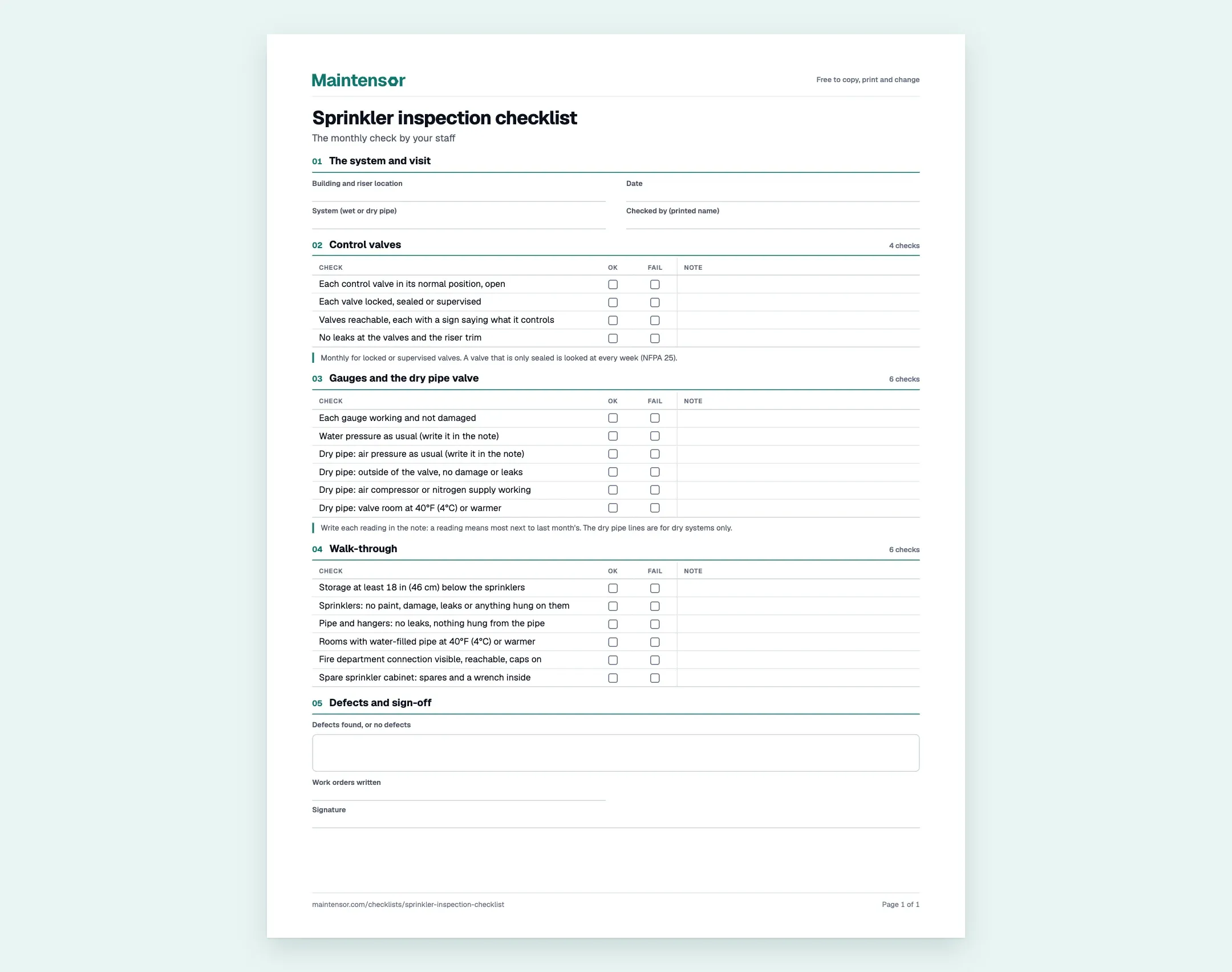
The monthly check by your staff
One sheet a month for each system, read at the riser. It is a look, not a test: nothing is opened and no water flows. A failed check gets a call to the sprinkler company and a work order.
Control valves4 checks
- Each control valve in its normal position, open
- Each valve locked, sealed or supervised
- Valves reachable, each with a sign saying what it controls
- No leaks at the valves and the riser trim
Gauges and the dry pipe valve6 checks
- Each gauge working and not damaged
- Water pressure as usual (write it in the note)
- Dry pipe: air pressure as usual (write it in the note)
- Dry pipe: outside of the valve, no damage or leaks
- Dry pipe: air compressor or nitrogen supply working
- Dry pipe: valve room at 40°F (4°C) or warmer
Walk-through6 checks
- Storage at least 18 in (46 cm) below the sprinklers
- Sprinklers: no paint, damage, leaks or anything hung on them
- Pipe and hangers: no leaks, nothing hung from the pipe
- Rooms with water-filled pipe at 40°F (4°C) or warmer
- Fire department connection visible, reachable, caps on
- Spare sprinkler cabinet: spares and a wrench inside
What counts as a fail, check by checkThe full tables, and where each check comes from.
The Source column names the section behind each check, or “Practice” where it is common practice and no rule. NFPA 25 section numbers are from the 2026 edition; in Canada the National Fire Code calls on the 2017 edition, which numbers some of them differently.
Control valves
| Check | Fail if | Source |
|---|---|---|
| Each control valve in its normal position, open | A valve shut or part shut that should be open | NFPA 25, 13.3.2 |
| Each valve locked, sealed or supervised | Lock or seal missing or broken, tamper switch loose | NFPA 25, 13.3.2 |
| Valves reachable, each with a sign saying what it controls | Stock or shelving in front of a valve, a sign missing | NFPA 25, 13.3.2 |
| No leaks at the valves and the riser trim | Water dripping or pooling at a valve or drain | NFPA 25, 13.3.2 |
Gauges and the dry pipe valve
| Check | Fail if | Source |
|---|---|---|
| Each gauge working and not damaged | Cracked glass, a needle stuck or at zero | NFPA 25, 13.2.4 |
| Water pressure as usual | Well below last month’s reading | NFPA 25, 13.2.4 (quarterly at least) |
| Dry pipe: air pressure as usual | Well below last month’s reading, or falling month to month | NFPA 25, 13.2.4 (monthly) |
| Dry pipe: outside of the valve, no damage or leaks | Damage, rust or water at the valve | NFPA 25, Table 13.1.1.2 (monthly) |
| Dry pipe: air compressor or nitrogen supply working | Not running when it should, or running all the time | NFPA 25, Table 13.1.1.2 (monthly) |
| Dry pipe: valve room at 40°F (4°C) or warmer | Colder, or the heater off; check it every day in freezing weather | NFPA 25, Chapter 4 |
Walk-through
| Check | Fail if | Source |
|---|---|---|
| Storage at least 18 in (46 cm) below the sprinklers | Anything stacked closer | OSHA 1910.159(c)(10); NFPA 25, 5.2.1.2 |
| Sprinklers: no paint, damage, leaks or anything hung on them | Paint, dust or grease on a sprinkler, a bent or leaking one, a cable or sign hung from it | NFPA 25, 5.2.1.1 (yearly); practice monthly |
| Pipe and hangers: no leaks, nothing hung from the pipe | A drip, a loose hanger, lights or cables tied to the pipe | NFPA 25, 5.2.2 and 5.2.3 (yearly); practice monthly |
| Rooms with water-filled pipe at 40°F (4°C) or warmer | A cold room, an open window by a riser, a heater off | NFPA 25, Chapter 4 |
| Fire department connection visible, reachable, caps on | Hidden by a vehicle or plants, a cap missing | Practice; the company inspects it quarterly |
| Spare sprinkler cabinet: spares and a wrench inside | Empty, short of a type, no wrench | NFPA 25, 5.2.1.4 (yearly) |
How often, in the United States and Canada
The same in both countries: the National Fire Code of Canada 2020 (6.4.1.1) calls on NFPA 25, the standard for water-based fire protection. These are the usual minimums; your fire marshal, insurer, state or province may ask for more.
| Check | By | How often |
|---|---|---|
| Control valves, and the gauges read with them | Your staff | Monthly (NFPA 25 asks for wet pipe gauges at least quarterly) |
| Dry pipe valve and its air pressure | Your staff | Monthly, dry systems |
| Inspection and test of the system | Sprinkler company | Quarterly |
| Full-flow trip test and air leak test | Sprinkler company | Every 3 years, dry systems |
| Gauges replaced or tested | Sprinkler company | Every 5 years |
| Internal check of the pipe | Sprinkler company | Every 5 years |
The monthly look assumes valves that are locked or supervised; a valve that is only sealed is looked at every week. A fire pump adds its own runs: weekly for a diesel pump, monthly for most electric ones, and a yearly flow test.
ExampleOne month's valve and gauge readings
A made-up warehouse in Ohio with a wet pipe system: one riser, two control valves and two gauges. Ryan Walsh reads them on the first Monday of each month.
| Valve or gauge | Usual | This month | Note |
|---|---|---|---|
| Main control valve, riser room | Open, locked | Open, locked | |
| Mezzanine control valve | Open, sealed | Shut | Shut for a pipe repair and never reopened |
| Gauge below the alarm valve | 78 psi | 77 psi | |
| Gauge above the alarm valve | 84 psi | 84 psi |
The mezzanine valve. A shut valve left the mezzanine without sprinklers. The sprinkler company reopened it that day and tested it, as NFPA 25 asks after a valve is closed and reopened.
Sealed only. This valve has a seal but no lock or tamper switch, so NFPA 25 asks for a look every week, not every month. A lock on it would have let the monthly round do.
What the sprinkler company does
Their visits follow NFPA 25’s tables. Your job is to book them, let the technician in and act on the report.
A system with a backflow preventer on its supply adds a weekly look at a reduced-pressure assembly and a yearly test of it. Where the waterflow and tamper switches report to a fire alarm system, its company tests that side too.
Before you start
When a check fails
A shut valve, a gauge at zero or a leaking sprinkler can mean part of the building is not protected. Call the sprinkler company now, and write a work order so the fix is tracked. Storage too close to the sprinklers is moved the same day.
NFPA 25 asks the owner for a plan for the times the system is out of service (its Chapter 15), and the NFC asks for other measures that keep the building protected meanwhile (6.1.1.4). Ask your fire department what it expects, such as a fire watch.
This list is a starting point to adapt with your sprinkler company, the system’s own drawings and signs, and the code your jurisdiction adopts. It is information, not training, and it does not replace the company’s inspections and tests.
Add it to an inspection calendar
Put these checks, and the rest of the building's, on a year plan with the usual minimums for the United States or Canada, then print it or add it to your calendar: open the inspection calendar with sprinkler system ticked.
What the rules say
In the United States, NFPA 25 sets the intervals through the fire code your state or city adopts. Where a workplace’s sprinklers were installed to meet an OSHA standard, OSHA adds a yearly main drain test and the 18 inches of clearance. In Canada, the National Fire Code calls on NFPA 25.
What the rules sayThe editions, OSHA's rule, the records to keep, and what was read.
- The US edition. NFPA 25’s 2026 tables, as NFPA prints them in its second draft report, and the 2020 text in an earlier public input report. NFPA’s blogs on sprinkler maintenance and the owner’s responsibilities give the owner’s side. Your jurisdiction may have adopted an earlier edition.
- Valves. Locked or supervised valves are looked at monthly; valves only sealed, weekly; NFPA 25 lets electrically supervised valves go quarterly (13.3.2.1).
- OSHA. 29 CFR 1910.159 covers sprinkler systems installed to meet an OSHA standard; others are exempt. It asks for a main drain flow test every year and the inspector’s test valve opened at least every two years ((c)(2)), and 18 inches (45.7 cm) between sprinklers and the material below ((c)(10)).
- The record. The owner keeps a record of every inspection, test and maintenance task, on paper or electronically, for the authority having jurisdiction, as NFPA’s guidance on the owner’s responsibilities puts it. In Canada the NFC (Division C, 2.2.1.2) asks for records kept at the building: at least the current and the previous ones, none destroyed within two years.
- Canada. NFC 2020, 6.4.1.1 calls on NFPA 25 in its 2017 edition. Each province and territory adopts its own edition of the NFC, and some, Ontario for one, publish their own fire code.
None of this is legal advice, and no checklist makes a sprinkler system compliant.
Sprinkler checks in Maintensor: one round, one riser
Make the sprinkler system an asset in its riser room, and build one procedure for the monthly round. There is no ready-made library, so you type the checks in once.
- The round. A Heading for each valve with an Inspection check for its position and lock, and a Number step for each gauge, with the usual pressure in the step’s name: “Gauge below alarm valve, psi (usually 78)”.
- The schedule. A work order that repeats monthly on a date, and a second one for the sprinkler company’s visit that repeats every 3 months, with their report attached when it comes.
- A Fail asks for a note and a photo, then offers a follow-up work order, and Mark asset down to show the system as Down while it is out of service.

What it does not do: a Number step has no limits, so a low reading is flagged only when the person reading it flags it, and the reading stays on that work order. Maintensor has no link to the tamper switches or the alarm panel. Only Admins and Full users answer checklists, so whoever reads the riser needs a user seat. It records what was checked; it certifies nothing. The facility maintenance software page shows the rest of a building’s setup.