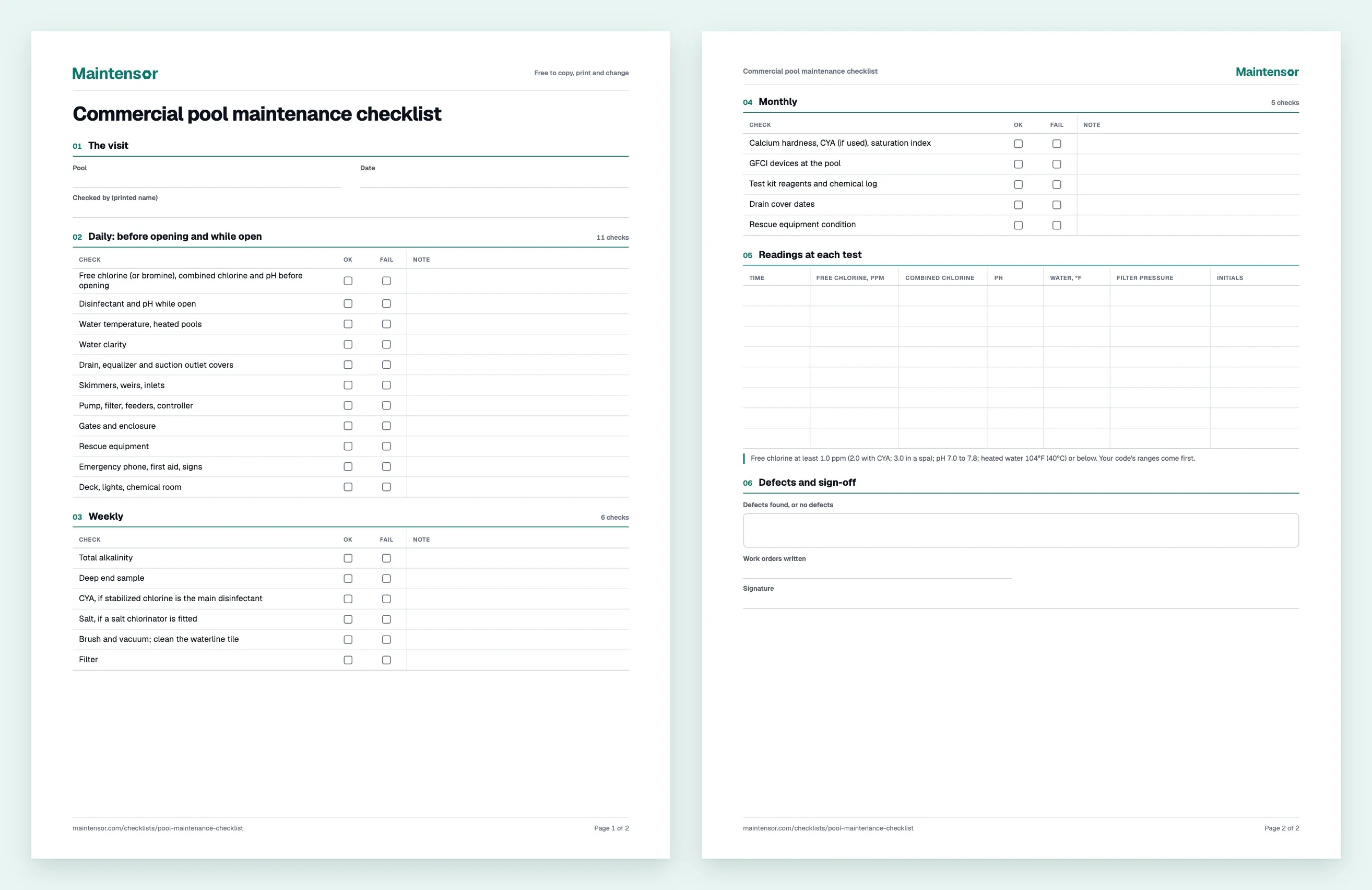
The checks, by visit
One sheet per pool and day: the daily checks before opening and while open, then the weekly and monthly work. A check that fails closes the pool or gets a work order the same day (below).
The numbers on this page come from CDC’s 2024 Model Aquatic Health Code (MAHC), the national model many health departments draw on. Your state or local pool code is the one that applies, and its numbers may differ.
Daily: before opening and while open11 checks
- Free chlorine (or bromine), combined chlorine and pH before opening
- Disinfectant and pH while open
- Water temperature, heated pools
- Water clarity
- Drain, equalizer and suction outlet covers
- Skimmers, weirs, inlets
- Pump, filter, feeders, controller
- Gates and enclosure
- Rescue equipment
- Emergency phone, first aid, signs
- Deck, lights, chemical room
Weekly6 checks
- Total alkalinity
- Deep end sample
- CYA, if stabilized chlorine is the main disinfectant
- Salt, if a salt chlorinator is fitted
- Brush and vacuum; clean the waterline tile
- Filter
Monthly5 checks
- Calcium hardness, CYA (if used), saturation index
- GFCI devices at the pool
- Test kit reagents and chemical log
- Drain cover dates
- Rescue equipment condition
What counts as a fail, check by checkThe full tables, what passes, and the MAHC section behind each interval.
Each check says what passes and what fails, and the last column says where the interval comes from.
Daily: before opening and while open
| Check | Pass | Fail if | Interval from |
|---|---|---|---|
| Free chlorine (or bromine), combined chlorine and pH before opening | Within your code’s ranges | Outside them: adjust and retest before opening | MAHC 5.7.5.1 |
| Disinfectant and pH while open | Within range at each test | Outside range: adjust, close if below minimum | MAHC 5.7.5.2 (every 2 hours, manual feed), 5.7.5.3 (every 4 hours, controller) |
| Water temperature, heated pools | Recorded with each chemistry test, within limit | Above 104°F (40°C) | MAHC 5.7.5.10 |
| Water clarity | Main drain or reference tile visible from the deck | Bottom not visible: closed | MAHC 5.7.6 |
| Drain, equalizer and suction outlet covers | In place, secure, unbroken | Loose, cracked or missing: closed until replaced | MAHC 5.7.1.5, 6.4.1.3.1 |
| Skimmers, weirs, inlets | Baskets clear, weirs in place, inlet covers on | Weir missing, cover broken | MAHC 6.4.1.3.1 |
| Pump, filter, feeders, controller | All running; filter pressure and flow recorded | Not running: closed | MAHC 6.4.1.3.1, 6.4.1.6 |
| Gates and enclosure | Gates self-close and latch; fence intact; no furniture to climb | Gate propped or not latching | MAHC 6.4.1.3.1 |
| Rescue equipment | Throwing device with rope and reaching pole with shepherd’s crook at the pool | Missing or damaged | MAHC 5.8.5.4 (unguarded pools over 2 feet deep) |
| Emergency phone, first aid, signs | Phone works; kit stocked; signs posted and readable | Phone dead, sign missing | MAHC 5.8.5, 6.4.1.3.1 |
| Deck, lights, chemical room | Deck clear of glass and trip hazards; underwater lights intact; chemical room locked | Glass, exposed wires, water in a light, unlocked chemical room | MAHC 6.4.1.3.1 |
Weekly
| Check | Pass | Fail if | Interval from |
|---|---|---|---|
| Total alkalinity | 60 to 180 ppm | Outside: adjust | MAHC 5.7.5.5 |
| Deep end sample | Included in one test this week | Never sampled | MAHC 5.7.4.3.3 |
| CYA, if stabilized chlorine is the main disinfectant | At or under 90 ppm | Over: partial drain and refill | MAHC 5.7.5.7.2 |
| Salt, if a salt chlorinator is fitted | In the maker’s range | Outside it | MAHC 5.7.5.11, or the maker |
| Brush and vacuum; clean the waterline tile | No algae, film or scale | Slime or algae on surfaces | Common practice; the daily inspection in MAHC 6.4.1.3.1 also checks that slime and biofilm are gone |
| Filter | Backwashed or cleaned at the pressure rise the maker gives | Pressure past the maker’s limit | The filter maker |
Monthly
| Check | Pass | Fail if | Interval from |
|---|---|---|---|
| Calcium hardness, CYA (if used), saturation index | In range | Out of range | MAHC 5.7.5.6 to 5.7.5.8 |
| GFCI devices at the pool | Trip on Test, restore on Reset | Do not trip | MAHC 6.4.1.3.2 |
| Test kit reagents and chemical log | Reagents in date; inventory log current | Expired reagents | MAHC 6.4.1.5 |
| Drain cover dates | Each cover inside the service life marked on it | Past its date: plan replacement | Common practice; CPSC recommends replacing expired covers |
| Rescue equipment condition | Rope not frayed; pole and crook sound | Frayed rope, cracked pole | Common practice |
Quarterly, twice a year and seasonal
| Check | When | Interval from |
|---|---|---|
| Total dissolved solids | Quarterly | MAHC 5.7.5.9 |
| Bonding conductors, where you can see them | Every 6 months, and after any work near them | MAHC 6.4.1.3.2 |
| Drain covers and fasteners, by a qualified professional | At least yearly | CPSC recommendation |
| Secondary anti-entrapment system (safety vacuum release or pump shut-off) | As its maker directs | The maker |
| Heater, pump motor and seal, chemical controller probes | As each maker directs | The makers |
| Filter sand or cartridges replaced | As the filter maker directs | The maker |
| Outdoor pool opening and closing | Each season: full daily list before reopening | Your health department |
Water chemistry targets
Values from the 2024 MAHC (5th edition). A spa here means a hot tub.
| What | Pool | Spa | MAHC section |
|---|---|---|---|
| Free chlorine, minimum, no cyanuric acid (CYA) | 1.0 ppm | 3.0 ppm | 5.7.3.1.1.2 |
| Free chlorine, minimum, with CYA | 2.0 ppm | CYA is phased out in spas | 5.7.3.1.1.2, 5.7.3.1.3.1 |
| Free chlorine, maximum | Product label; above 10 ppm with swimmers closes | Same | 5.7.3.1.1.5, 6.6.3.1 |
| Bromine, if used | 3.0 to 8.0 ppm | 4.0 to 8.0 ppm | 5.7.3.1.2 |
| pH | 7.0 to 7.8; below 6.5 or above 8.0 closes | Same | 5.7.3.4.1, 6.6.3.1 |
| Combined chlorine | Act above 0.4 ppm | Same | 5.7.4.4.2 |
| Total alkalinity | 60 to 180 ppm | Same | 5.7.4.4.1 |
| Calcium hardness | 2,500 ppm maximum | Same | 5.7.4.4.3 |
| CYA | 90 ppm maximum; 300 ppm or more closes | Phased out in spas | 5.7.3.1.3.2, 5.7.3.1.3.3 |
| Water temperature | 104°F (40°C) maximum | Same | 5.7.4.7.2 |
For hot tubs, CDC’s Legionella control toolkit suggests control limits of 3 to 10 ppm free chlorine (or 4 to 8 ppm bromine) and pH 7.2 to 7.8, testing at least twice a day, and no CYA.
ExampleHow often to drain a hot tub
The toolkit’s water replacement interval is days = (spa gallons ÷ 3) ÷ average bathers a day. A made-up 600-gallon hot tub with 25 bathers a day works out to (600 ÷ 3) ÷ 25 = 8 days between drain, clean and refill.
Before you start
When a check fails
The MAHC lists conditions that call for closing the pool at once (section 6.6.3), among them disinfectant below the minimum or above 10 ppm with swimmers present, pH below 6.5 or above 8.0, filtration or disinfection not running, a broken, loose or missing drain cover, a bottom you cannot see, and missing lifesaving equipment.
Close it, fix it, retest, and write down when it reopened. Every other failed check gets a work order the same day.
Records
The MAHC asks that operation, maintenance and management records be kept at least 3 years and shown to the health department on request (6.4.1.2.1). The daily record includes pH, disinfectant, combined chlorine, pump and filter pressures or flow, CYA if used, temperature, backwash times, and any equipment failure or calibration (6.4.1.6).
Many health departments supply their own log form: use it. A log is only worth what went into it, so read it: identical readings day after day are a sign of pencil whipping. For the equipment side, an equipment maintenance log keeps the pump, heater and filter history.
Drain covers and the VGB Act
The Virginia Graeme Baker Pool and Spa Safety Act applies to public pools and spas, and CPSC’s 2024 letter to pool operators spells out that this includes hotels, motels and apartment complexes. Every drain cover must meet the current federal standard, ANSI/APSP/ICC-16 2017, adopted at 16 CFR 1450.
What else the Act and CPSC askA second system for a single blockable drain, the cover's service life, and the yearly professional inspection.
A pool or spa with a single blockable main drain, or drains on the same plane less than 3 feet apart, also needs one of these: a safety vacuum release system, a suction-limiting vent system, a gravity drainage system with a collector tank, an automatic pump shut-off system, or a device that disables the drain.
Each cover is marked with a flow rating and a service life. CPSC’s Pool Safely FAQ recommends that operators inspect covers often and have them professionally inspected at least once a year, and its 2024 letter recommends replacing covers past the date on them. A cracked cover is a violation whatever its date.
Daily pool chemistry in Maintensor: readings and a signature
In Maintensor, the daily list becomes a procedure on a work order that repeats every day. The weekly and monthly tables become their own repeating work orders, weekly on a chosen day or monthly on a date.
- Readings. Number steps for free chlorine, pH, combined chlorine, water temperature and filter pressure. A Number step has no units or limits, so put the unit and the range in the step’s name, and follow the readings with an Inspection check such as “Chemistry within the posted ranges”, which can be failed.
- Checks and a signature. Inspection checks for the covers, gates and rescue equipment, and a Signature at the end. A Fail asks for a note and a photo and offers a follow-up work order.

Be clear about what it does not do. Readings stay on that day’s work order Checklist: there is no chart of chlorine across days, no export and no printed log, so keep the health department’s log sheet for the tests every 2 or 4 hours.
Only Full users and Admins answer checklists, so a backup operator at the front desk needs a Full user seat (pricing). The hospitality page describes a daily pool plant check for a hotel, and the hotel maintenance guide places the pool in the engineering week.