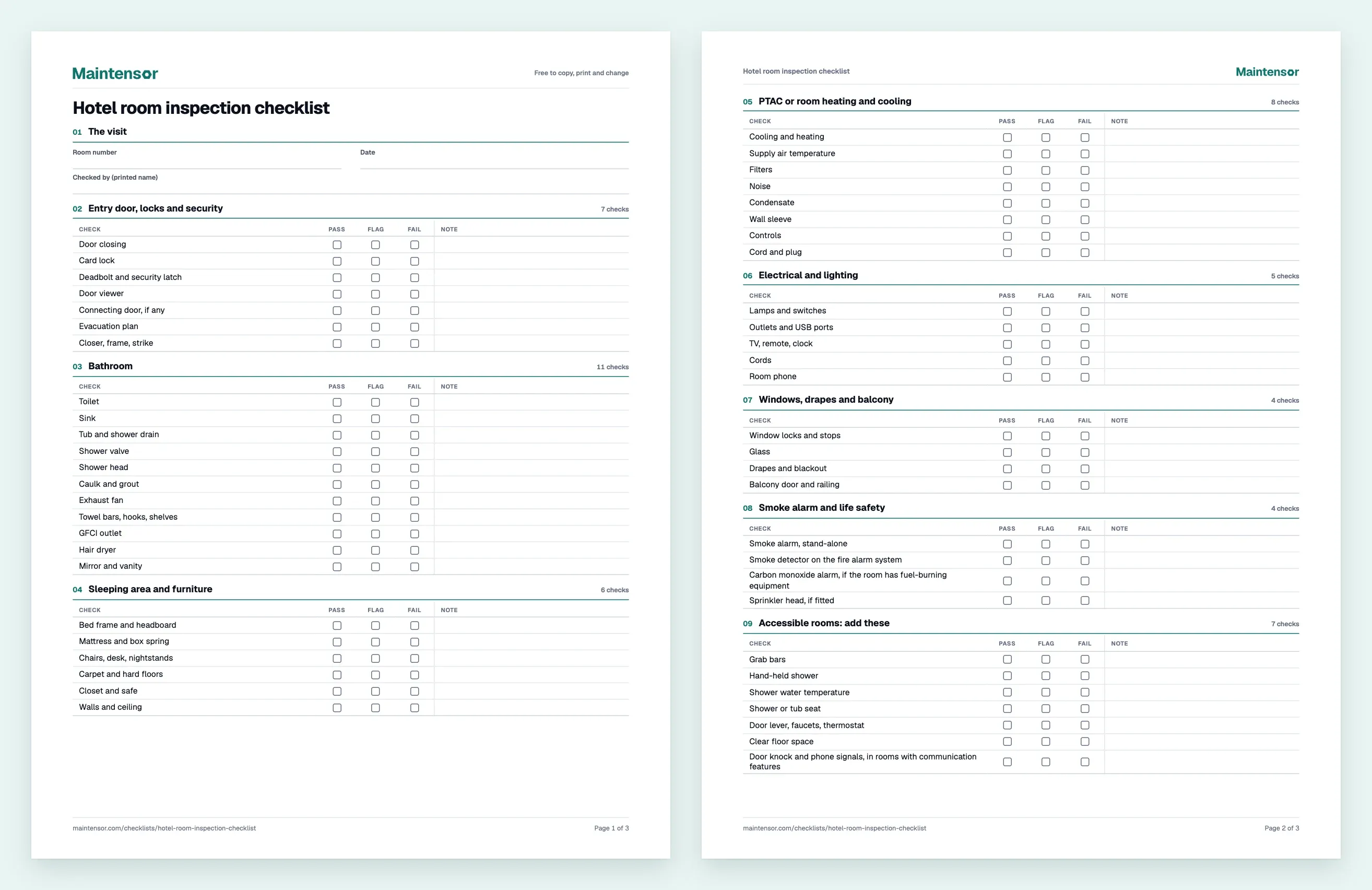
The checks, area by area
One sheet per room, worked through by an engineer while the room is vacant. Anything that fails is fixed on the spot or gets a work order with a photo. Add the items from your PTAC, lock and safe makers’ manuals, and cut what your rooms do not have.
Entry door, locks and security7 checks
- Door closing
- Card lock
- Deadbolt and security latch
- Door viewer
- Connecting door, if any
- Evacuation plan
- Closer, frame, strike
Bathroom11 checks
- Toilet
- Sink
- Tub and shower drain
- Shower valve
- Shower head
- Caulk and grout
- Exhaust fan
- Towel bars, hooks, shelves
- GFCI outlet
- Hair dryer
- Mirror and vanity
Sleeping area and furniture6 checks
- Bed frame and headboard
- Mattress and box spring
- Chairs, desk, nightstands
- Carpet and hard floors
- Closet and safe
- Walls and ceiling
PTAC or room heating and cooling8 checks
- Cooling and heating
- Supply air temperature
- Filters
- Noise
- Condensate
- Wall sleeve
- Controls
- Cord and plug
Electrical and lighting5 checks
- Lamps and switches
- Outlets and USB ports
- TV, remote, clock
- Cords
- Room phone
Windows, drapes and balcony4 checks
- Window locks and stops
- Glass
- Drapes and blackout
- Balcony door and railing
Smoke alarm and life safety4 checks
- Smoke alarm, stand-alone
- Smoke detector on the fire alarm system
- Carbon monoxide alarm, if the room has fuel-burning equipment
- Sprinkler head, if fitted
Accessible rooms: add these7 checks
- Grab bars
- Hand-held shower
- Shower water temperature
- Shower or tub seat
- Door lever, faucets, thermostat
- Clear floor space
- Door knock and phone signals, in rooms with communication features
What counts as a fail, check by checkThe full tables: what passes and what fails, area by area.
Entry door, locks and security
| Check | Pass | Fail if |
|---|---|---|
| Door closing | From fully open, the door swings shut and latches with no push | It stops short or does not latch |
| Card lock | Opens on the first try with a guest key; no low battery signal | It takes several tries, or signals a low battery |
| Deadbolt and security latch | Both engage fully from inside | Either one binds, is loose or is missing |
| Door viewer | Clear view of the corridor | Cracked, missing or painted over |
| Connecting door, if any | Locked, and opens from neither side without a key | It opens from either side |
| Evacuation plan | On the back of the door, readable, right for this room | Missing or for another room |
| Closer, frame, strike | Closer not leaking; frame sound; strike plate tight | Oil on the closer, split frame, loose strike |
Bathroom
| Check | Pass | Fail if |
|---|---|---|
| Toilet | Flushes fully, refills and stops; seat tight; no rock at the base | Runs on, leaks at the base or tank, rocks |
| Sink | Drains in seconds; no drip at the spout or below; stopper works | Standing water, drip, wet cabinet floor |
| Tub and shower drain | Keeps up with the shower running | Water rises while the shower runs (slow but keeping up is a Flag) |
| Shower valve | Hot water reaches your set temperature; nothing drips when off | Scalding or lukewarm water, drip |
| Shower head | Full, even spray | Clogged or spraying sideways |
| Caulk and grout | Continuous, no mold | Gaps or dark growth (Flag); water getting behind the wall (Fail) |
| Exhaust fan | Runs quietly and holds a tissue to the grille | Silent, noisy, or does not pull |
| Towel bars, hooks, shelves | Tight | Loose or pulling out of the wall |
| GFCI outlet | Test cuts the power; Reset restores it | Does not trip, or will not reset |
| Hair dryer | Cord and plug intact; runs on both settings | Damaged cord or plug |
| Mirror and vanity | Secure, no cracks or sharp edges | Loose or cracked |
Sleeping area and furniture
| Check | Pass | Fail if |
|---|---|---|
| Bed frame and headboard | Tight, no wobble, no sharp edges | Loose or broken |
| Mattress and box spring | Seams, piping and tags clean | Any sign of bed bugs (see below): out of order, call pest control |
| Chairs, desk, nightstands | Stable; drawers run | Wobbles, broken drawer or leg |
| Carpet and hard floors | No lifted seams or trip edges | A trip edge or tear |
| Closet and safe | Rod and shelf secure; safe opens and locks | Loose rod; safe fault |
| Walls and ceiling | No stains | A new water stain: find the leak above |
For bed bugs, EPA’s how to find bed bugs lists the signs: rusty or reddish stains, dark spots like marker dots, tiny pale eggs and shed skins, and live bugs, around mattress piping, seams and tags, and in cracks in the bed frame and headboard.
PTAC or room heating and cooling
| Check | Pass | Fail if |
|---|---|---|
| Cooling and heating | Each mode runs on command, and the air changes temperature | No change, or one mode dead |
| Supply air temperature | Recorded, and close to last quarter’s reading | A big change from last time |
| Filters | Clean, both in place | Torn, missing or clogged |
| Noise | Fan and compressor run without rattle or squeal | Rattle, squeal or buzz |
| Condensate | Drains outside; wall and floor below are dry | Water inside the room |
| Wall sleeve | Sealed to the wall; outdoor grille clear | Draft or daylight around the sleeve |
| Controls | Buttons or thermostat respond; display readable | Dead controls |
| Cord and plug | Intact and seated; no heat marks | Scorching or a damaged cord: Fail and unplug |
Electrical and lighting
| Check | Pass | Fail if |
|---|---|---|
| Lamps and switches | Every lamp lights from its switch | Dead or flickering (replace the lamp on the spot) |
| Outlets and USB ports | Cover plates on; plugs hold; ports charge | Loose outlet, scorch marks, missing plate |
| TV, remote, clock | Work | Not working |
| Cords | Not pinched under furniture or across walkways | Pinched or damaged |
| Room phone | Dial tone; reaches the front desk | Dead |
Windows, drapes and balcony
| Check | Pass | Fail if |
|---|---|---|
| Window locks and stops | Lock engages; any opening limiter stops the window where it should | Lock or stop broken or missing |
| Glass | Intact; no fog between double panes | Cracked glass (Fail); fog between panes (Flag) |
| Drapes and blackout | Run end to end; panels overlap | Off the track; light gap at the overlap |
| Balcony door and railing | Door locks; railing solid | Loose railing: out of order |
Smoke alarm and life safety
| Check | Pass | Fail if |
|---|---|---|
| Smoke alarm, stand-alone | Sounds when tested | Silent, chirping, or older than 10 years from the date on it |
| Smoke detector on the fire alarm system | Tested only under your fire alarm contractor’s procedure | Damaged, covered or missing |
| Carbon monoxide alarm, if the room has fuel-burning equipment | Sounds when tested | Silent or past its end-of-life date |
| Sprinkler head, if fitted | Nothing hung on it; not painted or damaged | Anything hung on it, paint or damage: call your sprinkler contractor |
The US Fire Administration’s smoke alarm guidance, written for homes, says to replace alarms 10 years from the manufacture date printed on them.
Accessible rooms: add these
| Check | Pass | Fail if |
|---|---|---|
| Grab bars | Tight; do not turn in their fittings | Loose or turning |
| Hand-held shower | Works both mounted and in the hand; hose intact | Hose split, holder broken |
| Shower water temperature | No hotter than 120°F (49°C) at the spray unit | Hotter |
| Shower or tub seat | Folds, locks and holds | Loose or will not lock |
| Door lever, faucets, thermostat | Work with one hand, no tight grasping or twisting | A knob has replaced a lever; a control is stiff |
| Clear floor space | Turning space and the space beside the bed are clear | Furniture has crept into them |
| Door knock and phone signals, in rooms with communication features | Light up when tested | No signal |
What Pass, Flag and Fail mean
The line between Flag and Fail is the guest. A tub that drains in a minute is a Flag; a tub that fills while the shower runs is a Fail.
The printed form has boxes for OK and Fail only: for a Flag, tick OK and write the work it will need on the note line.
Before you start
When a check fails
Fix it on the spot if it takes minutes and the part is on the cart. Otherwise write a work order with what was found and a photo.
If it is unsafe, or a guest would not accept the room as it is, tell the front desk to take the room out of order, and tell them when it is back.
This list is a starting point. It does not replace your fire code, your fire alarm contractor or the training your engineers need.
What federal law asks
Two federal rules touch a room inspection: one sets the smoke detectors a hotel needs to be on FEMA’s list for federal travelers, the other asks that accessible features be kept working. Your state or local fire code sets what your building needs and how detectors are tested.
What the rules sayThe Hotel and Motel Fire Safety Act, the ADA rules and Standards, and Canada.
- Smoke detectors. Under the federal Hotel and Motel Fire Safety Act, to be on FEMA’s National Master List (where federal employees on travel are expected to stay) a property needs hard-wired, single-station smoke detectors in each guest room, and an automatic sprinkler system unless it is three stories or lower (15 U.S.C. 2225).
- Accessible features. A public accommodation must keep the features required for accessibility in working condition, though isolated or temporary interruptions for repairs are allowed (28 CFR 36.211).
- What those features are. The 2010 ADA Standards set them, among them operable parts usable with one hand and no more than 5 pounds of force (309.4), grab bars that do not rotate in their fittings (609.6), hand-held shower spray units delivering water at 120°F (49°C) maximum (608.6), and visible notification devices for door knocks and phone calls in rooms with communication features (806.3.2).
- Canada. Provinces have their own building, fire and accessibility rules.
This is information, not legal advice: check the codes that apply to your property.
The room inspection in Maintensor, repeating every 3 months
Build the checklist once as a procedure, attach it to the room PM work order and set that to repeat every 3 months. There is no ready-made library, so it is typed in from this page. The hospitality page shows a room inspection like this on a demo hotel.
- The steps. A Heading step for each area, an Inspection check for each row, a Number step for the supply air temperature, a Photo step for anything to repair and a Signature step at the end. Split it into a standard room and an accessible room version if that suits you.
- A Fail. The engineer cannot move on until a note and a photo are added, and is then offered a follow-up work order and, if the work order is on the room’s PTAC unit, Mark asset down.
- A Flag. Once the work order is done, its Checklist tab counts the steps flagged or failed and offers a follow-up work order from those findings, so a Flag still turns into planned work. Required steps left open are listed at completion and written to the history, one guard against pencil whipping.

Only Full users and Admins answer checklists. Housekeepers who are Requesters report what they find as requests instead, one line per problem with the room picked under Where is it?; a request process people will use covers the rest. For an apartment turnover rather than a hotel room, the make-ready checklist fits better.