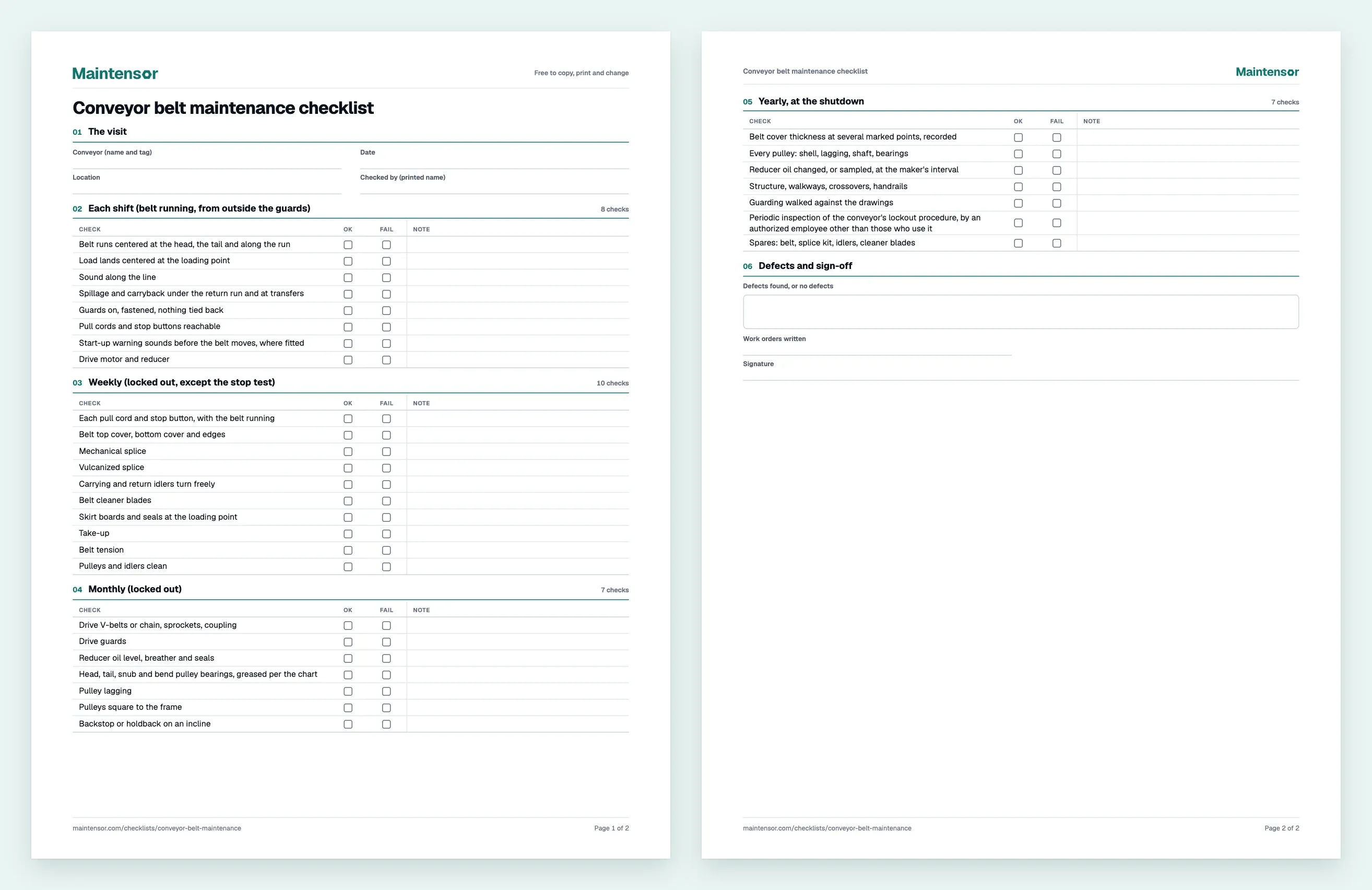
The checks, from each shift to yearly
Belts rarely fail without warning: a belt that walks, a roller that stops turning, a worn scraper and a lifting splice all show first. One sheet per conveyor and visit; a failed check gets a work order. Add the maker’s tasks for your conveyor, and where they disagree with this list, the manual wins.
Each shift (belt running, from outside the guards)8 checks
- Belt runs centered at the head, the tail and along the run
- Load lands centered at the loading point
- Sound along the line
- Spillage and carryback under the return run and at transfers
- Guards on, fastened, nothing tied back
- Pull cords and stop buttons reachable
- Start-up warning sounds before the belt moves, where fitted
- Drive motor and reducer
Weekly (locked out, except the stop test)10 checks
- Each pull cord and stop button, with the belt running
- Belt top cover, bottom cover and edges
- Mechanical splice
- Vulcanized splice
- Carrying and return idlers turn freely
- Belt cleaner blades
- Skirt boards and seals at the loading point
- Take-up
- Belt tension
- Pulleys and idlers clean
Monthly (locked out)7 checks
- Drive V-belts or chain, sprockets, coupling
- Drive guards
- Reducer oil level, breather and seals
- Head, tail, snub and bend pulley bearings, greased per the chart
- Pulley lagging
- Pulleys square to the frame
- Backstop or holdback on an incline
Yearly, at the shutdown7 checks
- Belt cover thickness at several marked points, recorded
- Every pulley: shell, lagging, shaft, bearings
- Reducer oil changed, or sampled, at the maker's interval
- Structure, walkways, crossovers, handrails
- Guarding walked against the drawings
- Periodic inspection of the conveyor's lockout procedure, by an authorized employee other than those who use it
- Spares: belt, splice kit, idlers, cleaner blades
What counts as a fail, check by checkThe full tables, and where each check comes from.
The last column says where each check comes from: Rule links the regulation, Maker points to the belt, cleaner or reducer maker’s manual, and Practice is common plant practice.
Each shift (belt running, from outside the guards)
| Check | Fail when | Basis |
|---|---|---|
| Belt runs centered at the head, the tail and along the run | An edge rubbing the frame or running off the idler ends | Practice |
| Load lands centered at the loading point | Material landing to one side | Practice |
| Sound along the line | A squeal, a knock, or a roller rattling | Practice |
| Spillage and carryback under the return run and at transfers | Piles under the belt, material building on return idlers | Practice |
| Guards on, fastened, nothing tied back | Any guard missing or open. 1910.212(a)(1) requires guarding against ingoing nip points and rotating parts | Rule |
| Pull cords and stop buttons reachable | A cord slack, broken or blocked, a button hidden behind stock | Practice |
| Start-up warning sounds before the belt moves, where fitted | Silent | Practice |
| Drive motor and reducer | A new noise, a hot smell, oil on the floor | Practice |
Weekly (locked out, except the stop test)
| Check | Fail when | Basis |
|---|---|---|
| Each pull cord and stop button, with the belt running | The belt keeps moving, or restarts without the switch being reset | Practice |
| Belt top cover, bottom cover and edges | A cut or gouge to the carcass, a rip, frayed or folded edges, cover lifting | Practice |
| Mechanical splice | A fastener missing, cracked or pulling through; a splice not square to the belt | Maker |
| Vulcanized splice | The cover or plies lifting or separating at the splice | Maker |
| Carrying and return idlers turn freely | A seized roller, a flat spot, a shell worn thin enough to cut the belt | Practice |
| Belt cleaner blades | Worn past the wear line, not touching the belt, tensioner slack | Maker |
| Skirt boards and seals at the loading point | Gaps letting material out, rubber worn away | Practice |
| Take-up | A gravity take-up that will not move freely; any take-up near the end of its travel | Practice |
| Belt tension | Slipping at the drive pulley, or sag between idlers beyond the belt maker’s figure | Maker |
| Pulleys and idlers clean | Material caked on a pulley face or idler | Practice |
Monthly (locked out)
| Check | Fail when | Basis |
|---|---|---|
| Drive V-belts or chain, sprockets, coupling | Cracked or glazed belts, a stretched chain, hooked sprocket teeth, a worn coupling insert. 1910.219(p)(1) requires power-transmission equipment to be inspected at intervals not exceeding 60 days | Rule |
| Drive guards | Loose, damaged or missing. 1910.219(d)(1) requires guards on pulleys 7 feet (2.1 m) or less from the floor | Rule |
| Reducer oil level, breather and seals | Below the mark, a plugged breather, a leaking seal | Maker |
| Head, tail, snub and bend pulley bearings, greased per the chart | Running hotter than last month, rough, or purging dirty grease | Maker |
| Pulley lagging | Worn smooth, peeling, or tiles missing | Practice |
| Pulleys square to the frame | Out of square when measured against the frame | Practice |
| Backstop or holdback on an incline | The belt rolls back when stopped | Maker |
A thermometer or an infrared camera turns “running hot” into a number you can compare month to month.
Yearly, at the shutdown
| Check | Fail when | Basis |
|---|---|---|
| Belt cover thickness at several marked points, recorded | Worn to the belt maker’s limit | Maker |
| Every pulley: shell, lagging, shaft, bearings | Cracked shell or weld, worn shaft, rough bearing | Practice |
| Reducer oil changed, or sampled, at the maker’s interval | Overdue, or the sample shows water or wear metal | Maker |
| Structure, walkways, crossovers, handrails | A cracked weld, heavy rust, a missing rail or bolt | Practice |
| Guarding walked against the drawings | A nip point that can be reached, against 1910.212(a)(1) | Rule |
| Periodic inspection of the conveyor’s lockout procedure, by an authorized employee other than those who use it | Not done in the last year. 1910.147(c)(6) requires it at least once a year | Rule |
| Spares: belt, splice kit, idlers, cleaner blades | Not on the shelf for a conveyor that would stop the plant | Practice |
Before you start
When a check fails
- Stop the line, lock it out, mark it Fail, and do not restart until it is fixed: a pull cord or stop that does not stop the belt, a missing guard, a splice with fasteners missing or pulling through, a rip across the belt.
- Fail, and fix it this shift: a seized idler, or the belt rubbing the frame, before friction heat or a cut edge does more damage.
- Flag, with a work order for this week: a worn cleaner blade, worn lagging, spillage building.
- Pass with a note, and look again next week: a slight new noise, light carryback.
The same idler failing every few weeks is a cause to find, not a part to keep buying: root cause analysis is the method. The list is written for belt conveyors carrying bulk material or packages; a roller or chain conveyor keeps the drive, guard and stop sections and drops the belt ones.
Conveyor guarding and emergency stops: what OSHA asks
OSHA’s general industry rules have no general section on conveyors. 1910.212(a)(1) requires guarding against hazards such as ingoing nip points and rotating parts, which on a conveyor means the head, tail, snub and bend pulleys and the idlers where hands can reach.
What the rules sayOSHA's 1990 letter, the drive and lockout rules, construction sites, ASME B20.1, Canada.
- Belt edges and pull cords. In a 1990 letter about walkways beside belt conveyors, since archived, OSHA wrote that nip points and the belt edge must be guarded and that an emergency stop pull cord along the length of the conveyor was also required.
- The drive and lockout. 1910.219 covers the drive’s belts, pulleys, chains and couplings, and 1910.147 covers lockout, including stored energy.
- Construction sites. 1926.555 requires a stop at the operator’s station, an audible warning before start-up, emergency stops that keep the conveyor stopped until reset, and lockout with a “Do Not Operate” tag during repairs.
- ASME B20.1. 1926.555 refers to the 1957 edition of ANSI B20.1. Its current form, ASME B20.1 (2024), the Safety Standard for Conveyors and Related Equipment, covers the hazards of conveyors in their design, installation, inspection, maintenance and operation.
- Canada. Provinces have their own machine guarding and lockout rules.
This is information, not legal advice: check the rules that apply to your plant and the conveyor maker’s manual.
Conveyor checks in Maintensor: three procedures and a lockout step
Make three procedures: the operator’s shift walk, the weekly locked-out inspection, and the monthly drive service. Set each work order to repeat: the shift walk on Weekly with the working days ticked, the inspection weekly, the drive service monthly.
- Start the weekly and monthly ones with an Instruction step naming the lockout points and the take-up to block, then a Checkbox marked Required: “Locked out, take-up blocked, start button tried.” A skipped required step does not stop anyone finishing, but it is listed at sign-off and written to the work order’s history.
- Make each line an Inspection check, and each reading a Number step: belt deflection, take-up travel left, bearing temperature. A Number step has no unit, so put the unit and the limit in its words, such as “Take-up travel left, inches (fail under 6)”.
- A Fail asks for a note and a photo, and offers a follow-up work order and Mark asset down. Add the idler or blade to the follow-up as a part; when one part goes onto the same conveyor three or more times this year, the asset says so and asks you to check for a recurring fault.

What it does not do: a repeat goes by the day, so a plant on two shifts makes two shift-walk work orders, one per shift. An operator answering the shift walk in the app needs a Full user seat; a Requester can report a torn belt but cannot answer a checklist.
The manufacturing maintenance page shows the rest of a plant’s setup, and the preventive maintenance checklist covers the other equipment on the floor.