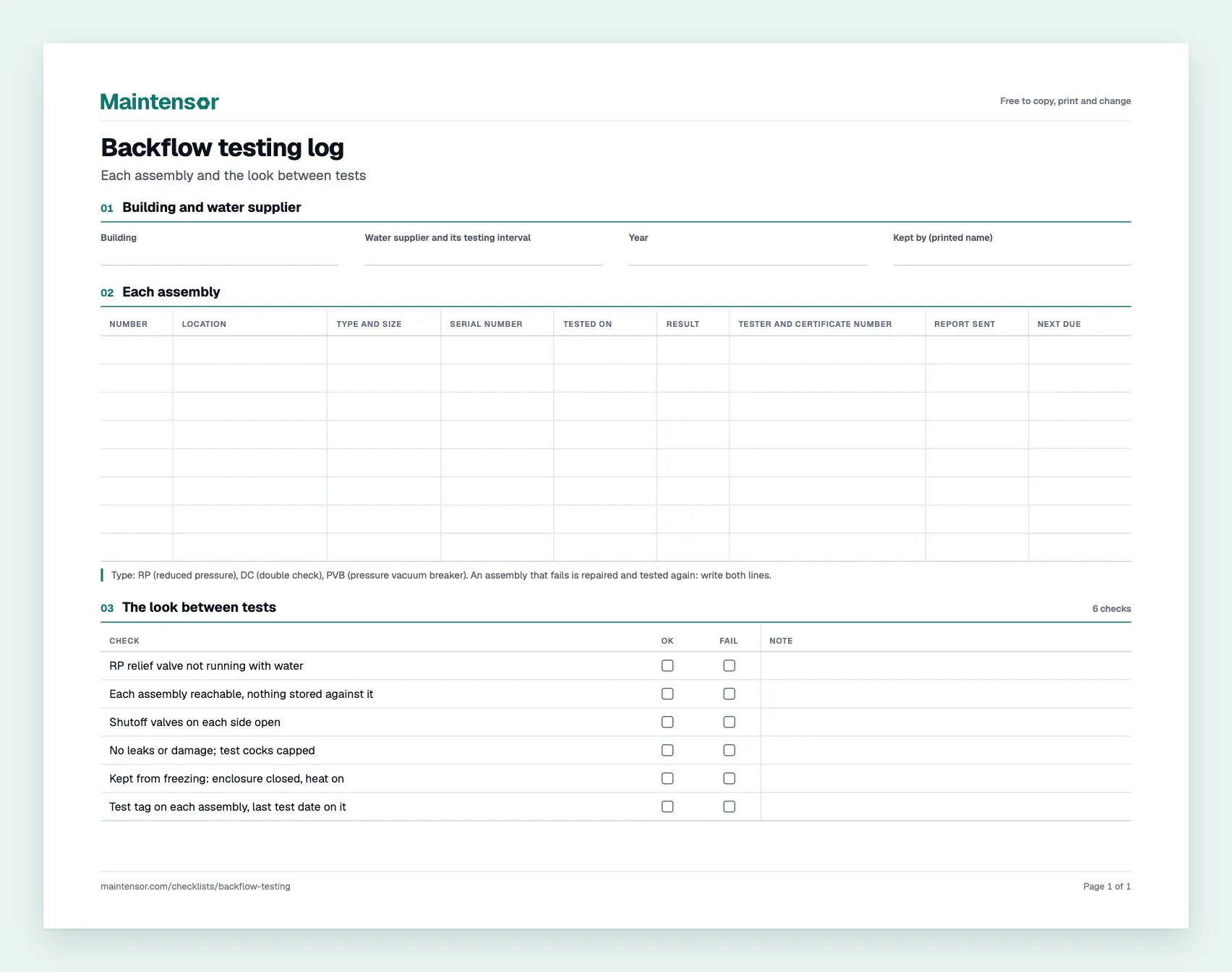
What the log holds
One landscape page for a building, kept for the year: a line for each assembly and its test, and the look your staff take between tests. The tester’s own report goes with it.
ExampleA year's log: three assemblies
A made-up food plant in Oregon, with three testable assemblies. Its water supplier asks for a test every year. A certified tester comes in May; Jessica Turner keeps the log.
| Assembly | Type | Tested | Result | Note |
|---|---|---|---|---|
| BF-1, main supply in the boiler room | RP, 2 in | May 12 | Fail | Relief valve spilling at the test. First check cleaned, retested May 14: pass |
| BF-2, fire sprinkler supply | Double check, 6 in | May 12 | Pass | Monitoring company told before the water was shut off |
| BF-3, lawn irrigation | PVB, 1 in | May 12 | Pass |
BF-1. Jessica had noted water dripping from its relief valve on her April look. The test found the first check valve fouled. Both lines go on the log, and both results to the water supplier.
BF-2. A test shuts the sprinklers’ water off while it runs, so the monitoring company and the fire department are told first, as for any sprinkler shutdown.
The look between tests
The test belongs to the certified tester. Between tests your staff only look: nothing is opened, closed or taken apart.
The look between tests6 checks
- RP relief valve not running with water
- Each assembly reachable, nothing stored against it
- Shutoff valves on each side open
- No leaks or damage; test cocks capped
- Kept from freezing: enclosure closed, heat on
- Test tag on each assembly, last test date on it
What counts as a fail, check by checkThe full table, and where each check comes from.
“Practice” means common practice and no rule.
| Check | Fail if | Source |
|---|---|---|
| RP relief valve not running with water | Water running from the relief port, not just a short spill after a pressure drop | EPA Cross-Connection Control Manual (how the relief valve works); NFPA 25, 13.7.1 on a sprinkler supply (weekly) |
| Each assembly reachable, nothing stored against it | Stock, pallets or plants in the way of the test | Practice |
| Shutoff valves on each side open | A valve left shut after a test or a repair | Practice |
| No leaks or damage; test cocks capped | A drip at a joint, a cracked body, a cap missing | Practice |
| Kept from freezing: enclosure closed, heat on | An open enclosure door, a heater off in cold weather | Practice |
| Test tag on each assembly, last test date on it | No tag, or the date past the interval | Toronto (a tag on each device with its test history) |
How often, and who sets it
No national rule sets how often a backflow assembly is tested. Your water supplier sets it, or your state, city or municipality in its plumbing code or a bylaw, along with who may test. The EPA’s own summary: “Testing intervals typically are annual, semi-annual, or risk-based.”
| Check | By | United States | Canada |
|---|---|---|---|
| Test each testable assembly | A certified tester | As your water supplier or state sets: usually yearly, sometimes twice a year for an RP | As your municipality sets: at least yearly in Toronto |
| Test after installing or repairing one | A certified tester | As your supplier sets; the EPA’s model ordinance has the owner pay for the retest | Toronto: at installation, and within 72 hours of a cleaning, repair or replacement |
| On a sprinkler supply: look at an RP assembly | Your staff | Weekly (NFPA 25) | Weekly (NFPA 25, through the National Fire Code) |
| On a sprinkler supply: the yearly flow test | The sprinkler company | Yearly (NFPA 25) | Yearly (NFPA 25) |
| The look between tests | Your staff | Monthly, as practice | Monthly, as practice |
The inspection calendar below has no preset for the test itself: you choose the interval your water supplier gives you.
The kinds of assembly
The EPA’s Cross-Connection Control Manual and its 2007 paper describe them. Which one a line needs depends on what could flow back through it, and your water supplier decides.
Before you start
When a check fails
Water running steadily from a relief valve, a leak, a failed test: call your tester or plumber, and write a work order so the fix is tracked. A repaired assembly is tested again, and the result goes to the water supplier.
This log is a starting point to adapt with your water supplier’s rules and your tester. It is information, not training, and it does not replace the test.
Add it to an inspection calendar
Put these checks, and the rest of the building's, on a year plan with the usual minimums for the United States or Canada, then print it or add it to your calendar: open the inspection calendar with backflow preventers ticked.
What the rules say
In the United States, the water supplier runs a cross-connection control program under its state’s rules, and the plumbing code your state or city adopts sets the rest. In Canada, your municipality or water supplier sets it, usually in a bylaw.
What the rules sayWhat was read, and the records to keep.
- The EPA. The Cross-Connection Control Manual (2003) describes the assemblies, says an atmospheric vacuum breaker cannot be tested once installed, and gives a model ordinance: the owner pays for the permits, the yearly or twice-yearly tests and the retest after a failure, and the supplier keeps a list of certified testers. Its 2007 issue paper finds intervals “typically are annual, semi-annual, or risk-based”, with Boston testing RP assemblies twice a year and double check assemblies once a year, as its state asks. It adds that systems put an atmospheric or pressure vacuum breaker on a low hazard, a double check where water could be pushed back under pressure, and an RP where the hazard is high.
- Toronto. The backflow prevention program: industrial, commercial, institutional and larger residential properties; a test at installation, within 72 hours of a repair, and at least once a year; by a certified Cross Connection Control Specialist, who reports online; a test tag on each device; records kept on site for seven years.
- Fire sprinkler supplies. NFPA 25 adds a weekly look at a reduced pressure assembly (13.7.1) and a yearly forward flow test (13.7.2), whatever the water supplier asks.
None of this is legal advice, and no log makes an assembly compliant.
Backflow tests in Maintensor: each assembly an asset
Make each assembly an asset in its location, with its type and serial number in the description. An asset’s Work orders tab then lists every test, open and done.
- The test. A work order for each assembly that repeats yearly, or as your supplier sets, with the tester’s report attached and the readings in its notes.
- The look. One procedure with an Inspection check for each line, answered Pass, Flag or Fail, on a work order that repeats monthly. There is no ready-made library, so you type the checks in once.
- A Fail asks for a note and a photo, then offers a follow-up work order for the repair.

What it does not do: Maintensor does not send the test report to your water supplier, and it does not know a tester’s certificate is current. Only Admins and Full users answer checklists, so whoever takes the look needs a user seat. It records what was checked; it certifies nothing. The facility maintenance software page shows the rest of a building’s setup.