Key points
- A blind count gives the counter the part, its shelf and its unit, but not the quantity on record.
- In the example, 400 parts in three classes take about 3 counts a working day.
- A difference is recounted and researched before the record changes, and each adjustment carries a reason.
- The GAO guide says inventory record accuracy goals should be 95% or higher.
- The count sheet is free to download, as a PDF to print and an Excel file.
Cycle counting vs a yearly full count
A cycle count covers a few parts every day or week. A full count, sometimes called a wall-to-wall count, counts everything at one moment, usually at year end, with the storeroom closed. The U.S. Government Accountability Office’s executive guide to accurate inventory counts (GAO-02-447G) describes a cycle count as counting “a portion of the inventory” daily, weekly or monthly.
| Full count | Cycle count | |
|---|---|---|
| How often | Once or twice a year | A few parts every day or week |
| Storeroom | Closed while counting | Stays open; only the parts being counted are held |
| Errors found | Months after they happened | Within weeks, while someone remembers why |
| Who counts | Everyone, for a day | One or two people, 15 to 30 minutes at a time |
A maintenance storeroom suits it well, because breakdowns do not wait for a count. And when a technician finds an empty shelf the record called full, the crew starts keeping private stashes in toolboxes, which makes the count worse.
Cycle counting methods
There are three common ways to choose which parts come up each day.
The schedule below uses all three: the class sets how often each part comes up, the day’s parts are picked by shelf, and a trigger adds a part to the day’s sheet.
ABC classes for a maintenance storeroom
Sort the parts into three classes and count each at its own rhythm. Two things decide the class:
A gearbox that was not used last year has a usage value of zero, but a wrong count on it is found during a breakdown, the worst time. A few parts from a made-up plant:
Six parts, classedFrom a bearing used 200 times a year to a gearbox never used, which is still class A
| Part | Used last year | Unit cost | Yearly usage value | Critical? | Class |
|---|---|---|---|---|---|
| Bearing, ball, 6205-2RS | 200 | $9 | $1,800 | No | A |
| Grease cartridge, EP2 | 150 | $7 | $1,050 | No | A |
| Seal kit, mechanical, CIP pump | 1 | $650 | $650 | Yes | A |
| Gearbox, filler infeed conveyor | 0 | $4,800 | $0 | Yes | A |
| V-belt, B48 | 10 | $18 | $180 | No | B |
| Wire ties, 8 in, bag of 100 | 30 | $6 | $180 | No | C |
A V-belt and a bag of wire ties can have the same usage value, $180 here, and still land in different classes. That is a judgment call: a missing belt stops a compressor, and a missing bag of wire ties stops nothing.
A cycle count schedule: 400 parts, one counter
In a made-up storeroom of 400 parts with one counter, three classes come to about 3 counts a working day:
| Class | Which parts | Parts | Counted | Counts a year |
|---|---|---|---|---|
| A | The top of the value list (35 parts holding about 70% of the yearly usage value) and every critical spare (25) | 60 | Every 3 months | 240 |
| B | The next band of value | 100 | Every 6 months | 200 |
| C | Everything else: cheap, plentiful, easy to buy | 240 | Once a year | 240 |
| Total | 400 | 680 |
240 + 200 + 240
680 ÷ 50 weeks
14 ÷ 5 days
At a few minutes a part, that is well under half an hour a day. The GAO guide describes sites that counted higher-value items more often, which is the same idea.
Count outside the schedule too, when it is cheap and useful:
- When a shelf is nearly empty. There are few to count, and the reorder point only works if the count behind it is right.
- When a technician finds less than the record says. Count it before the next job is promised a part that is not there.
- When the record goes below zero. Something was not entered.
- When a delivery does not match its packing slip.
How to do a cycle count, from blind count to adjustment
- Print the day’s list with the part, its shelf and its unit, but not the quantity on record. This is a blind count.
- Hold the parts being counted. Nothing of those parts goes in or out until the count is done. Counting before the shift starts is the easy way.
- Check what is in flight. A part taken for a job still open, a kit packed for next week, a delivery on the dock not yet entered: each makes the shelf and the record differ without anyone being wrong.
- Count every place the part lives, including the tagged critical spare in the corner, the kits and the open box. Count in the unit on the sheet: if the record is in single filters, count filters, not boxes.
- Compare with the record. A supervisor or the storeroom keeper fills in the record quantity after the count. Within tolerance: done.
- Recount anything outside tolerance, by a second person if you can.
- Research before you adjust. Look at recent work orders, receipts and the other storeroom.
- Adjust with a reason, approved by the supervisor, and fix the cause. If three differences in a month are parts taken on night shift without a work order, the fix is a sign-out sheet, not three adjustments a month for ever.
What the GAO guide says
On step 1: “Blind counts offer the greatest degree of assurance of accurate and reliable counts.” On step 6, a difference between the count and the record calls for a second count. On step 7, records are typically not changed until recounts and research are done.
Keep the reasons to a short list, so they can be added up:
Ideally the person who counts does not look after the shelf. In a crew of three that is rarely possible; the GAO guide suggests blind counts and closer supervision instead, so a supervisor recounting two or three parts a week is a fair substitute.
Inventory record accuracy: a month of counts worked out
inventory record accuracy = parts whose record proved right, within tolerance ÷ parts counted × 100
Set the tolerance by class. For A parts and critical spares, zero: the count must match exactly. For C parts counted by the handful, such as screws, a small percentage. The GAO guide found tolerances ranging from zero to 5%.
A month in the made-up storeroom: 60 parts counted. 51 matched exactly, 3 bulk C parts were within 5%, and 6 were outside tolerance. The recount confirmed all 6, and research found that one of them was not an error at all:
The six differences, researchedFive real errors and one record that was right, with the adjustment for each
| Part | Class | Record | Counted | Difference | What research found | Adjustment |
|---|---|---|---|---|---|---|
| Bearing, ball, 6205-2RS | A | 14 | 11 | −3 | Used on night shift, no work order | Remove 3 |
| V-belt, B48, main storeroom | B | 6 | 8 | +2 | A delivery entered to the line 2 crib but shelved here | Add 2 here, remove 2 at the crib |
| Sensor, inductive proximity, 18 mm | A | 3 | 2 | −1 | In the kit for an open work order, which the counter missed; the record was right | None |
| Grease cartridge, EP2 | A | 18 | 15 | −3 | Used on the lube route, which lists no parts | Remove 3, add grease to the route’s parts |
| Fuse, 10 A, time delay | C | 20 | 30 | +10 | A box of 10 received and never entered | Add 10 |
| Wire ties, 8 in, bag of 100 | C | 12 | 9 | −3 | Taken for a cabling job, no work order | Remove 3 |
51 exact + 3 within 5% + 1 right record
55 ÷ 60 × 100
Against the GAO guide’s goal of 95% or higher, this storeroom has work to do. The research says where: three of the five real errors are parts that left the shelf without being listed on a work order. If you report the money too, report it net and gross: $500 over on some parts and $500 under on others is $0 off net, and $1,000 off gross.
A cycle count sheet: what it holds, and one filled in
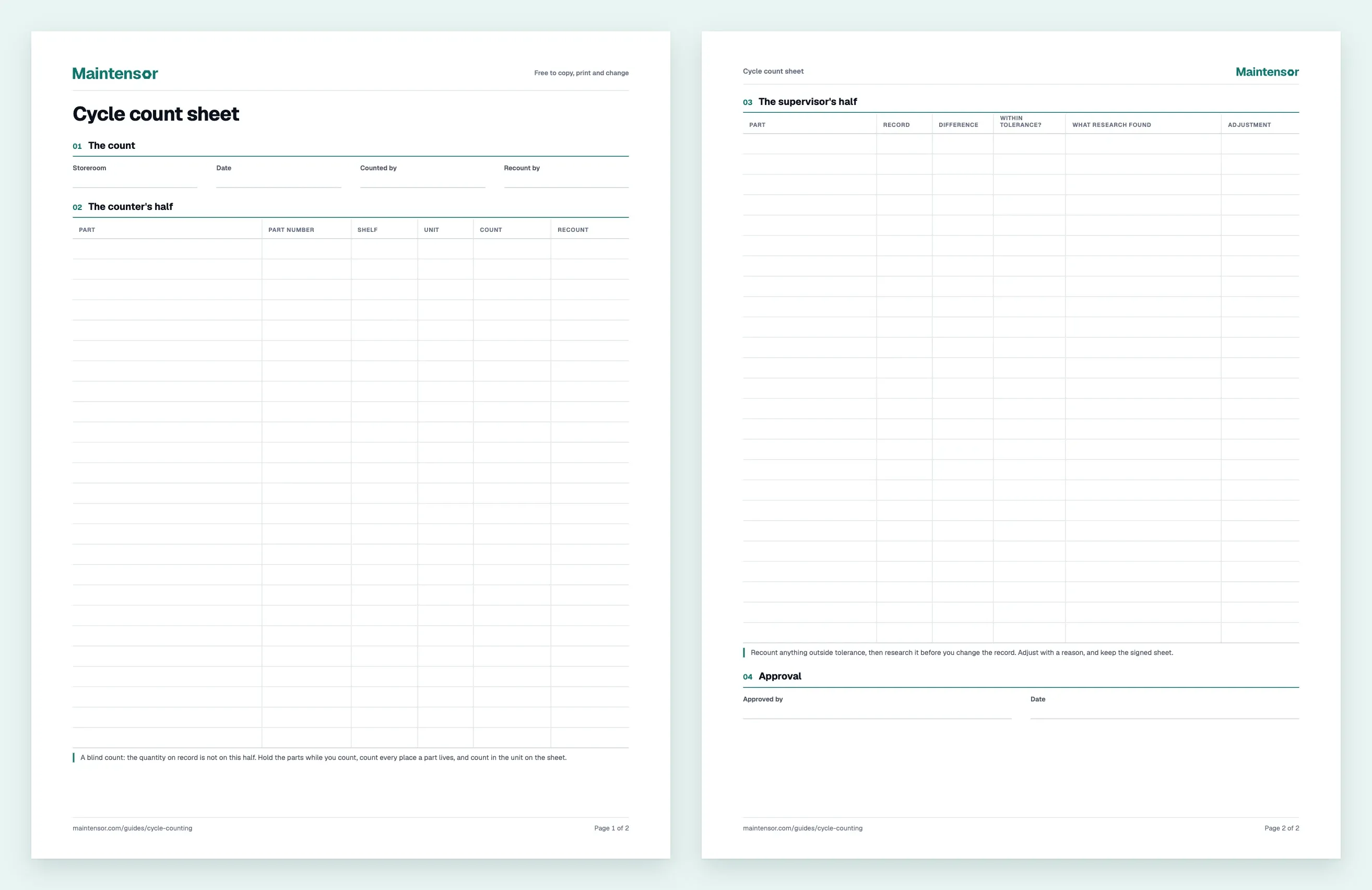
Under a header (storeroom, date, who counted, who recounted), a count sheet has two halves.
- The counter’s half: one line per part, with its name, part number, shelf and unit printed, and the count and any recount written in. There is no record column.
- The supervisor’s half, filled in after the count: the quantity on record, the difference, whether it is within tolerance, what research found and the adjustment, then a signature.
The sheet is free to download. In the PDF, each half has its own page, so the counter never sees the record.
Keep the signed sheets: they are the evidence behind every adjustment.
One day's sheet, filled inThree made-up parts, both halves, and what the sensor's line shows.
Main storeroom, March 10, in the made-up storeroom above. Tom Reyes counted before the shift; Maria Chen, the supervisor, did the recounts. The seal kit was due on the schedule; a technician’s report added the bearing, and its reorder level added the sensor.
The counter’s half:
| Part | Part number | Shelf | Unit | Count | Recount |
|---|---|---|---|---|---|
| Seal kit, mechanical, CIP pump | SKT-0150 | A-02-3 | kit | 2 | Not needed |
| Bearing, ball, 6205-2RS | BRG-0012 | A-03-2 | each | 11 | 11 |
| Sensor, inductive proximity, 18 mm | SEN-0007 | A-03-4 | each | 2 | 2 |
The supervisor’s half, filled in after the count:
- Seal kit: record 2, difference 0. Within tolerance, no adjustment.
- Bearing: record 14, difference −3. Outside class A’s zero tolerance. Used on night shift, no work order: remove 3.
- Sensor: record 3, difference −1. Outside class A’s zero tolerance. In the kit for an open work order, which the counter missed; the record was right, so no adjustment.
Approved by Maria Chen, March 11. Only one line changes the record: 14 − 3 = 11, the count. The sensor shows why step 7 comes before step 8: an adjustment made straight from the count would have removed a part that was in a kit, waiting for its job.
Recording counts in Maintensor
There is no cycle count feature in Maintensor’s spare parts inventory management software. A count is recorded as a correction to one location’s stock:
- Open Restock on the part, at the location you counted.
- Choose Add stock or Remove stock. The form shows what that location holds and what it will hold after the change, so you can check the arithmetic.
- Write the reason in the note (“Cycle count: 3 used on night shift, no work order”). A removal requires a note; write one on an addition too.
- Attach a photo of the signed count sheet to the movement.
The part’s History lists each correction as Restocked or Removed, with its note. Parts on an open work order stay on the record until it is completed, which is the in-flight check in step 3 of the count. A completed work order is never held up by stock, so it can take a location below zero, while Remove stock cannot: a count below zero is a part to count today. The To reorder and Out of stock views list the shelves worth an extra count.
What it does not do
There is no count schedule, no count sheet, no blind count mode, and no field to type a counted quantity and have the difference worked out. There is no export, so the day’s list comes from your own sheet. The app reads no barcodes already printed on parts; on Pro and Max, a part can carry a printed QR label that opens it, with its stock, when scanned with a phone’s camera.
An import from Excel or CSV (on Pro and Max) gives a part its opening count at a location that does not hold it yet, but never changes the count at one that does, so it cannot stand in for a count.