What a maintenance BOM lists
A maintenance BOM, also called an equipment parts list or spare parts list, is written per asset. Each line is one part: what it is, its reference number on the maker’s drawing, the part number you order by, how many the machine holds, and how many you keep.
| Manufacturing BOM | Maintenance BOM | |
|---|---|---|
| Lists | What goes into a product you make | The parts that fit a machine you own |
| Quantities | Per unit of product | Per machine, and how many to stock |
How to build a maintenance BOM in six steps
- Open the manual. Its parts list and exploded drawings give each part a reference number.
- Get the list for your serial number. The maker or dealer has it for your exact build.
- Read the work history. Two or three years of work orders show what was used.
- Look at the machine. Belt, filter and bearing numbers are printed on the parts.
- Decide what to stock. Wear parts, and long-lead parts that would stop a critical machine. One pump maker’s manual suggests at least a set of bearings and a spare of each moving part; reorder points set how many.
- Note shared parts. If a twin pump takes the same seal, one spare covers both.
Keep it in step with the machine
Update it when a part is superseded (keep the old number beside the new), as the last step of any job that modifies the machine, and yearly against the parts its work orders used.
Maintenance BOM example: a pump
A made-up end-suction pump, P-101, with an identical twin, P-102. Part numbers, prices and lead times are invented; the bearing sizes are standard.
| Ref | Part | Part number | In the pump | Keep | Why |
|---|---|---|---|---|---|
| 1 | Mechanical seal | MS-150-A | 1 | 1 | Replaced twice in 3 years |
| 2 | Casing gasket | GK-210 | 1 | 2 | Replaced with every seal job |
| 3, 4 | Bearings | 6309 and 3309 | 1 each | 1 set | The maker suggests a set |
| 5 | Impeller | IMP-85 | 1 | 0 | 3-week lead time accepted: P-102 can carry the load |
| 6 | Shaft sleeve | SL-45 | 1 | 1 | Scored by worn seals |
| 7 | Coupling element | CE-20 | 1 | 1 | Cheap, and the pump stops without it |
At made-up prices (seal $420, two gaskets at $15, bearing set $90, sleeve $110, coupling element $35), $685 on the shelf covers both pumps for the failure their history says comes every 18 months.
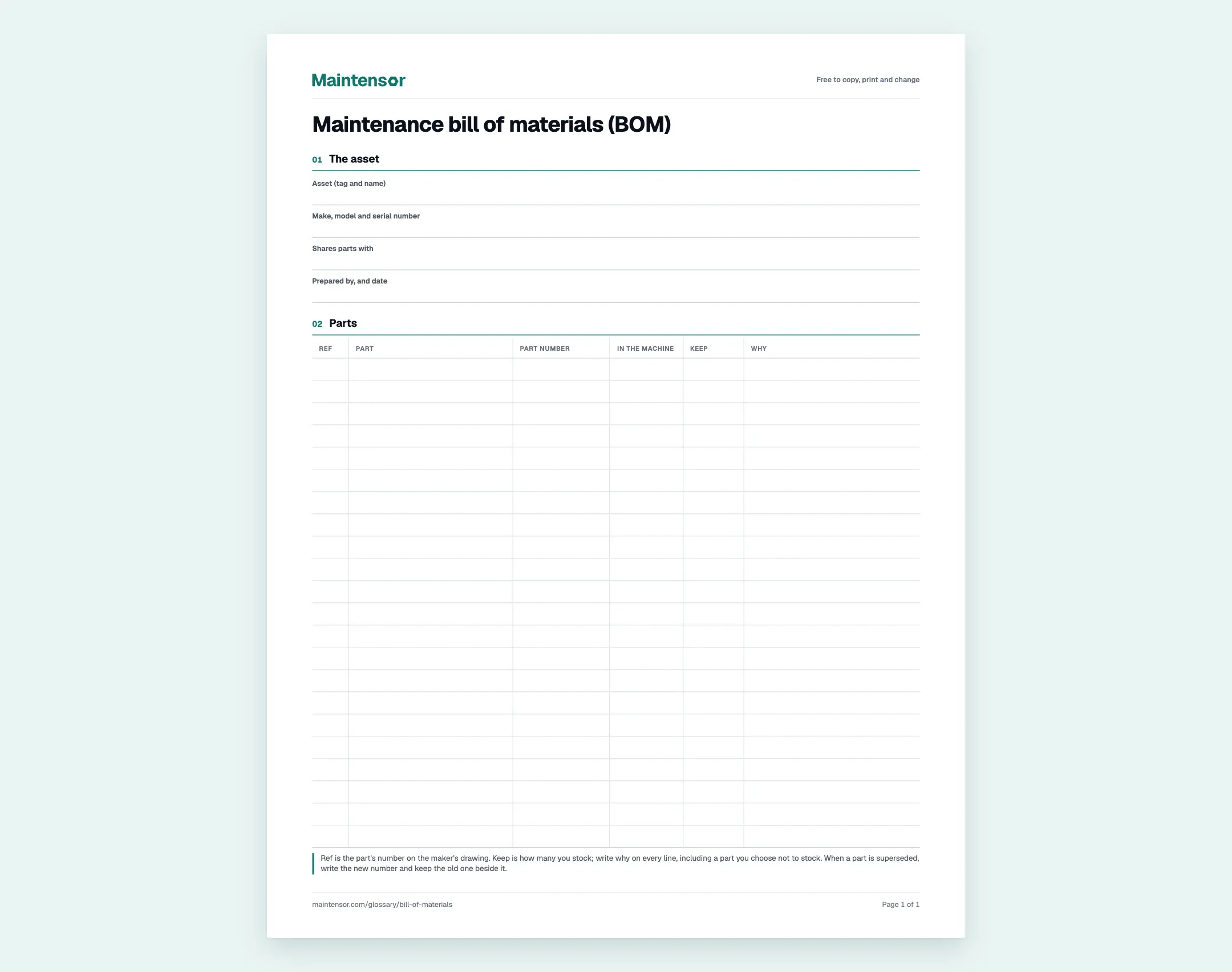
The same columns are a free Excel file, one sheet per asset, with 60 lines and a box at the top for the asset, its make, model and serial number, and the machines that share its parts.
Maintenance BOM vs asset hierarchy, MRO inventory and a job’s parts list
- The asset hierarchy stops at components; the BOM is the level below.
- MRO inventory is the whole storeroom; the BOMs say why each part is in it.
- A job’s parts list is the few parts one work order needs, taken from the BOM.
Spare parts inventory management covers the storeroom around the BOMs.
Linking parts to the assets they fit in Maintensor
In Maintensor’s spare parts inventory management software, a part’s record has a “Used on” list of assets, and each asset’s Parts tab shows the parts it uses with what is on hand across all locations, marking any below its reorder level.
The link has no quantity: it says a part fits, not how many the machine holds, so note the count in the asset’s Description.
