What the log holds
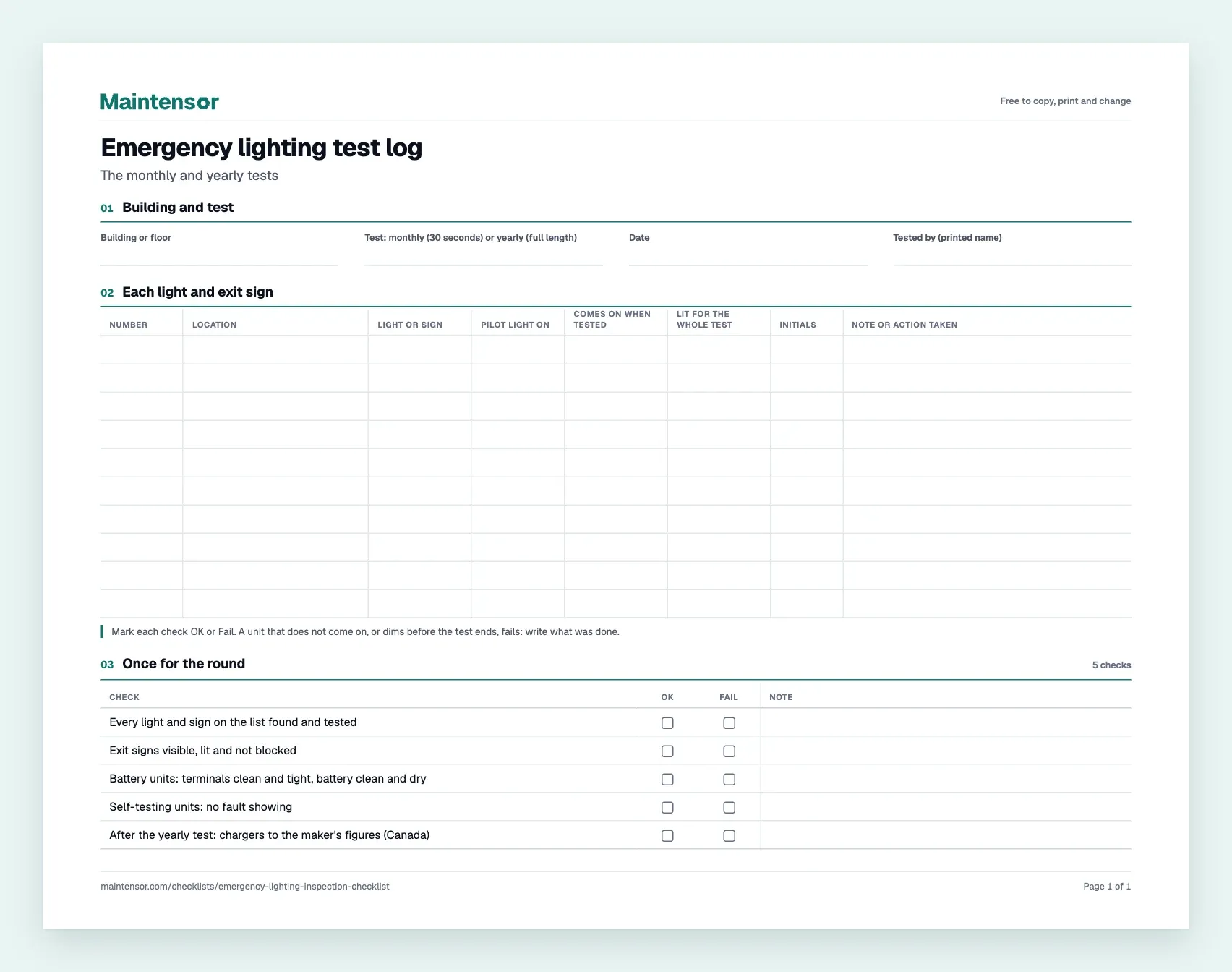
One landscape page for a building or a floor, each test: what kind of test, who made it and when, a line for each light and exit sign, and five checks made once for the round. Keep the list of units, or a floor plan with them marked, with the log.
ExampleThe yearly test in a small warehouse
A made-up warehouse in Saskatchewan: four battery lights and two exit signs, tested for their design time of 30 minutes by Laura Bennett in October.
| Unit | Kind | Comes on | Whole test | Note |
|---|---|---|---|---|
| EL-01, office corridor | Light | OK | OK | |
| EL-02, dock 1 | Light | OK | OK | |
| EL-03, dock 3 | Light | OK | Fail | Dim at 20 minutes. Battery from 2018 replaced, retested Oct 9 |
| EL-04, battery charging | Light | OK | OK | |
| EX-01, main exit | Sign | OK | OK | |
| EX-02, dock exit | Sign | Fail | Fail | Did not light. Unit replaced by an electrician |
EL-03. It passed every monthly test this year. Only the long test shows a battery running down early, and the Minnesota Department of Health’s guide puts a maintenance-free lead-acid battery’s life at 5 to 10 years.
EX-02. A sign that does not light on its battery leaves an exit dark in an outage. The electrician’s work goes on the log’s note, then the unit is tested again.
The checks for each round
Each round, the tester also checks the building as a whole: every unit found, the exit signs seen, the batteries looked at.
The monthly safety inspection checklist glances at these lights on its walk; this log is the test itself.
Once for the round5 checks
- Every light and sign on the list found and tested
- Exit signs visible, lit and not blocked
- Battery units: terminals clean and tight, battery clean and dry
- Self-testing units: no fault showing
- After the yearly test: chargers to the maker's figures (Canada)
What counts as a fail, check by checkThe full tables, and where each check comes from.
NFPA 101 is the US Life Safety Code; NFC is the National Fire Code of Canada 2020. “Practice” means common practice and no rule.
Each light and exit sign
| Check | Fail if | Source |
|---|---|---|
| Pilot light on | Off, damaged or hidden | NFC 6.5.1.6(1)(a); practice in the US |
| Comes on when tested | No light on battery | NFPA 101, 7.9.3.1.1; NFC 6.5.1.6(2)(a) and 6.5.1.8(2)(a) |
| Lit for the whole test | Out or dim before the time is up | NFPA 101, 7.9.3.1.1; NFC 6.5.1.6(2)(b) and 6.5.1.8(2)(b) |
Once for the round
| Check | Fail if | Source |
|---|---|---|
| Every light and sign on the list found and tested | A unit missing, or skipped | Practice; NFPA 101 asks for every required unit |
| Exit signs visible, lit and not blocked | A sign hidden by stock or a new wall, or unlit | NFC Note A-6.5.1.8; practice |
| Battery units: terminals clean and tight, battery clean and dry | Corrosion, a loose clamp, a wet or dirty battery | NFC 6.5.1.6(1)(b) to (d) |
| Self-testing units: no fault showing | A status light showing a fault | NFPA 101, 7.9.3.1.2 |
| After the yearly test: chargers to the maker’s figures (Canada) | Charging voltage, current or recovery time outside the maker’s figures | NFC 6.5.1.6(3) |
How often, in the United States and Canada
The usual minimums. Your fire marshal, insurer, state or province may ask for more.
| Check | By | United States | Canada |
|---|---|---|---|
| Battery lights and exit signs: switch to battery | Your staff | Monthly, 30 seconds, 3 to 5 weeks apart | Monthly, with a look at the pilot light, terminals and battery |
| Battery lights and exit signs: the long test | Your staff | Yearly, 90 minutes | Yearly, for the design time, then the charger checked |
| Self-testing units | Your staff | A monthly look at the status light; yearly, 90 minutes | The same tests as other battery units |
| Lights fed by the building’s generator | Your staff | Monthly, 30 seconds on generator power | Yearly: the lights and signs work on emergency power |
The US figures are from NFPA 101 (2012), 7.9.3.1, as the Minnesota Department of Health’s guide gives them. The Canadian ones are from the National Fire Code of Canada 2020, 6.5.1.6 to 6.5.1.8. The generator itself has its own tests on the generator maintenance checklist.
How the test is made
The Minnesota guide lists three ways to put a unit on its battery, each with a catch. The unit’s maker says which suits its units.
For the long test the guide warns against adding a switch at each light to cut its power, which the electrical code does not allow, and suggests asking the maker how to hold the test.
Before you start
When a check fails
A unit that does not light, or dims before the time is up, fails. Write a work order for the repair, test it again once fixed, and note both on the log.
An exit left dark is a gap in the way out: fix it before the next round, and ask your fire department what it expects meanwhile.
This list is a starting point to adapt with the units’ makers’ manuals and the code your jurisdiction adopts. It is information, not a substitute for an electrician where one is needed.
Add it to an inspection calendar
Put these checks, and the rest of the building's, on a year plan with the usual minimums for the United States or Canada, then print it or add it to your calendar: open the inspection calendar with emergency and exit lights ticked.
What the rules say
In the United States, NFPA 101, the Life Safety Code, sets the tests through the codes your state or city adopts, in the edition it adopts. In Canada, the National Fire Code sets them itself, in 6.5.1.6 to 6.5.1.8.
What the rules sayThe sections, the records to keep, and what was read.
- United States. NFPA 101 (2012), 7.9.3.1.1 for the monthly 30-second and yearly 90-minute tests, 7.9.3.1.2 for self-testing units, and 7.10.9.2 for exit signs on a battery, as the Minnesota Department of Health’s guide reads them. Computer-based systems that run every test themselves (7.9.3.1.3) are left out here.
- The US record. NFPA 101 asks for written records of the tests for the authority having jurisdiction. Minnesota’s fire code, the guide notes, asks for them to be kept three years, with the location, pass or fail, the date and who tested.
- Canada. NFC 2020, 6.5.1.6 (battery units), 6.5.1.7 (other emergency lights, yearly) and 6.5.1.8 (exit signs), read in the code itself. The NFC (Division C, 2.2.1.2) asks for records kept at the building: at least the current and the previous ones, none destroyed within two years.
- Your province. Each province and territory adopts its own edition of the NFC, and some, Ontario for one, publish their own fire code.
None of this is legal advice, and no log makes a building compliant.
Emergency light rounds in Maintensor: one round per floor
Build one procedure per floor, with a Heading for each light and sign. There is no ready-made library, so you type the list in once.
- Each unit. An Inspection check for “comes on and stays lit”, answered Pass, Flag or Fail. For the yearly test, a Number step for the minutes it stayed lit, with the time in its name: “Minutes lit (90 or more)”.
- The schedule. A work order that repeats monthly for the short test: on a date or on a weekday, the tests land 4 to 5 weeks apart, inside NFPA 101’s 3 to 5 weeks. A second one repeats yearly for the long test.
- A Fail asks for a note and a photo before the next step, then offers a follow-up work order for the repair.

What it does not do: Maintensor does not talk to self-testing units, so it holds only what the tester records, and a Number step flags nothing by itself. Only Admins and Full users answer checklists, so whoever makes the round needs a user seat. It records what was tested; it certifies nothing. The facility maintenance software page shows the rest of a building’s setup.