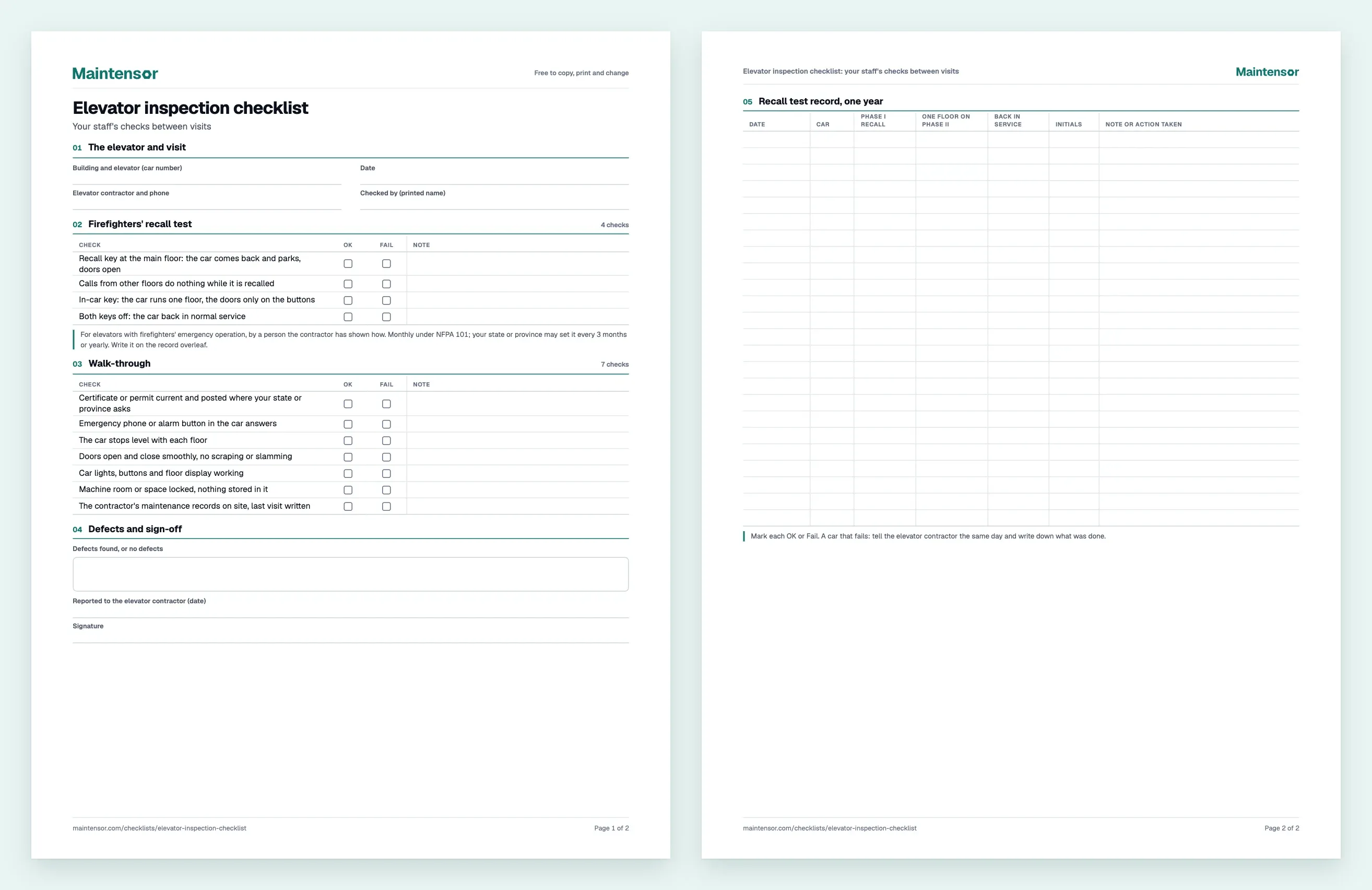
The checks your staff make
One sheet per elevator, each round. These are the checks between the inspector’s and the elevator contractor’s visits. Your staff stay out of the hoistway, the pit and the car top, and do no work in the machine room: that is the licensed mechanic’s. A fault goes to the elevator contractor and a work order.
Firefighters' recall test4 checks
- Recall key at the main floor: the car comes back and parks, doors open
- Calls from other floors do nothing while it is recalled
- In-car key: the car runs one floor, the doors only on the buttons
- Both keys off: the car back in normal service
Walk-through7 checks
- Certificate or permit current and posted where your state or province asks
- Emergency phone or alarm button in the car answers
- The car stops level with each floor
- Doors open and close smoothly, no scraping or slamming
- Car lights, buttons and floor display working
- Machine room or space locked, nothing stored in it
- The contractor's maintenance records on site, last visit written
What counts as a fail, check by checkThe full tables, and where each check comes from.
The Source column names the rule behind each check, or “Practice” where it is common practice and no rule.
Firefighters’ recall test
For elevators with firefighters’ emergency operation: a key switch at the main floor that calls the car back for the fire department. The person who makes the test is shown how by the elevator contractor first; British Columbia’s regulator calls them authorized personnel.
| Check | Fail if | Source |
|---|---|---|
| Recall key at the main floor: the car comes back and parks, doors open | The car does not come, or parks with its doors shut | ASME A17.1 (2000), 8.6.10.1, as Mississippi’s test form quotes it |
| Calls from other floors do nothing while it is recalled | A call from another floor moves the car | Mississippi’s test form |
| In-car key: the car runs one floor, the doors only on the buttons | The car does not move, or its doors open by themselves | ASME A17.1 (2000), 8.6.10.1 |
| Both keys off: the car back in normal service | The car stays out of service | Mississippi’s test form |
Walk-through
| Check | Fail if | Source |
|---|---|---|
| Certificate or permit current and posted where your state or province asks | Out of date, or not where it should be | Mississippi Rule 1.22 (posted in the car, or in the lobby within 10 feet of the call button) |
| Emergency phone or alarm button in the car answers | Nobody answers, or the alarm is not heard | Practice |
| The car stops level with each floor | A step up or down at the door | Practice |
| Doors open and close smoothly, no scraping or slamming | A door that drags, bangs or stops halfway | Practice |
| Car lights, buttons and floor display working | A light out, a button dead, the display blank | Practice |
| Machine room or space locked, nothing stored in it | Unlocked, or boxes and cleaning supplies kept there | Practice |
| The contractor’s maintenance records on site, last visit written | No records, or the last visit missing | Washington L&I; Texas 16 TAC 74.68; Mississippi Rule 1.22(3) |
How often: set where you are
No national rule sets how often an elevator is inspected. In the United States, each state, and some cities, adopts the elevator code (ASME A17.1) in an edition of its choosing, with its own changes. In Canada, each province and territory does the same through its own regulator and the Canadian code, CSA B44.
| Check | By | United States | Canada |
|---|---|---|---|
| Inspection and tests | An inspector your state or province recognizes | Set by your state: every year in Washington and in Mississippi | Set by your province: in Ontario, TSSA sets each elevator’s interval by risk |
| Maintenance | Your elevator contractor | To its maintenance control program, with the records on site | The same |
| Firefighters’ recall test | Your staff, once shown how | Monthly under NFPA 101; every 3 months in Michigan, Washington and Wisconsin | Every 3 months in high buildings (National Fire Code); yearly in British Columbia |
| Elevators run on emergency power | Your elevator contractor | Set by your state | Yearly in high buildings (National Fire Code) |
The inspection calendar below starts the recall test at monthly in the US and every 3 months in a Canadian high building, and you can change it to your state’s. The inspection itself has no preset: you choose the interval your state or province gives you.
ExampleA year of recall tests: two elevators
A made-up four-story office in Wisconsin, with two elevators. The state asks for the recall test every 3 months, so Daniel Price makes it on both cars in January, April, July and October.
| Month | Car | Phase I recall | One floor on Phase II | Back in service | Note |
|---|---|---|---|---|---|
| January | 1 | OK | OK | OK | |
| January | 2 | OK | OK | OK | |
| April | 1 | OK | OK | OK | |
| April | 2 | OK | Fail | OK | Doors opened at the floor without the button held. Contractor called; fixed the next day |
Car 2 in April. On Phase II, a firefighter controls the doors, so a door that opens by itself could open onto a smoky floor. The contractor’s mechanic fixed it, and Daniel tested the car again before the note was closed.
What the inspector and the contractor do
Their work is theirs to plan. Your job is to know when each is due, let them in, and act on what they find.
Where the fire alarm calls the cars back by itself, the National Fire Code’s test in high buildings covers that automatic recall too (7.2.2.1(2)(c)). The alarm system’s own rounds are on the fire alarm inspection checklist.
Before you start
When a check fails
A car that does not recall, a door that slams, a car that stops out of level: call the elevator contractor, keep people off the car if it is unsafe, and write a work order so the fix is tracked.
Some states ask more of the owner. Mississippi asks for an unsafe elevator to be taken out of service and the state told within 24 hours, and an accident reported within 72 hours.
This list is a starting point to adapt with your elevator contractor and your state’s or province’s rules. It is information, not training, and it does not replace the inspection.
Add it to an inspection calendar
Put these checks, and the rest of the building's, on a year plan with the usual minimums for the United States or Canada, then print it or add it to your calendar: open the inspection calendar with elevators ticked.
What the rules say
In the United States, your state adopts ASME A17.1 and NFPA 101 sets the monthly recall test where its edition is adopted. In Canada, your province or territory adopts CSA B44, and the National Fire Code adds the checks for high buildings.
What the rules sayThe states and provinces read, and the sections.
- Washington. WAC 296-96-00675: a yearly periodic inspection, tests at the intervals of ASME A17.1, and the recall test every 3 months by authorized personnel. Washington L&I asks for the maintenance control program’s records on site, on the contractor’s forms, in the machine room.
- Mississippi. Rule 1.22: an inspection at least every 12 months, records in the building, the certificate posted, unsafe equipment out of service. Its monthly recall test form quotes ASME A17.1 (2000), 8.6.10.1.
- Michigan and Wisconsin. Michigan R 408.7056 and Wisconsin SPS 318.17086(11)(b) change ASME A17.1’s 8.6.11.1 to a recall test every 3 months, Michigan with the record in the machine room.
- Texas. 16 TAC 74.68: maintenance and inspection records in the machine room, or reachable in the building.
- NFPA 101. The Life Safety Code (2012), 9.4.6.2: a monthly operation of the firefighters’ emergency operation, with a written record. Its standard page is NFPA’s.
- Ontario. TSSA schedules each elevator’s periodic inspection itself, by a risk model.
- British Columbia. Technical Safety BC, IB-ED 2020-04: a yearly recall test by authorized personnel, with a record for the mechanics and the regulator.
- High buildings in Canada. The National Fire Code of Canada 2020, 7.2.1.1 and 7.2.2.1: the recall test every 3 months and a run on emergency power every year. Your province’s elevator rules come first.
ASME A17.1 and CSA B44 are sold by their publishers and were not read here; their sections are as the states and BC quote them. None of this is legal advice, and no checklist makes an elevator compliant.
Elevator checks in Maintensor: the cars as units
Make the elevators one asset in the building, with each car as a unit: each has its own status and its own last service. Build one procedure for the recall test and the walk-through. There is no ready-made library, so you type the checks in once.
- The rounds. An Inspection check for each line, answered Pass, Flag or Fail. Each car gets a work order that repeats at your state’s interval, monthly or every 3 months, with the procedure on it.
- A Fail asks for a note and a photo before the next step, then offers a follow-up work order, and Mark asset down to show the car as Down until the mechanic has been.
- The inspection. A work order that repeats yearly, or as your state sets, with the inspector’s report and the new certificate attached.

What it does not do: Maintensor has no link to the elevator’s controller or the alarm panel, so it knows only what someone records. Only Admins and Full users answer checklists, so whoever makes the rounds needs a user seat. It records what was checked; it certifies nothing. The facility maintenance software page shows the rest of a building’s setup.