Key points
- Write each step as one action, starting with a verb, in the order it is done at the machine.
- Give every reading a limit and an action; a number with no limit only records a fact.
- An SOP is finished when someone who has never done the job can do it from the page alone.
- Keep one live version, review it once a year, and name one approver.
- The free template comes in Word and PDF, on two Letter pages, with no sign-up.
Maintenance SOP template: free Word and PDF
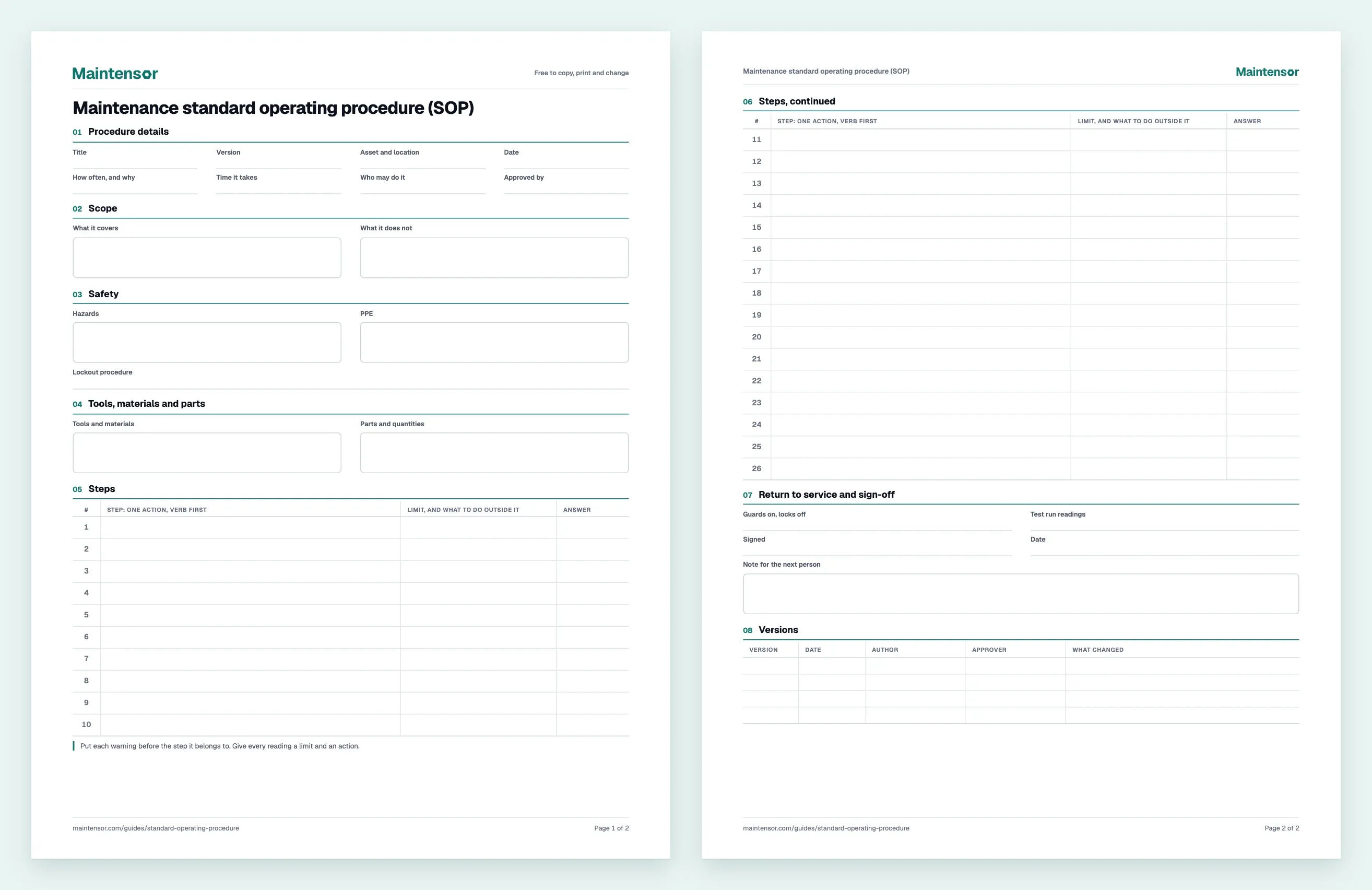
Two Letter pages, free and with no sign-up: the procedure details, scope, safety and lockout, tools and parts, 26 numbered steps, the return to service and sign-off, and a list of versions. The air handler example below shows one filled in.
Maintenance SOP example: the monthly air handler service
A filled-in SOP for a monthly air handler service, from a made-up plant. Every name, tag and figure is invented to show the shape.
ExampleAHU-2: monthly service, version 3
| Field | Entry |
|---|---|
| Title | AHU-2: monthly service |
| Asset and location | Air handler AHU-2, roof mechanical room, Riverside Plant |
| Scope | Filters, belt, fan bearings, drain pan, a look at the coil, and a test run. Not covered: coil cleaning (quarterly procedure) and refrigerant work (contractor). |
| Who | One HVAC technician trained in lockout |
| Interval and time | Monthly, from the maker’s manual; 1 hour 30 minutes |
| Hazards and PPE | Rotating fan and belt drive, sharp coil fins, roof access. Safety glasses, cut-resistant gloves. |
| Lockout | EC-AHU-2: disconnect DS-7 at the unit |
| Tools | Belt tension gauge, grease gun with the grease on the lube chart, thermometer, flashlight |
| Parts | 4 pre-filters, 24 x 24 x 2 in., from the roof mech room stores |
| Version | v3, approved by Maria Chen. Changed: drain pan step added after a leak in June. |
| # | Step | Answer |
|---|---|---|
| 1 | Tell the production lead the unit will be off for about an hour. | Tick |
| 2 | With the fan running, read the filter gauge. Replace at 0.5 in. w.c. or more. | Reading |
| 3 | Lock out AHU-2 at DS-7 under EC-AHU-2. With everyone clear, press Start to prove it does not run, then return the switch to Off. | Tick |
| 4 | Pull the pre-filters. Pass: replaced, or clean and under the limit. | Pass or fail |
| 5 | Inspect the belt for cracks, glazing and frayed edges. Any of these: Fail, replace the set. | Pass or fail |
| 6 | Measure belt deflection at mid-span. Limit from the drive label: 1/2 to 3/4 in. (13 to 19 mm). | Reading |
| 7 | Wipe both fan bearing fittings and give each 2 shots of grease. | Tick |
| 8 | Drain pan drains, with no standing water or slime. | Yes or no |
| 9 | Look at the coil face. Heavy dirt or many bent fins: Flag for the quarterly cleaning. | Pass, flag or fail |
| 10 | Close all panels. Remove your lock under EC-AHU-2. Start the unit. | Tick |
| 11 | After 10 minutes, read supply air at the duct probe. Limit 50 to 58 °F (10 to 14 °C). | Reading |
| 12 | Sign, and note anything the next person should know. | Signature and note |
What goes in a maintenance SOP
- Header. The asset and its tag, the task, how often and on whose say-so, how long it takes, who may do it, and the version with its date and approver.
- Scope. What the job covers, and what it does not. “Refrigerant work: contractor only” stops a well-meaning technician at the right place.
- Safety. The hazards in plain words, the PPE, and the lockout. Point to the machine’s energy control procedure by its number, so there is one copy to keep right.
- Tools, materials and parts. Special tools, the lubricant by name, torque values, part numbers and quantities, so everything comes to the machine in one trip.
- Steps. Numbered, in the order they are done at the machine.
- Readings with limits. What to measure, where, in which units, the acceptable range, and what to do outside it.
- Pictures. Where words fail: which of three grease fittings, how the belt is routed. Take them on your machine.
- Return to service and sign-off. Guards on, locks off under the lockout procedure, a test run with its readings, a signature, and a note for the next person.
When a rule requires written procedures
In the US, OSHA’s lockout rule requires a written energy control procedure for most machines your crew services (29 CFR 1910.147(c)(4)); our lockout tagout procedure guide covers what it must say.
Sites under the process safety management rule need written procedures to keep process equipment sound (1910.119(j)(2)).
Check the rules that apply to your site and your equipment maker’s manual: they come before anything here.
How to write a maintenance SOP in 8 steps
- Pick the job. Start with the one that goes wrong most, that only one person knows, or that a rule covers.
- Watch the best person do it. Write down what they actually do, then compare it with the maker’s manual. Where they differ, find out why before you choose.
- Draft at the machine. Steps written at a desk come out in the wrong order.
- One action per step, verb first. “Remove the four panel screws and lift off the access door” is one action. “Remove the door, check the belt and grease the bearings” is three steps pretending to be one.
- Put each warning before the step it belongs to. A warning after the step is read after the injury.
- Give every reading a limit and an action. A number with no limit records a fact. A number with a limit and “if over, do this” prevents a failure.
- Add pictures where a new person would hesitate.
- Test it, approve it, number it. Testing has its own section below.
Steps that can fail
The difference between a vague step and a specific one is most of the craft. “Check” with nothing after it invites pencil whipping: there is nothing true to record. The figures here are made up; yours come from the manual, the drive label and the design sheet.
| A step nobody can fail | A step that can fail |
|---|---|
| Check belts | Inspect the belt for cracks across the ribs, glazing or frayed edges. Any one of these: replace the set. |
| Check filters | Read the filter gauge with the fan running, before you lock out. At 0.5 in. w.c. (125 Pa) or more, replace the pre-filters. |
| Make sure it runs OK | Run 10 minutes. Supply air 50 to 58 °F (10 to 14 °C) at the duct probe; no new noise or vibration. |
| Lock out | Lock out at disconnect DS-7 under procedure EC-AHU-2, make sure everyone is clear, press Start to prove the fan does not run, then return the switch to Off. |
Test it with someone who has never done the job
An SOP is finished when a competent person who has never done this job can do it from the page alone. Hand it to a new hire, or a technician from another trade, and watch without helping.
ExampleTwo trials of the AHU-2 SOP
A made-up first trial took 2 hours 5 minutes against the 1 hour 30 minute estimate, with 9 questions and 2 wrong moves: greasing the motor instead of the fan bearings, and reading the filter gauge after the filters were out.
The author added where each fitting is, moved the gauge reading to step 2, with the fan still running, and split one step in two. The second trial, with a different person, took 1 hour 35 minutes with one question. That is ready.
Testing the document is not training the person
The new hire still needs lockout training and supervision before working on the machine alone.
Versions, review and change
- One live version, with its number and date on it. When a new one is approved, old printouts come off the clipboards.
- Review it once a year, and at once after a failure it should have caught, a near miss, a change of model or part, or when the same note keeps coming back on the completed work.
- Keep a short change log of what changed and why. “Added drain pan step after June leak” tells next year’s reviewer the step earns its place.
- Name one approver. A second person reads it for safety. A procedure everyone can change and nobody owns drifts.
SOP, work instruction, checklist: which is which
An SOP covers one whole job, a work instruction one task inside it, and a checklist is the short form a trained technician runs on the day.
| Document | What it covers | Example |
|---|---|---|
| Standard operating procedure | One whole job, start to finish, with scope, safety, tools and sign-off | Monthly service of air handler AHU-2 |
| Work instruction | One task inside a job, in more detail, often with pictures | Replacing the fan belt on AHU-2 |
| Checklist | The short form a trained technician runs: steps to tick and readings to write | The 12 lines on this month’s AHU-2 work order |
| Work order | This job, this week: who, when, which asset | The AHU-2 service due Wednesday |
In many plants “SOP” means how operators run a line, and maintenance writes “work instructions”. The label matters less than the content.
The useful split for a small crew
The SOP is the full version, written once, used to teach the job and kept as the reference. The checklist is what gets run on the work order. When the checklist is clear enough that a trained person can do the job from it alone, the two can be one document.
Maintenance SOP mistakes, and when not to write one
Not every job needs a full SOP
A two-minute task is a line on a checklist. A yearly job done by a licensed contractor with the maker’s procedure in hand needs a work order that names the contractor, not your rewrite of their method.
To choose which jobs get an SOP, the preventive maintenance checklist gives a list of routine tasks to sort from.
How Maintensor holds an SOP
Maintensor works as maintenance checklist software for this: an SOP becomes a procedure, built from 14 kinds of step. An SOP mostly uses Heading, Instruction (a warning or note that takes no answer), Checkbox, Number, Inspection check (Pass, Flag or Fail), Photo and Signature. Mark a step Required when the job is not finished without it.

- Draft, then Publish. A procedure cannot be attached to a work order until someone presses Publish.
- A new version. A change is published as a new version, and the history lists each one and who published it. A work order already using the procedure keeps its version and shows Update available; a repeating work order picks up the current version when the next one is created.
- Duplicate. It copies a procedure as a new draft, which is how the AHU-2 SOP becomes the start of AHU-3’s.
What it does not do
A Number step has no unit and no limit, so write both into the step’s words, and nothing flags a reading out of range. Put an Inspection check after the reading, so the technician judges it against the limit.
Steps hold words only, so keep reference photos on the asset’s record. Any Admin or Full user can publish, with no separate approval step, so agree who approves.
There is no library of ready-made SOPs, no import of the documents you already have and no print layout. Required steps never block the finish: the job can be completed with exceptions, and the open steps are written to its history.